Just released a plugin for flea (by @thisisgm).
It lets you manage and access your Backblaze B2 buckets.
It's a big plugin that launches its own program and window to set up your B2 credentials.
Once that's done, your buckets are fully integrated into flea.
Just released a plugin for flea (by @thisisgm).
It lets you manage and access your Backblaze B2 buckets.
It's a big plugin that launches its own program and window to set up your B2 credentials.
Once that's done, your buckets are fully integrated into flea.
A year ago, I was struggling to find a framework for reasonably cross-platform native desktop apps.
Fast forward: I'm burning insane amounts of tokens benchmarking the best options out of a gazillion possibilities. Most of them vibe-coded.
Just launched Cousoir .
→ your Calibre library, fast + pretty
→ Ctrl+D → on your Kobo or Kindle
→ finds duplicates
→ wears your Omarchy theme
Calibre stays in charge, nothing to import
Open source 👇
a 3080. Flea was using Vulkan, and zero swapiness.
I think the difference in absolutes values may comes from the nvidia driver.
But the point is not absolute values but what the quickshell dependency can save compared to a pure Qt/QML app.
And my guess is ~0.
If that's the case, i prefer my apps to depend directly of Qt.
@thisisgm Mmmh, maybe i don't understand what i am seeing, but it looks like flea don't run on top of omarchy quickshell but on its own process.
On my system flea backend runs at 6mb plus a 250 mb qs process.
(and the omarchy quickshell takes 570mb).
I ported kbextract to GTK.
We're moving from a C++/Qt/QML stack to Go + GTK.
I don't know if it shows on the screenshots, but it's a largely superior version.
The immediate benefit of using GTK (libadwaita) is that it's also possible to apply the GNOME guidelines for the application design.
QML brings enormous freedom, but you constantly have to reinvent the wheel.
One day we'll maybe have a coherent design system for Omarchy or Quickshell, meanwhile continue to leverage the rest of the ecosystem seems to remain a good option.
I continued to refine kbextract, and in particular I've made good progress on the UI.
My objective is to have a boilerplate easily reusable for my future development of omarchy-first apps.
The base code stays in C++, the UI in QT/QML, but with a Kirigami layer.
QML gives a lot of freedom for the interface, and that's why using a coherent design system is important.
I continued to refine kbextract, and in particular I've made good progress on the UI.
My objective is to have a boilerplate easily reusable for my future development of omarchy-first apps.
I continued to refine kbextract, and in particular I've made good progress on the UI.
My objective is to have a boilerplate easily reusable for my future development of omarchy-first apps.
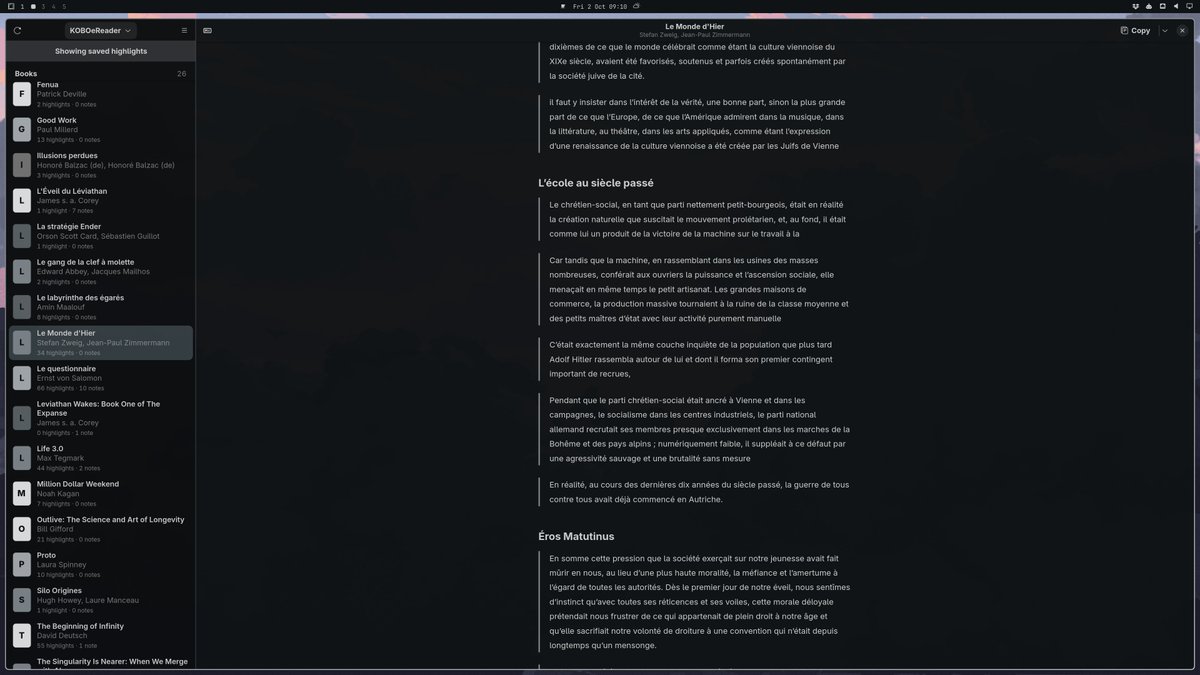
Just released a minimal app for extracting highlights and notes from Kobo e-readers.
Heavily based on omadji by the excellent @iamdothash for the Qt/QML code organization and Omarchy theming. Thanks !
Just released a minimal app for extracting highlights and notes from Kobo e-readers.
Heavily based on omadji by the excellent @iamdothash for the Qt/QML code organization and Omarchy theming. Thanks !