Founder ➡️ VC
Pre-Seed/Seed in product companies built by few and loved by many @aikidoSecurity, @Dusthq, @HeyOyster, @plainsupport @typeform, @TrueLayer
💥 We are thrilled to unveil today our new visual identity and website 💥
tl;dr Same love for product, more love for product founders and a ...toggle.
https://t.co/WeXNOCle7N
A year ago everyone said LLMs would get commoditized but the opposite happened (Save this).
And the reason is something most investors are still underestimating, the model itself was never the moat but the moat is what surrounds it.
Sarah Friar laid out the thesis that the agentic layer creates context and memory that compounds with every interaction.
Her own Codex instance knows her role, her communication style, her priorities, her family situation because the system has been learning her across hundreds of sessions.
That distinction matters enormously for the investment case.
A generic model can be replicated by any lab with enough capital, context and memory accumulated over time cannot.
The longer an agent operates inside a person's life or a company's workflows, the more it knows that is irreplaceable specific preferences, past decisions, undocumented institutional knowledge, the way a particular CFO thinks about risk versus the way her predecessor did.
This is what the enterprise AI race is actually about, not which model scores best on benchmarks which system owns the context graph.
Salesforce built an entire agentic memory architecture specifically to solve this.
Their work describes the problem precisely, stateless agents that reset at the start of every session fail at enterprise scale because they cannot learn, cannot improve, and cannot be trusted with autonomous long-horizon work.
The companies building persistent memory infrastructure episodic memory for past events, semantic memory for accumulated knowledge, procedural memory for learned workflows are building something that becomes more valuable the longer it runs, not less.
That compounding dynamic is fundamentally different from every prior generation of enterprise software.
A seat license for a CRM tool has the same value on day one as it does on day 1,000 and the software does not know anything new.
An agent with deep memory and context integration is worth multiples more on day 1,000 because it has absorbed a thousand days of decisions, corrections, preferences, and outcomes.
This is why enterprise CEOs are moving because they can see the switching cost accumulating in real time on the other side of these deployments.
The pricing model is changing to match the economics.
A16Z and the leading enterprise SaaS analysts have been tracking a shift away from per-seat pricing toward outcome-based models, pay per resolution, per contract closed, per ticket resolved, per line of code shipped.
Gartner projects that by 2030, at least 40% of enterprise SaaS spend will shift toward usage, agent, or outcome-based pricing.
That is a complete restructuring of the software revenue model.
The best AI-native products give non-engineering teams the power to build, automate, and ship.
If you are building a vertical or horizhontal product that pushes this shift, I'd love to talk (DM me)
With AI, EVERYONE is becoming an engineer.
Security teams → engineering teams @AikidoSecurity
Design teams → engineering teams @Dessn_ai
Customer support teams → engineering teams @plainsupport
Business intelligence teams → engineering teams @steepapp
Is it the most competitive industry out there? Yes.
Do we have a radically different take on it? Also yes.
Come see what designing in prod feels like: https://t.co/7vio3vsVVM
The best product founders are overly technical and bold. And they build products that let users express themselves in the ways they actually want to work.
🚀 Thrilled to announce we led a $6m seed round in @Dessn_ai, backing the awesome @GabriellaHachem@CheemaNim23684
So excited to share that @Dessn_ai has raised $6m, led @pietrobezza , with participation from @betaworks , N49P, and a few other amazing partners and angels.
@eminimnim and I started the company 2 years ago
with one conviction: the future of product development wouldn’t happen in disconnected mockups or recreated environments. It would happen directly in production.
Today, Dessn is the only product that enables an entire team to design and prototype directly in prod — visually, collaboratively, and in one click.
No other design tool can "get a view of your app rendered to use as a starting point" because no other design tool runs your production repo like we do
This is pretty spot on from Karri😍
Most confusion about the future of software design stems from a confusion in terminology.
My view: production design will increasingly be automated. The economic logic is self-evident — training machines to mimic and refine existing production practices is cheaper, faster, and more reliable than training humans to do the same.
Strategic design, or “what at are we doing and why,” will look very different. The mediums will broaden: from pencil and paper all the way to automated experiments running in production, iterated on by agents while we sleep.
The inputs and systems we create to find opportunities will reward the most intrepid problem-finders. Design stops being a method of sitting and ruminating on possible forms or solution spaces. Design becomes active, research-based, and built around speed of discovery and expression.
Exploratory design will undergo the greatest shifts. Historically this has been the domain of the artist and the inventor. What existed in the world sprung from the imaginations of people with waking hours to spare and the technical chops to give form to their ideas.
But soon agents will join the mix. Humans and machines alike will generate novel ideas and expressions, building on a vast combinatorial space of possibility. Humans and machines alike will be capable of bringing these forms to market.
The key difference? Humans sleep and have finite, socially agreed upon vocabulary. We may be intuitively suited to know the desires of our fellow man. But machines will have a vaster set of references to draw from, and methods to choose what's most effective in the wild — using taste/selection criteria no human operator alone can summon.
These forces are not mutually exclusive. But they DO operate on a common landscape of global demand—of Desire in the grandest sense.
No matter how much we might wish otherwise, human designers and creatives are not divorced from the logic of desire — nor from unit economics, opportunity costs, or the ever-evolving ways we probe and understand an open-ended set of markets made up of humans and agents alike. Creativity has no bounds. But desire underpins it all.
Design itself will not be recognizable from what exists today. Imagine describing NYC to an ancient cave dweller. Agents today are like the most primitive forms of seafaring trade.
Instead it will be defined by the designers who build new systems and methods for understanding, channeling, and feeding desire in all its forms.
That line hit me:
“Transitioning from Sketch to Figma was a no brainer because all of a sudden we went from working in local files to web based collaboration”
People frame the current moment as “designers will code now”. I think the bigger story is simpler.
We are quietly going back to local again. We already lived through local pain once.
In the Photoshop era, a design file was a thing that lived on your machine. Big files, messy versions, “who has the latest” and collaboration felt like passing a large file from person to person.
Even later, in a large company, we used Sketch with a semi cloud setup.
Basically: shared storage, a versioning workflow, and rules everyone had to learn. We used Abstract for branching and merging. It worked, but it came with onboarding cost. New designers did not just learn the product, they learned the system.
UI kits made it heavier. Consistency depended on process. Sync depended on discipline.
Prototyping was also split across extra tools. If you wanted “real”, you learned a separate craft:
After Effects, Principle, Origami, ProtoPie, or even React with early @Framer. It was doable, but it was not flowing. It was tool switching.
Then Figma happened and it was obvious. Not because it was prettier, because it moved the work into shared space. Collaboration became the default, not an add on.
AI coding tools are bringing back the same old friction
Now designers are building “coded prototypes” with Claude Code, Cursor, and similar tools.
They are powerful, but the workflow pulls you into local reality again: repos, env vars, local DBs, running servers, PRs, deployment, and “it works on my machine”
That is what the report calls “we’re back in local space”
And I agree. The problem is not capability. The problem is location.
⎯⎯⎯⎯⎯
Why I keep reaching for Figma Make?
My current workflow at @diffusionhq is simple: we design in @Figma, and if needed, I prototype in Figma Make.
Not because it's magically better than Cursor or v0.
Because the setup cost is almost zero, and the output is easy to share.
Click, prompt, iterate, send a link.
That matters more than people admit.
I mostly use it for one thing: previewing the experience at true scale, in the browser, at 100% zoom, with real interaction. Since we are building a browser tool, that feedback loop is gold. It helps me catch issues early, make decisions faster, and reduce back and forth before handoff.
Big prototypes still take time, sure. But the difference is the collaboration stays online, which keeps the team moving.
⎯⎯⎯⎯⎯
The real “next switch”?
Photoshop to Sketch was a productivity jump.
Sketch to Figma was a collaboration jump.
This next jump will be the same type of collaboration leap, but for coded prototypes.
This is not “designers can code now”. It is about keeping design work shareable and close to production.
The teams that win will not be the ones with the fanciest local setups. They will be the ones who keep making, testing, and reviewing work in the same shared space.
That idea is a big part of how we think at Diffusion. A browser based video editor where work stays shared, friction stays low, and iteration stays fast
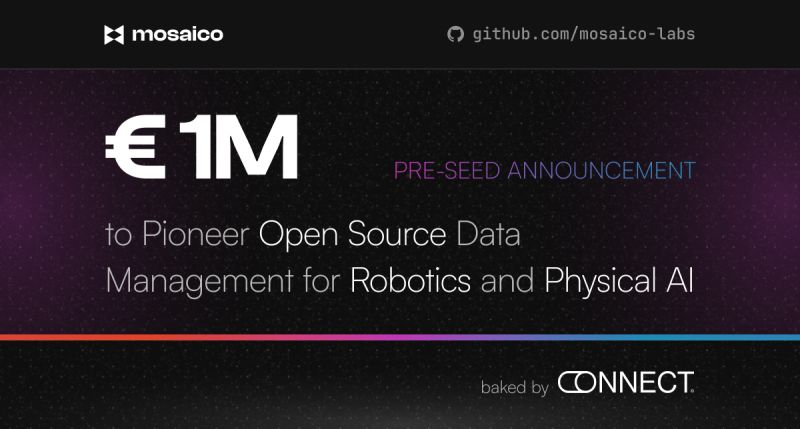
We’re excited to announce our investment in Mosaico, an open-source, next-generation data management platform built specifically for robotics.
https://t.co/Xkhnkxelq1
Boom 💥💥 A huge day for @AikidoSecurity as they announce a $60m Series B and for Connect Ventures as we add another 🦄 to our portfolio.
I wrote the full story here: https://t.co/USRggzWon6
From “no bullsh*t security” to $1 billion valuation in three years.
Announcing @AikidoSecurity $60M Series B at $1B led by Tom Stafford at DST Global.
What’s next? Self-securing software.
Stay tuned.
AI = trajectories.
"Fifth, trajectories are the basis for optimizing AI models through reinforcement learning. Smaller specialized models trained on high-value paths replace massive generalists.
https://t.co/gKrwXkgSBX
"9 months later but 9 times better"
We're releasing a deep-dive agent that has access to your entire company data (structured and unstructured) and all the MCP tools connected to a Dust workspace to perform high level tasks on longer time horizons.
It has taken over a number of weekly multi-hours tasks that used to be done by humans including our team.weekly meeting preparation as well as aggregation of user testimonials and feedback from call transcripts. I used it last week during a call with an investor to generate a specific retention graph they were asking for, sharing the results before the call was ended instead of going to our data team.
Yes it's 9 months after deep research. But this is definitely 9 times better if your goal is to get things done at work.
It has access to all our unstructured data presented as a file-system (notion, slack, drive, ...), all our data-warehouse with discoverability capabilities, and all of the MCP servers connected to our Dust workspace.
The team has been using it increasingly shifting from custom agents accomplishing tasks to deep-dive based-agents accomplishing outcomes.
7 different technical initiatives went into enabling deep-dive in Dust. We're diving into the detail of each of them in the blog post below. A great read if you're looking to use or build long-time-horizon agents.
https://t.co/Lxnyl2jx7h
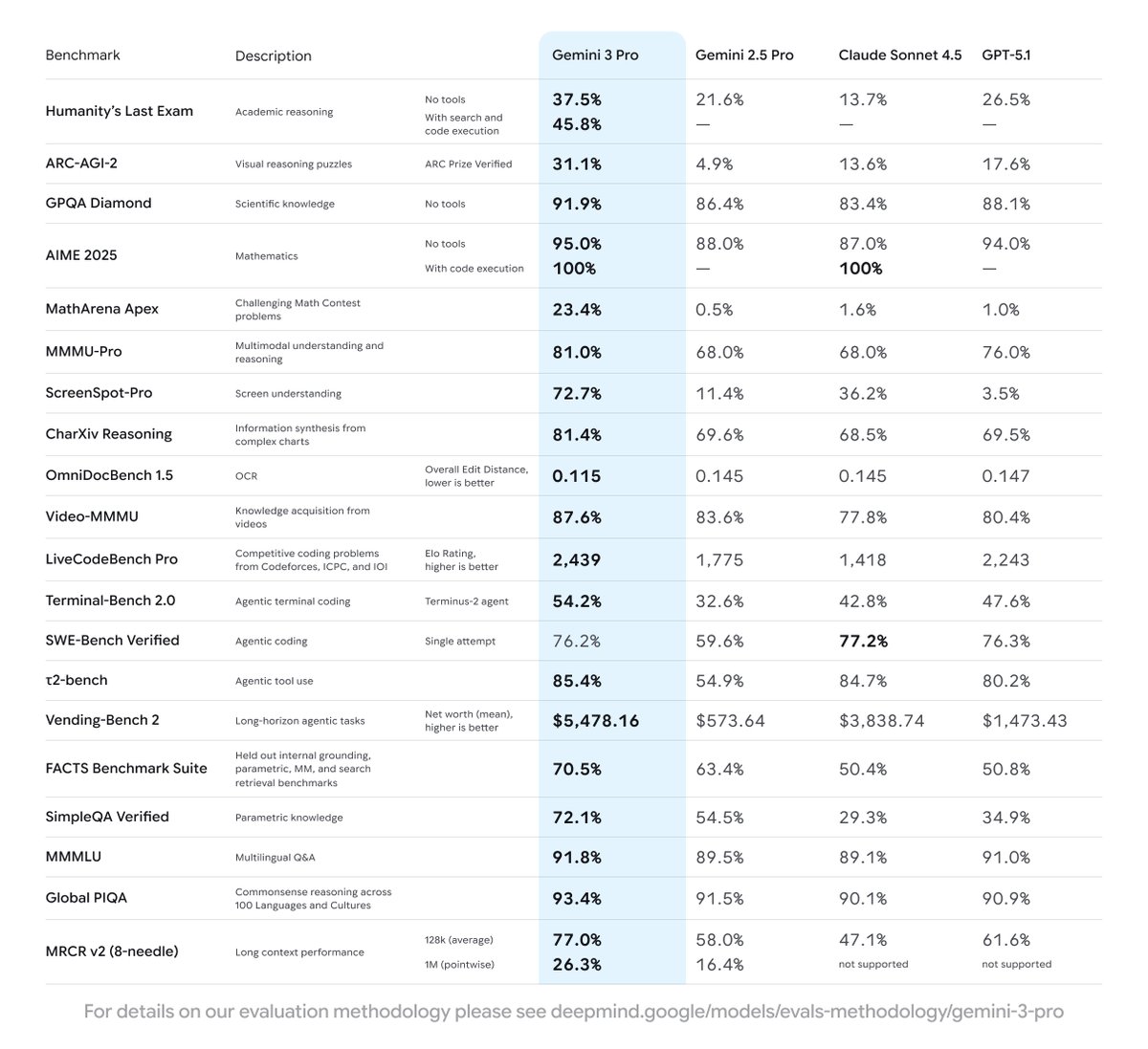
The secret behind Gemini 3?
Simple: Improving pre-training & post-training 🤯
Pre-training: Contra the popular belief that scaling is over—which we discussed in our NeurIPS '25 talk with @ilyasut and @quocleix—the team delivered a drastic jump. The delta between 2.5 and 3.0 is as big as we've ever seen. No walls in sight!
Post-training: Still a total greenfield. There's lots of room for algorithmic progress and improvement, and 3.0 hasn't been an exception, thanks to our stellar team.
Congratulations to the whole team 💙💙💙
Within a year, an AI sales rep will join every human sales rep on every Zoom and call
🤖 95% of “I don’t knows” and “Uh I’ll get back to you” will be gone
Within a year, an AI BDR will answer all inbound sales questions
🤖98% of humans setting up appointments with AEs will be gone
Within a year, an AI CSM will handle 70% of renewals.
🤖No reason for this to be such a headache and friction-full experience anymore
We’re already close on all of this
I'm really happy to say that Plain now powers support for @meetgranola - one of the most remarkable, and most loved productivity tools I've seen in a very long time.
Few products go from launch to a daily essential this fast. When you see it as both partner and user, you know it's special. ❤️
Thrilled to work with their wonderful team. They're the most talented, smart and humble people. And yes, they're hiring!