... What happens next is up to Microsoft.
We took a close look at the growing frustration around Google's new AI Search, and the trend is hard to ignore. Users are calling out quality issues, clutter, and results that feel less helpful than they used to be.
At the same time, Bing is in a stronger position than it has been in years, hitting a billion monthly active users.
Between AI integration, cleaner results, and rising user curiosity, Microsoft suddenly has a real opening in a space Google has dominated for decades.
@JezCorden breaks down what is happening, why users are noticing the shift, and what it means for the future of search.
https://t.co/nU2p0KSZjT🔗
For what it's worth, I love using M365 & Copilot. Before working at Microsoft, I had the same perspective as my San Francisco startup friends, aka Copilot is a clunky, confusing product. But today I use it all the time.
1/ Copilot is everywhere. When I have a question and I'm on Teams, PowerPoint, Outlook, the icon is always there. It’s even a key on my computer keyboard! It's deeply integrated with all the software I use (which are all made by MSFT).
2/ Copilot is integrated to everything. I'm new, so I often have questions about the org chart, some documents on SharePoint I can't find but Copilot can, some acronyms I don't understand but Copilot has our company knowledge, etc.
There is also the multi-model part. This is especially true for coding with Copilot-cli, where depending on the task, I might use GPT 5.5 or Opus 4.7. Same when I use the Excel/Powerpoint/Word agents.
Now, the elephant in the room, why does Copilot have a bad reputation on X? My own view, and I might be wrong:
1/ We often mess up. We are a 51-year-old large company moving at the speed of AI, and sometimes we ship inconsistent product experiences or product experiments that we unify later.
2/ Deployment takes a long time, so users often have older versions of Copilot. Also some great features are first available in our Frontier program and will be generally available later.
3/ Privacy and compliance are very important for us, so sometimes IT admins haven't unlocked all the Copilot features yet.
4/ Microsoft is often compared to the world’s most advanced AI labs (some didn’t even exist five years ago and are the fastest-growing businesses in history!). IMO that comparison is a compliment. It pushes us to hold ourselves to an even higher standard in how we serve our customers.
Voila, just my 2 cents! (talking about cents, it's wild that you can have elite AI deeply integrated everywhere in all the software stack for $30/month)
ps: I'm French, so I’m very direct and extremely low BS. I wouldn't have written that if it weren’t my reality.
In case you missed the news: we are LAUNCHING a 50 city community tour to bring all things Copilot Cowork, M365 Copilot and Copilot Studio to you!
Each event will have sessions on:
1. A Keynote by someone on our team setting the stage for what’s going on in the tech industry and with Copilot all up
2. Using Copilot Cowork to actually DO your job stuff
3. Building AND TESTING Agents in Copilot Studio with automation, MCP, Work IQ, ALM, etc.
4. M365 dev sessions with topics like Custom Engine Agents, Declarative Agents, Agent SDK, etc.
5. Customer showcases!
6. And surprise topics!
You will learn a LOT about the whole Copilot Agentic Platform and how to use it for YOUR work and emerge a ⭐️
The series goes wheels up in September…get signed up to attend, volunteer, sponsor or speak in the comments 👇🏼
Excel Copilot one-shotted a tiny GPT-style language model for me inside a spreadsheet: embeddings, causal attention, weights trained with stochastic gradient descent, next-token prediction, and a live slider to watch it learn.
Most business teams are barely scratching the surface of Microsoft Graph and Agentic AI platforms.
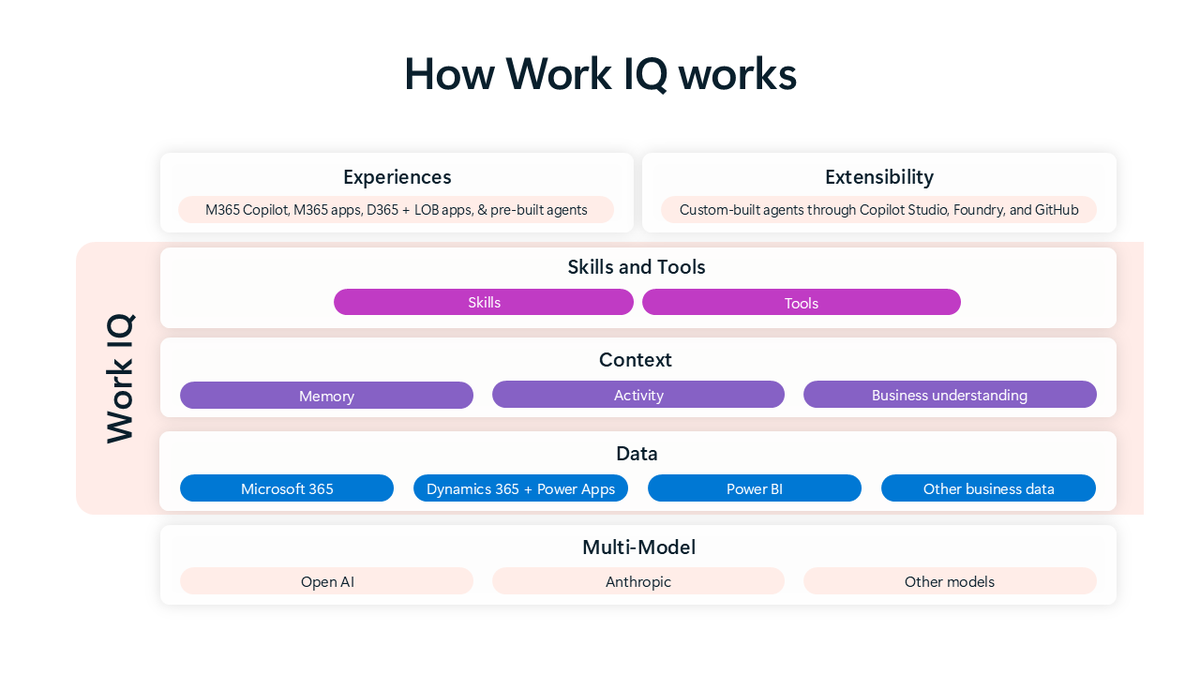
In Microsoft 365 they're using it to fetch emails, calendar events, files, chats, and directory data. Useful, sure. But raw access isn't the win. Work IQ is what turns that access into actual leverage.
Graph API gives you the pipes. Work IQ gives you judgment.
It adds agentic workflows on top of Graph so work doesn't stop at retrieval. Agents can read context, decide what matters, trigger the next step, coordinate actions across tools, and keep moving without a human babysitting every click.
That's the difference between:
• seeing work
• understanding work
• moving work forward
This is where things get interesting. When you combine Graph data with agentic orchestration like OpenClaw, you stop building passive dashboards and start building systems that can actually do the work:
• triage email by intent
• prep meetings from live context
• surface blockers before they turn into delays
• route approvals without the usual chaos
• turn scattered activity into usable operational intelligence
Work IQ doesn't replace Graph API. It makes it dangerous in the best way.
That's the real shift: from data access to work execution.
#WorkIQ #GraphAPI #AIagents #AgenticAI #OpenClaw
Microsoft is quietly taking over the Enterprise AI Agent stack.
And most people have only seen ~10% of it.
Everyone talks about Copilot.
Some know Azure.
A few use GitHub Copilot.
But underneath...
Microsoft has built a full-stack AI ecosystem
—from models → to agents → to governance.
Here’s the full breakdown 👇
📌 1. Models (the brain)
Azure GPT-5.1, Phi-4, MAI-1, KOSMOS-2, Florence 2, MAI-Voice
This is the intelligence layer powering everything.
📌 2. Frameworks (the builder layer)
Semantic Kernel, AutoGen, Task Weaver, Agent Framework
These are what let you actually build AI agents.
📌 3. Responsible AI (the guardrails)
Azure AI Content Safety, Purview, Defender, Entra
Security + governance baked in from day one.
📌 4. Productivity (the distribution)
Excel, Teams, Outlook, PowerPoint
AI is not a feature. It’s embedded in daily workflows.
📌 5. Image & Video (creative layer)
Designer, Clipchamp, Copilot Image
Content creation → fully inside the ecosystem.
📌 6. Coding (developer layer)
GitHub Copilot, VS Code, Azure AI Toolkit
From writing code → to deploying → AI is everywhere.
📌 7. AI Agents
Microsoft Copilot, SharePoint Knowledge Agents, Copilot Studio, Dynamics 365, Power Platform, Viva Learning Agent, Edge Copilot, Security Copilot , The autonomous layer that ties the entire ecosystem together
And this is just the outer surface of the Microsoft Core offering.
If we start to dive deeper into Azure AI, the layer goes even deeper.
This just shows Microsoft's commitment on helping enterprises adopt agentic AI.
Not only do they make it very easy with no-code tools like Power Platform,
but also allows you to customize it and build custom agents using their agent frameworks and tools.
Save 💾 ➞ React 👍 ➞ Share ♻️
Another SOTA model drop! This time from the @Bing team: meet Harrier, a new open-source embedding model with state-of-the-art performance and the #1 spot on the industry standard multilingual MTEB-v2 benchmark.
🦞 TL;DR: New Job at Microsoft. Bringing OpenClaw + personal agents to Microsoft 365!
My goal is to help usher in a new generation of workplace proactive assistants, ones that lighten your load by taking on tasks end-to-end, and that can also step in proactively when they can help.
As part of this mission, I’ll be partnering with the @OpenClaw + M365 community to bring the energy of this work to our customers. We’ve already hit the ground running with a fully integrated Teams plugin for OpenClaw, and I can’t wait to help usher in the era of personal agents at work.
In 2019, MIT professor Patrick Winston gave a legendary 1-hour lecture called “How to Speak.”
It has 18M+ views for a reason.
His frameworks:
• Your ideas are like your children
• The 5-minute rule for job talks
• Why jokes fail at the start
15 lessons on communication:
Huge thanks to @johnsonshi86 for this continued support and contributions to the OpenClaw community. If you'd like to run OpenClaw in Microsoft Azure, check out Johnson's guide! He's cooking up some other things too, so be sure to follow him as well. https://t.co/pQ5bS4doKe
Automation consultants charge $15K for what Claude Code now does in 2 hours.
I know because we're the ones who used to charge it.
Here's the exact process:
Step 1: Discovery (20 min)
→ Paste your org chart, tool stack, and top 3 bottlenecks
→ Claude interviews you with clarifying questions
→ Outputs a full process inventory ranked by time cost
Step 2: Workflow Mapping (15 min)
→ Describe any department's daily operations in plain English
→ Claude builds a complete process map
→ Every manual handoff, redundant step, and automation trigger flagged
Step 3: Opportunity Audit (10 min)
→ Feed it the workflow map output
→ Returns your top 10 automation opportunities
→ Ranked by ROI, complexity, and build time
Step 4: Architecture Design (20 min)
→ Claude designs the full system architecture
→ Which tools connect where, what the data flow looks like
→ Agents for complex logic, linear flows for the repetitive stuff
Step 5: Build (ongoing)
→ Claude writes the actual workflow JSON
→ Self-documents everything as it builds
Step 6: The output.
A live dashboard your whole team can work from.
→ Clickable process maps for every department
→ Automation opportunities ranked by ROI
→ Implementation progress by phase
→ KPIs updated in real time
→ One link you share with clients, freelancers, or your team to execute
This is what we hand every client at the end of discovery.
The .md file is what makes all of it possible.
Without it, Claude guesses.
With it, Claude builds like a $15K consultant.
Like this post, RT and comment "BLUEPRINT" and I'll send you the full prompt stack and the .md file we use internally. (Must be following so I can DM you)
🎁 Bonus: The first 100 people get a real Precision AI Blueprint — an actual sample audit doc from a client engagement so you can see exactly what the output looks like.
Great question, and I think the answer is both, by design.
Based on the Agent 365 docs, each agent gets its own Microsoft Entra Agent ID, which is a purpose-built identity type (not a regular user account). The whole point is that you can scope agent access to only the resources it needs and apply risk-based conditional access policies on top of that.
So agents can have meaningful permissions, but they're meant to be governed through least-privilege controls, policy enforcement, Purview compliance, and Defender threat detection (not given the keys to the kingdom).
The E5 user account sidesteps the governance layer Microsoft is building specifically to prevent agent compromise and oversharing. You'd also be paying full E5 licensing per agent instead of the Agent 365 per-instance license model (which is clearly how they intend to handle scale/cost). We're using Agent 365 now with OpenClaw as a Frontier tenant.
TL;DR: Agent 365 is designed so you don't have to treat agents like human users. The Entra Agent ID gives you granular control without the overhead. Worth waiting to see how the Frontier preview shakes out before committing to the E5 workaround. https://t.co/BzlkDmIdgQ
Our company has begun deploying AI aggressively over the last month.
Here’s a list of nearly everything we’ve used it for so far.
These are simple but highly impactful things you can copy today.
Nadella paid $650 million to acquihire Mustafa Suleyman and 70 Inflection employees in March 2024. The job: make Copilot the AI product that justifies Microsoft’s infrastructure bet. Two years later, Suleyman no longer runs Copilot.
The corporate framing is generous. “Freed up to focus on superintelligence.” The numbers tell a different story.
Microsoft 365 has 450 million paid commercial seats. After two years on the market, during the largest AI hype cycle in history, Copilot converted 15 million of them. That’s 3.3%. At $30/user/month, those seats generate roughly $5.4 billion annually. Microsoft spent $37.5 billion on AI infrastructure in a single quarter.
The competitive data is worse. Recon Analytics surveyed 150,000+ enterprise users in January 2026. Copilot’s paid subscriber share dropped from 18.8% to 11.5% in six months. Gemini passed it in November. The most damning finding: 70% of users initially preferred Copilot because it was already embedded in their Office apps. After trying ChatGPT and Gemini, 8% kept choosing it.
That 70-to-8 drop is the number that explains this entire reorg. Microsoft has the greatest distribution advantage in enterprise software history, and 90% of users leave after trying the competition.
So Nadella hands Copilot to Jacob Andreou, a former Snap executive. You bring in an eight-year consumer growth operator when the problem is adoption, not science. And Suleyman gets “superintelligence”: no shipped product, no revenue target, no quarterly earnings call where an analyst asks about the 3.3%.
The $650 million acquihire just became the most expensive research fellowship in tech history.