Tadej Pogačar firma su enésima exhibición en el @LeTour, reina en el Tourmalet, vence la etapa, le mete dos minutos y medio a Jonas Vingegaard, recupera el maillot amarillo y deja casi sentenciado el Tour de Francia. Alienígena.
A website to follow up on the latest science around Lactate and its role as fueling solution.
Hope this is useful. New studies and references will be added soon.
Check here:
https://t.co/Toy07z0mTq
Veiem per primera vegada la torre de Jesucrist il·luminada!
L'espectacle de llum iniciat des de la base fins a la il·luminació de la creu ha culminat amb una composició de llums guiats per drons, que han dibuixat la figura Gaudí i la frase «primer l'amor, després la tècnica».
Exogenous Lactate, the preferred energy substrate. New post in @Glut4Science after 3 years!!
I hope you can enjoy the read of our journey behind ExoLactate and the science behind this potential fuelling solution! 🤓
Thank you very much for reading!
https://t.co/h6lUmJ1wBs
ATHLETES, COACHES, NUTRITIONISTS & PHYSIOLOGISTS🏃🚴♀️🧪
Our latest paper is out in The Journal of Physiology: https://t.co/CKR2pgc7iA
- Comparing glucose & glucose–fructose fuelling during running at altitude
The sort of altitude used for training camps - 2500m
A brief🧵
1/
At Zone 2, mitochondria are at metabolic equilibrium and at the highest operating capacity. This is why it is a challenging intensity for well-trained athletes (it must be).
Lactate is being produced at a meaningful rate as glycolytic rate is moderate, but the mitochondrial lactate oxidation complex (mLOC) is clearing it at the same rate, converting it back to pyruvate and feeding it directly into oxidative phosphorylation. The lactate shuttle, both within and between cells and tissues, is running at full capacity.
Fat oxidation is at its peak. The NAD⁺/NADH ratio is stable, reflecting a healthy redox environment in which glycolysis and mitochondrial processing remain tightly coupled. The system is maximally stimulated while still in balance.
This is precisely why Zone 2 is probably one of the most powerful sustained training stimulus for mitochondrial adaptation. Mitochondrial biogenesis requires that the organelle be pushed close to its capacity. Zone 2 does that, while keeping the internal environment stable enough that the stimulus can be sustained for a prolonged period and recovered from it efficiently.
-And with all this said, high intensity training is absolutely key for performance.
https://t.co/CWkZyRnJKl
30 years ago I was working with elite athletes and drawing training zones on paper based on blood lactate curves.
No substrate data. No indirect calorimetry. Just the conviction that something metabolically distinct was happening at each intensity — and that Zone 2 was where the most important adaptation was taking place.
In 2005 I began adding fat and carbohydrate oxidation rates to the picture, and what the substrate data revealed confirmed what the lactate curves had been suggesting all along: each intensity represents a distinct metabolic state, not just a point on a continuum of effort.
That work became the Metabolic Map in 2013. Then the metabolic flexibility paper with George Brooks in 2018. And now the updated 2026 framework, which maps four metabolic states onto classical threshold models and asks a question the older models never quite posed:
Is the system in optimal metabolic balance, or is it drifting away from it?
Lactate turns out to be the best real-time proxy we have for answering that question. It tracks metabolic equilibrium, the onset of drift, and the progression toward overload better than any other single variable we can measure in the field.
Thirty years of work. One molecule. One central question.
My last substack article
https://t.co/hvNuIVnH6b
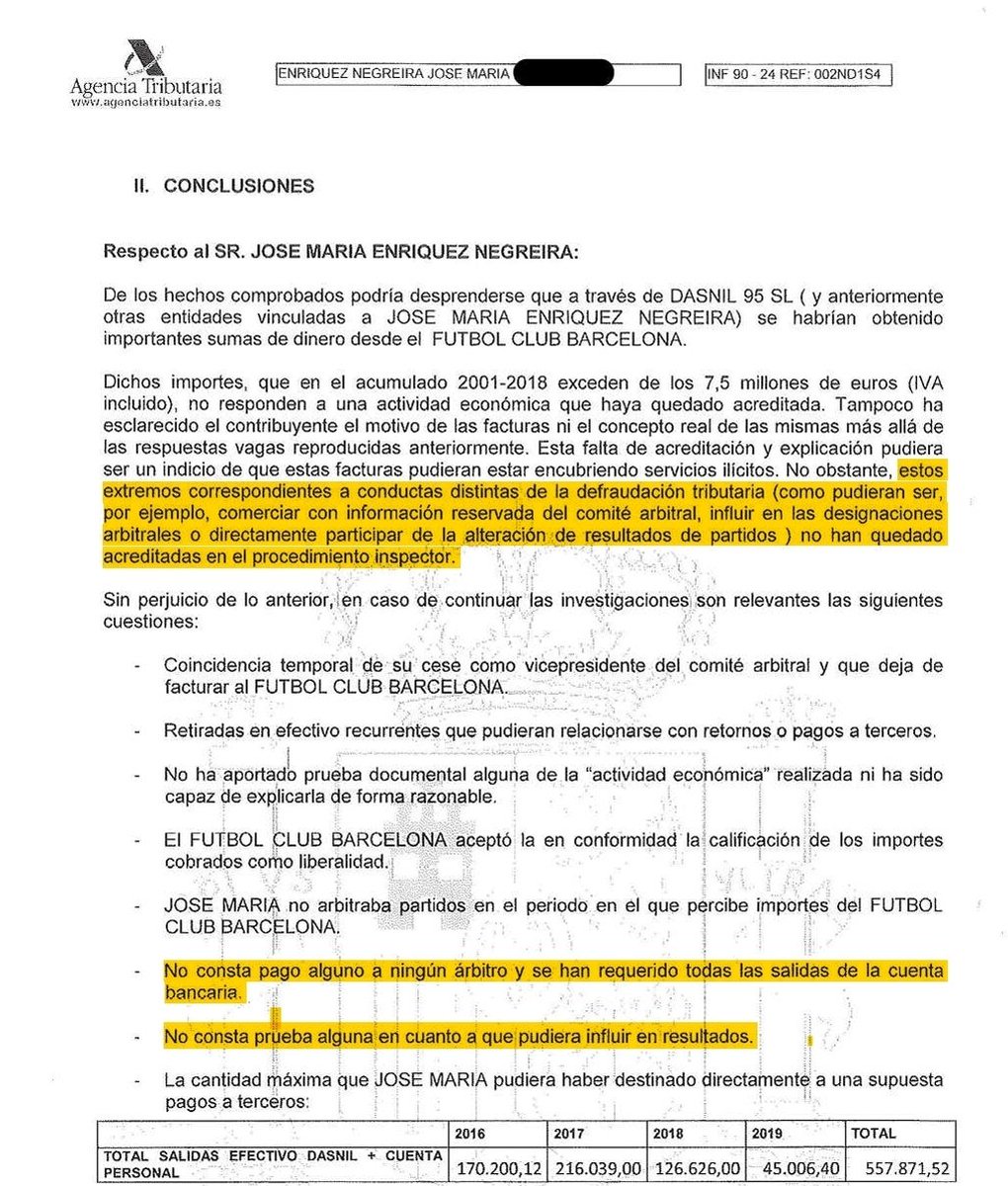
HACIENDA no ve corrupción deportiva del @FCBarcelona : la Agencia Tributaria concluye que NO consta pago alguno a árbitros NI prueba alguna de que los pagos a Negreira pudieran influir en los resultados del FC Barcelona.
Los grandes medios llevan meses construyendo un relato penal sobre el caso Negreira sin mostrar a la opinión pública los documentos íntegros de la Agencia Tributaria. Hoy difundo el informe completo, en el que la propia AEAT, tras años de inspección, descarta indicios de corrupción deportiva imputables al Fútbol Club Barcelona.
En el ámbito del Derecho penal económico y del Derecho administrativo sancionador, esta omisión informativa no es menor: altera la percepción del principio de presunción de inocencia y condiciona el debate jurídico.
El documento es inequívoco cuando afirma que:
“en el presente procedimiento no se acreditan servicios prestados por el contribuyente, por ejemplo, conocer con información reservada el criterio de los árbitros, ni las designaciones arbitrales, ni nada que se le parezca, ni que se pudiera influir en resultados determinándose, no ha quedado acreditado en el procedimiento inspector”.
Y añade:
“No constan pago alguno a ningún árbitro y se han requerido todas las salidas de la cuenta bancaria. No consta prueba alguna en cuanto a que pudiera influir en resultados”.
La AEAT está descartando la existencia de elementos probatorios que permitan sustentar un delito de corrupción deportiva, al menos en el marco de este expediente administrativo.
Precisamente por esa razón, la responsabilidad de informar con rigor exige reproducir literalmente estos pasajes y contextualizarlos, en lugar de seleccionar fragmentos parciales que induzcan al público a conclusiones incompatibles con el contenido real del informe oficial.
Imagen obtenida de: https://t.co/ME06dMYJHA
My updated metabolic map is less focused on substrate utilization and thresholds and more focused on metabolic stability. I believe the shift is subtle but important.
Instead of only asking:
“What fuel is being used?”
The model also asks:
“How stable is the metabolic system under stress?”
In this framework, lactate becomes the central proxy to understand the balance, drift, or overload of the metabolic system.
Approximate translation and comparison with different models:
• Zone 1 = low metabolic stress
Clearly below LT1/VT1
• Zone 2 = metabolic equilibrium
Near LT1/VT1, where lactate production and clearance remain tightly matched and the system operates at its highest sustainable balance
• Zones 3–4 = metabolic drift
The system progressively moves away from optimal mitochondrial matching capacity, even if lactate may still achieve a “steady state”…CP/MLSS/VT2/LT2/V4…
• Zone 5+ = metabolic overload
Above CP/MLSS/VT2/LT2/V4, where no true steady state is physiologically achievable
The key conceptual distinction:
A lactate steady state is not the same as optimal metabolic equilibrium.
The metabolic equilibrium ceiling is near LT1/VT1 and Zone 2.
The steady-state ceiling is CP/MLSS/VT2/LT2/V4.
Performance is ultimately defined by how long the body can preserve metabolic equilibrium.