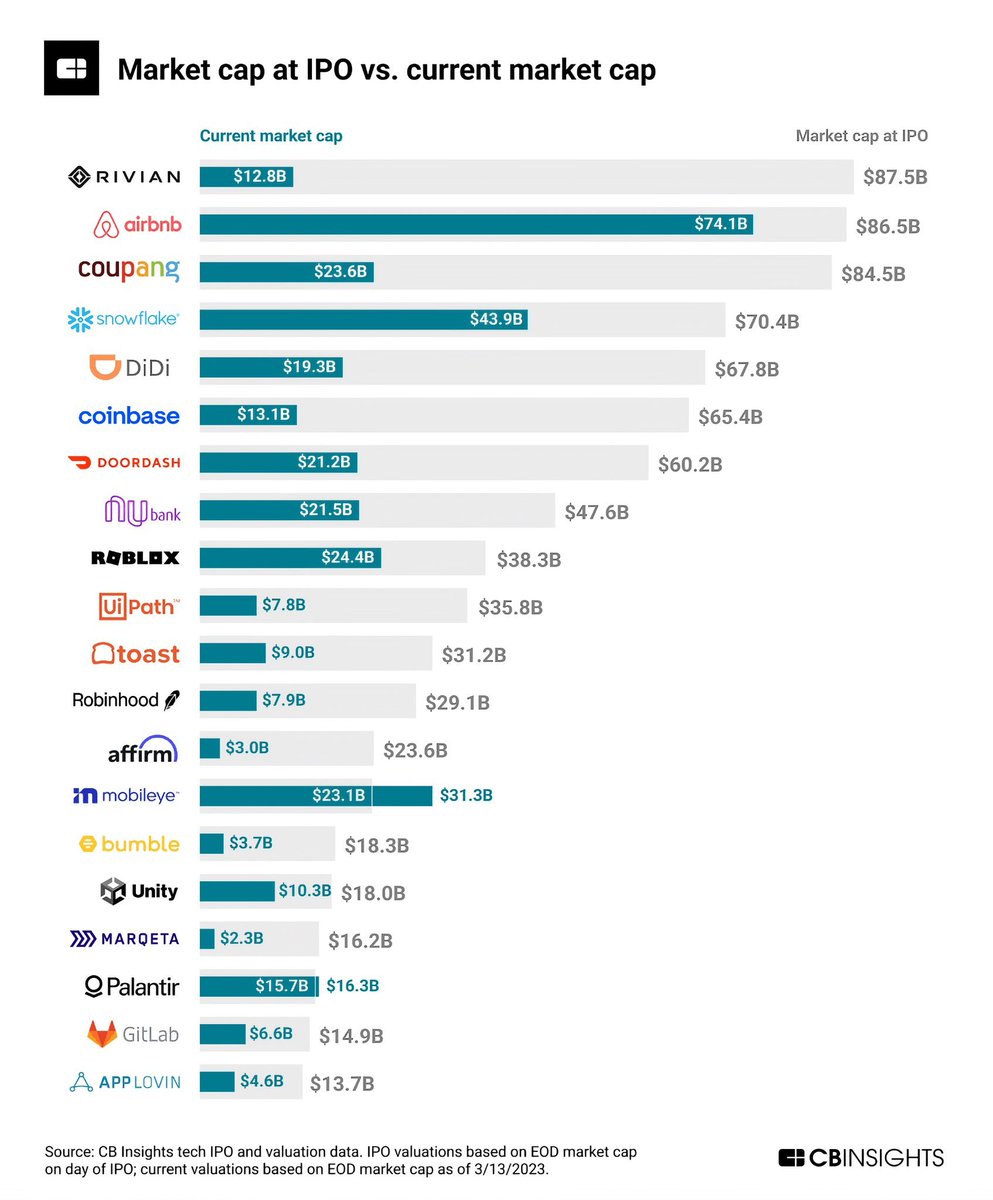
This phenomenon is called the Debt Spiral, and it's apparent mathematically that we have already entered one
If you want to know more about that you can read all about it in a thread posted over a year ago, right here:
https://t.co/7bFr5dMhZT
The EV market is very polarized.
Some people seem to think it’s a climate panacea. Others seem to think it has no value.
The answer from broad science lies somewhere in the middle, with nuance. 🧵
After I shared my trading setup, people began to ask about why I have so many screens.
I've decided to explain why and how I organize my screens.
#tradingsetup#ict#trading#smc
20 ChatGPT prompts that use next-level mental models to help you make strategic business decisions:
1. Second-Order Thinking
Prompt: "Apply Second-Order Thinking to assess [my business decision]. Consider not only the immediate consequences but also the second-level consequences that may arise."
2. Pareto Principle (80/20 Rule)
Prompt: "Use the Pareto Principle to evaluate [my business decision]. Focus on the 20% of factors that could be responsible for 80% of the results."
3. First Principle Thinking
Prompt: "Use First Principle Thinking to evaluate [my business decision]. Rethink the problem from the ground up and separate the underlying facts from the assumptions made based on them."
4. Regret Minimization Framework
Prompt: "Use the Regret Minimization Framework to assess [my business decision]. Think long-term and weigh the emotional impact to minimize future regret."
5. Opportunity Costs
Prompt: "Assess [my business decision] by considering the Opportunity Costs. Think about the costs arising from choosing this option against every other option available."
6. The Sunk Cost Fallacy
Prompt: "Assess [my business decision] while avoiding the Sunk Cost Fallacy. Evaluate the decision based on future value, not past costs."
7. Occam's Razor
Prompt: "Apply Occam's Razor to assess [my business decision]. Choose the less complex explanation or option that satisfies the conditions without unnecessary multiplication."
8. Systems Thinking
Prompt: "Use Systems Thinking to assess [my business decision]. View the problem as part of an interconnected system and understand how variables influence one another."
9. Inversion
Prompt: "Utilize Inversion to analyze [my business decision]. Look at the problem from the endpoint instead of the starting point and ask: 'What must I avoid?' rather than 'What do I need to do?'"
10. Leverage
Prompt: "Analyze [my business decision] through the lens of Leverage. Determine how the right lever can amplify my efforts and lead to significant outcomes."
11. Circle of Competence
Prompt: "Apply the Circle of Competence to analyze [my business decision]. Make sure the decision aligns with [my areas of expertise]. Straying outside of my circle can lead to poor decisions."
12. Law of Diminishing Returns
Prompt: "Evaluate [my business decision] using the Law of Diminishing Returns. Consider the turning point where additional investments offer less value and costs may rise."
13. Niches
Prompt: "Analyze [my business decision] focusing on Niches. Determine how specialization within a niche can lead to expertise and success in this context."
14. Margin of Safety
Prompt: "Use the Margin of Safety to evaluate [my business decision]. Assume that your assumptions might be wrong and plan with a safety margin to mitigate risks."
15. Hanlon's Razor
Prompt: "Evaluate [my business decision] through Hanlon's Razor. Don't assume ill intent when mistakes can be explained by ignorance or error."
16. Randomness
Prompt: "Evaluate [my business decision] with the concept of Randomness in mind. Remember that not everything follows cause-effect relationships and some outcomes may be random."
17. Critical Mass
Prompt: "Analyze [my business decision] by considering Critical Mass. Recognize if you are at a point where momentum may become self-sustaining."
18. The Halo Effect
Prompt: "Evaluate [my business decision] while considering the Halo Effect. Recognize how impressions in one area can bias judgment in others."
19. Feedback Loops
Prompt: "Analyze [my business decision] through the understanding of Feedback Loops. Consider how actions and reactions within the system can influence subsequent decisions."
20. Scarcity and Abundance Mindset
Prompt: "Evaluate [my business decision] considering both Scarcity and Abundance Mindset. Reflect on how your mindset can influence the decision-making process."
Bill Gates owns 4 private jets:
🛩️ 2 Gulfstream G650ERs
🛩️ 2 Bombardier Challenger 350s
Each one of them emits more carbon in a single flight than your car in your entire lifetime.
But it's your car that's causing climate change 🤡
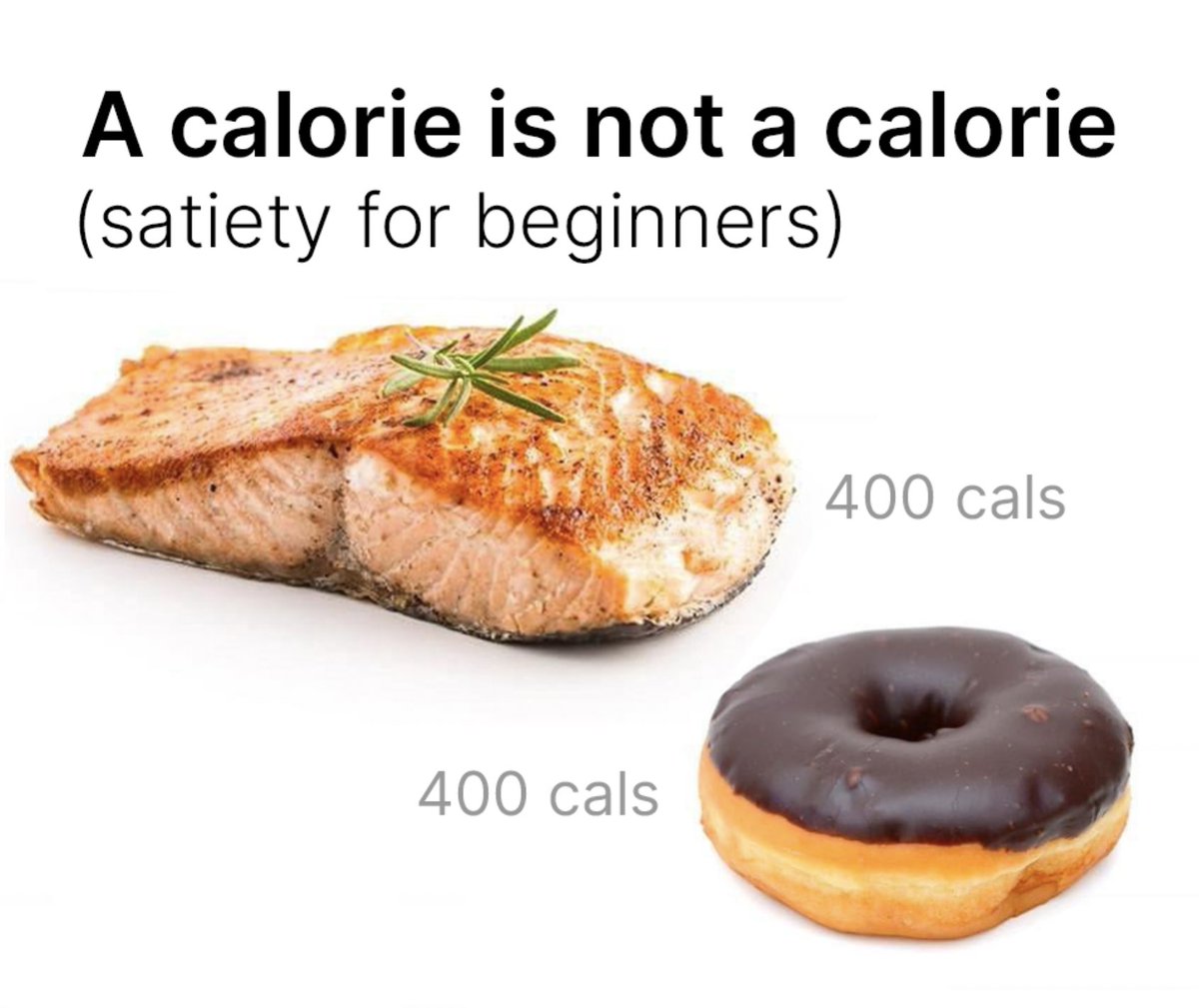
A calorie is not a calorie.
As rates of obesity have skyrocketed over the past few decades, we’ve been fed a lie. It’s all about counting and restricting calories. Just eat less and run more, and you’ll be OK.
It does not work like that.
A 400-calorie donut and 400 calories of salmon have *wildly* different effects on the body and satiety and future food intake.
Repeatedly eating a 400-cal donut drives obesity and poor metabolic health, while 400 cals of salmon protect against it.
A calorie is not a calorie. In the human body, their effects are different. Some foods, some calories, satisfy more than others.
Our food environment has changed in profound ways over the past few decades. The result is clear. An epidemic of poor metabolic health, like obesity, high blood sugar, high blood pressure, and more.
93% of the adult US population has poor metabolic health today. This drives all our top chronic diseases and poor quality of life.
So what exactly is driving this? What is it about our food environment that has changed?
Some believe it’s all about the carbs. They certainly matter, but it’s not just about carbs. While low-carb diets tend to work well for many, carbs are not the only factor. Many studies demonstrate this.
Some believe it’s all about eating “real” foods or whole foods. That’s a great start, but what exactly that means is unclear.
Some talk about avoiding ultra-processed foods (UPFs). Clearly, this is getting close to the truth. Repeated studies strongly link ultra-processed foods, overeating, and metabolic disease.
The truth appears to be far more complex.
Beyond processing, the variety of diets out there does not make it easier. Should you go low carb? Low fat? Vegan? Carnivore?
Seemingly opposite approaches all achieve good results, at least for some people. One large study (DIETFITS) tested a low-carb diet vs. a high-carb diet for 600 people. The result? Both groups lost lots of weight, with no clear difference; the two groups were equally successful.
How can people get equally good results by seemingly taking the opposite approach?
Well, they all did some things right. Both groups got less processed foods, with less sugar, and many other differences.
Some people claim that “all diets work”. It may be that the standard processed diet that people eat today is the worst one ever created, as it’s optimized for profit, with the resulting overeating as an unintended side effect.
If the standard diet is the worst ever, any change would be for the better. Therefore, “all diets work”. It’s like if you were in a burning house. It does not matter how you get out. Use any door or window.
Get away from the ultra-processed diet any way you can.
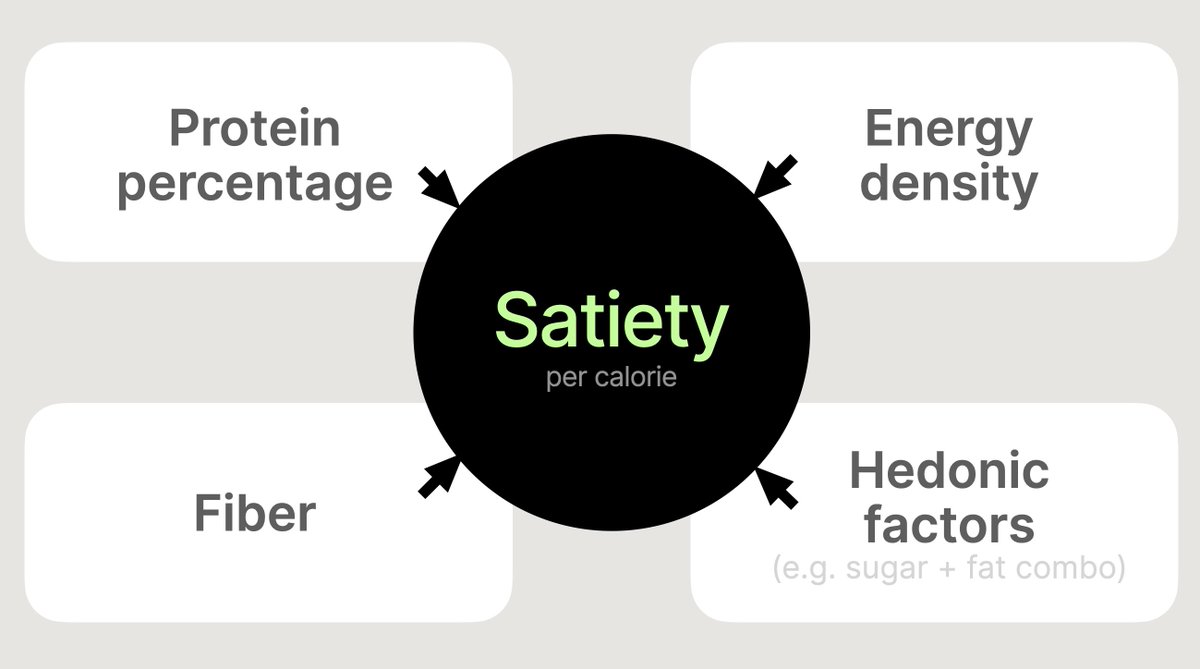
So what’s really the problem with UPFs? There appear to be many components. For example, it’s less nutritious, with less protein and less micronutrients. It’s highly energy-dense, meaning you’ll quickly eat more calories in a shorter time. It’s low on fiber. And it’s engineered to be highly rewarding, ideally even addictive.
All this complexity makes it VERY difficult to figure out how to compare different foods. You almost need a Ph.D. in nutrition to even get started. Then you need to analyze everything you eat with a spreadsheet.
What if it could be made much, much simpler?
We believe it’s possible. It’s possible to take all this complexity and make it simple.
It’s possible to identify what foods are more or less satiating, and which have lower or higher #satiety.
It’s possible to build tools to guide people in a simple, delightful way to more satiating foods they’ll love. We’re working on it, and we’ll share more on satiety and health daily.
Together we can help more people live better lives. If this message resonates with you, please share it.
Much more to come. To keep connected, follow us @JoinHava on Twitter, and sign up at https://t.co/M4FvNzmXzG for early access to our tools.
Leave a comment below, and we’ll answer many of them.







![moritzkremb's tweet photo. 20 ChatGPT prompts that use next-level mental models to help you make strategic business decisions:
1. Second-Order Thinking
Prompt: "Apply Second-Order Thinking to assess [my business decision]. Consider not only the immediate consequences but also the second-level consequences that may arise."
2. Pareto Principle (80/20 Rule)
Prompt: "Use the Pareto Principle to evaluate [my business decision]. Focus on the 20% of factors that could be responsible for 80% of the results."
3. First Principle Thinking
Prompt: "Use First Principle Thinking to evaluate [my business decision]. Rethink the problem from the ground up and separate the underlying facts from the assumptions made based on them."
4. Regret Minimization Framework
Prompt: "Use the Regret Minimization Framework to assess [my business decision]. Think long-term and weigh the emotional impact to minimize future regret."
5. Opportunity Costs
Prompt: "Assess [my business decision] by considering the Opportunity Costs. Think about the costs arising from choosing this option against every other option available."
6. The Sunk Cost Fallacy
Prompt: "Assess [my business decision] while avoiding the Sunk Cost Fallacy. Evaluate the decision based on future value, not past costs."
7. Occam's Razor
Prompt: "Apply Occam's Razor to assess [my business decision]. Choose the less complex explanation or option that satisfies the conditions without unnecessary multiplication."
8. Systems Thinking
Prompt: "Use Systems Thinking to assess [my business decision]. View the problem as part of an interconnected system and understand how variables influence one another."
9. Inversion
Prompt: "Utilize Inversion to analyze [my business decision]. Look at the problem from the endpoint instead of the starting point and ask: 'What must I avoid?' rather than 'What do I need to do?'"
10. Leverage
Prompt: "Analyze [my business decision] through the lens of Leverage. Determine how the right lever can amplify my efforts and lead to significant outcomes."
11. Circle of Competence
Prompt: "Apply the Circle of Competence to analyze [my business decision]. Make sure the decision aligns with [my areas of expertise]. Straying outside of my circle can lead to poor decisions."
12. Law of Diminishing Returns
Prompt: "Evaluate [my business decision] using the Law of Diminishing Returns. Consider the turning point where additional investments offer less value and costs may rise."
13. Niches
Prompt: "Analyze [my business decision] focusing on Niches. Determine how specialization within a niche can lead to expertise and success in this context."
14. Margin of Safety
Prompt: "Use the Margin of Safety to evaluate [my business decision]. Assume that your assumptions might be wrong and plan with a safety margin to mitigate risks."
15. Hanlon's Razor
Prompt: "Evaluate [my business decision] through Hanlon's Razor. Don't assume ill intent when mistakes can be explained by ignorance or error."
16. Randomness
Prompt: "Evaluate [my business decision] with the concept of Randomness in mind. Remember that not everything follows cause-effect relationships and some outcomes may be random."
17. Critical Mass
Prompt: "Analyze [my business decision] by considering Critical Mass. Recognize if you are at a point where momentum may become self-sustaining."
18. The Halo Effect
Prompt: "Evaluate [my business decision] while considering the Halo Effect. Recognize how impressions in one area can bias judgment in others."
19. Feedback Loops
Prompt: "Analyze [my business decision] through the understanding of Feedback Loops. Consider how actions and reactions within the system can influence subsequent decisions."
20. Scarcity and Abundance Mindset
Prompt: "Evaluate [my business decision] considering both Scarcity and Abundance Mindset. Reflect on how your mindset can influence the decision-making process."](https://pbs.twimg.com/media/F3LGO63agAEKtON.png)