@healthapiguy@HeyEpic@Freakonomics It’s hard to fault her/Epic on continuing to do what’s made them successful through the years. But the continuation of this effectively closed ecosystem model is out of step with the current paradigm of software and cloud computing.
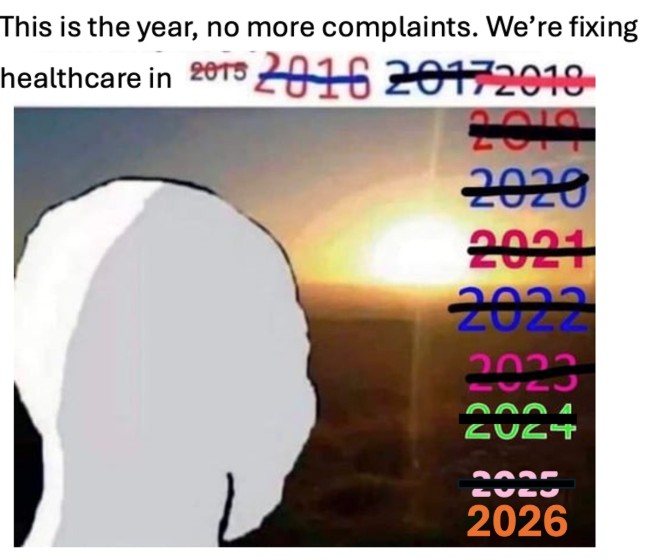
Have you ever wondered why the U.S. healthcare system is so confusing?
Because it’s designed to be.
Monopolistic insurance and pharma companies want it to be opaque, so regular people and regulators don’t know how to fix it.
So let me cut through the noise and tell you my top 5 healthcare issues that we need to address immediately:
Accessibility - we can keep raising the ceiling, but first we need to raise the floor for the 10s of millions of low-income citizens who require good healthcare.
Medicare reform - the current system is financially unsustainable and needs to be updated.
Reduction in certain regulations - innovators pay too large a penalty to enter and disrupt the industry (especially in Health IT)
Stronger enforcement of antitrust laws - large institutions are gatekeepers and are rent-seeking from smaller entities.
Drug Pricing - see my previous post about TRumpRX.
Until we tackle these issues, the healthcare industry will continue to fail millions of Americans across the country.
Health insurance stocks plummeted this week, and no one outside of Wall Street is complaining.
So why are the most vilified American companies tanking right now?
On Monday, January 26th, the Trump Administration announced that it wouldn’t increase medicare spending on private insurance companies.
The government is basically saying to insurance companies, “Healthcare is too expensive, and you guys make enough money as is”.
It’s kinda like if you’ve given an employee a raise every year for a decade, but they start slacking off, and you decide to withhold their Christmas bonus.
These insurance companies have been making a fortune by overcharging Americans and the U.S. government.
With the average U.S. family insurance plan costing as much as a Honda Civic ($26,993), people and the government are fed up.
Personally, the biggest changes I’d like to see to the insurance industry would be:
- Incentivizing greater competition - especially in smaller markets (disrupt the monopolies)
- Holding insurers accountable in cases where coverage is not approved in a timely manner (which directly improves patient outcomes)
- Creating greater financial transparency and reporting so that we can really see how these massive corporations are recognizing revenue (mitigate predatory cost structures)
If this trend of holding insurance companies accountable continues, we may finally see the overhaul of one of America’s most important industries.
I think genetically engineering babies is a good thing.
Startups like Nucleus got a lot of criticism for their “controversial” subway ads that promote the idea of using genetic engineering to alter your baby.
And I get why this upsets people.
To alter a human life just because you want your child to be a few inches taller or have different colored eyes seems dystopian.
But this new technology can do way more than make your kid look like Sydney Sweeney or Tom Brady.
Companies like Manhattan Genomics are using gene editing innovations to end genetic conditions like:
- Cystic fibrosis
- Huntington's disease
- Muscular dystrophy
- Sickle cell anemia
If humanity can use this technology in a safe and regulated way, we could save millions of lives every single year.
So if the consequence of saving human lives is having more babies born with blue eyes, then yes, that is something I will happily accept.
@telegram @AdityaXC7 @telegram is there a second way to authenticate a login attempt, without using SMS? Foreign SMS messages are being blocked in Iran, leaving users there locked out.
@telegram is there a second way to authenticate a login attempt, without using SMS? Foreign SMS messages are being blocked in Iran, leaving users there locked out.
ChatGPT has proven itself shockingly accurate at diagnosing illnesses. But what if it makes a mistake?
This is the challenge in adopting AI in healthcare - who assumes liability and risk?
It’s one thing if a team of doctors works tirelessly to help someone, and tragically, the patient doesn’t make it.
But if AI messes up and a patient dies, who is responsible?
A historical analogy for why things are progressing so slowly may lie in nuclear power - just look at what happened to the industry after Chernobyl.
Nuclear energy accounts for the fewest per capita deaths of any energy source, but we’re still facing the backlash of one accident 40 years later.
So, how do we prevent this from happening with AI in healthcare? It’s simple: companies like OpenAI, Anthropic, and any healthtech AL looking to move the needle forward need to assume some risk and liability in how they serve their ultimate users – the patients.
And we practice what we preach.
At @nimblemind, we publish all of our numbers for transparency and bake these benchmarks into the delivery of our services. We maintain or exceed our accuracy - no exceptions.
That way, our customers know that we’re assuming risk and take our mission to serve patients seriously.
True innovation in healthcare is only possible when companies are held accountable.
Everyone thinks that AI can’t replace human empathy… but that might be wrong.
Initial research shows that ChatGPT could actually empathize more with patients than doctors.
This isn’t because doctors are bad at their jobs.
It’s because their jobs are hard.
Part of the reason is that a doctor's job is measured on relative value units (aka RVUs), which assign value to physician services based on expenses, resources required, and malpractice insurance.
Over the last few decades, RVUs have forced doctors to be more like machines, treating patients like numbers.
But AI doesn’t have to deal with that same pressure and stress.
Which could be a really good thing for people.
Because if we integrate AI into medical practice, it can focus on the backend RVU work while doctors focus on patients.
In the end, doctors working alongside AI may be the solution to bringing humanity back into healthcare.
Protests in Tehran Jan 13, 2026. Estimates that over 1 Million Iranians are in Tehran tonight demanding the end of the Islamic Regime.
They are unarmed, and the Regime is intentionally shooting to kill, but they return in bigger numbers each night.
Bravest people alive. 🦁☀️
One of the biggest court cases in healthtech history is going down, here’s why this is important:
In May of 2025, an anti-trust lawsuit was filed against Epic Systems, the largest EHR provider in the U.S,. controlling up to 325M patient records.
The suit alleges that Epic has engaged in anticompetitive practices, effectively using their control over massive amounts of patient data to limit other companies' access.
Without access to this data, companies like CureIS claim that customers are forced to choose Epic’s products over theirs.
And it’s not just one allegation. CureIS, Particle Health, and now the Texas attorney general have filed individual anti-lawsuits.
If these allegations are true, you don’t have to be a Harvard JD to understand why one company controlling so much health data is a problem.
If Epic is really gatekeeping data, it makes it hard for healthcare providers to provide patient information quickly.
This could lead to:
- Fragmented patient records
- Missed and delayed diagnosis
- Real patient harm and degraded health outcomes
Only time will tell us how these lawsuits shake out, but regardless, one thing is clear: data access and management in healthcare is one of our most pressing issues.
In a world where technology and AI define patient outcomes, data is more important than ever.
Read more about the case here: https://t.co/wlrSg1pAe4
@realMaalouf How about we just celebrate bravery and courage where ever it is? No more slamming on the “the other side” - let’s support freedom and those striving for it where ever they are
@HomoLittlest The bravery of the Iranian people can not be overstated. They are facing organized, well armed thugs without weapons of their own and without an organization to lead them. They are making history #FreeIran
But if it can cheaply make our broken healthcare system more efficient, that would be a net positive for patients and providers.
Read OpenAI’s announcement here: https://t.co/NJEGbzf8IM
ChatGPT just launched a health feature that could change healthcare forever.
5% of ChatGPT users already ask health questions every week, so this launch shouldn’t come as a surprise.
But now ChatGPT health can act as a routing agent, assessing patients symptoms and then referring them to the specialists they need.
People shouldn’t be scared that AI is going to replace doctors. It won’t.