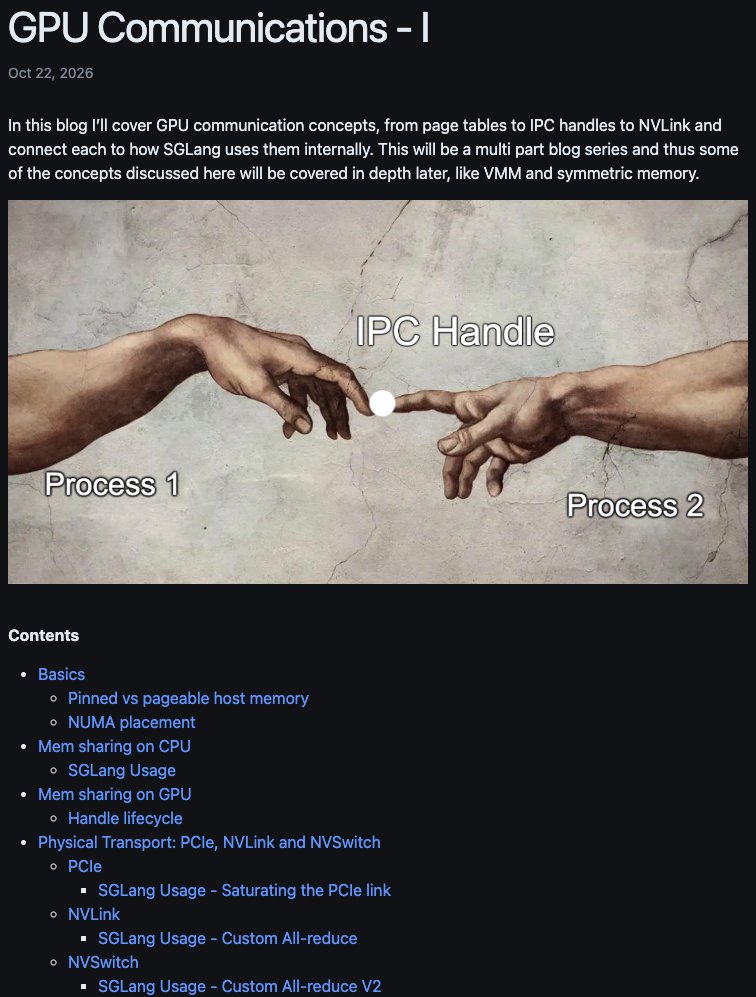
My article about Cgroups is out.
Namespaces make a container see its own little world, but nothing stops it from eating every CPU core and every byte of RAM. That's the job of cgroups: namespaces change what a process can see, cgroups limit how much it can use.
In this article we explore an example of how cgroups work from the interface, to how is represented internally in the code, and even going through the process of a simple cgroup limit.
You can take a look here: https://t.co/Qbwlo9QsuI
#Linux #Containers #Cgroups
For io_uring nerds...
uringscope: eBPF tracer and analyzer for io_uring. Reconstructs per-request latency, io-wq punts, and batching from kernel tracepoints, then names the problem and suggests a fix.
https://t.co/hzXyjbu3ov
A lot of infrastructure problems are networking problems wearing a different costume.
These 6 resources can help you build stronger networking fundamentals:
1. Beej's Guide to Network Concepts: https://t.co/JJpJ8YHBJF
2. Cloudflare Learning Center: https://t.co/y7R4lcwzEZ
3. Computer Networking: Principles, Protocols and Practice: https://t.co/XF4UxMGR23
4. Wireshark User's Guide: https://t.co/8c31M6qZ9f
5. Practical Networking: https://t.co/XFIK5Crf9Y
6. OverTheWire Bandit: https://t.co/Vtyo7a6KLq
Learn DNS, TCP, routing, TLS, ports and packet analysis.
Then troubleshoot a real connection failure using `dig`, `curl`, `ss` and Wireshark.
That's how networking knowledge starts paying off in DevOps.
Finding it very educational and interesting to learn about the hardware layer of GPUs: how they are structured, the obvious advantages and disadvantages bs CPUs.
This is from Modal’s excellent “GPU Glossary” print book @can gave me (the PDF is free here: https://t.co/ltzxXm1GSi)
"Mathematical Theory of the Transformer" is an extensive, 825-page mathematical monograph exploring the theoretical foundations of Transformer architectures.
It covers a remarkable range of topics, including embeddings and positional encoding, self-attention and multi-head attention, matrix decompositions, linear algebra, spectral analysis, information geometry, training dynamics, redundancy, optimization, and incremental Transformer architectures.
This is an advanced, mathematically rigorous read for anyone interested in understanding the mathematical structures underlying Transformer-based AI systems, including modern generative AI.
https://t.co/wwa1ucTYiF
FORGET TOY PROJECTS FOR A MOMENT
These 7 GitHub repositories can help you understand how real engineering systems are built.
1. Kubernetes https://t.co/f6WB613LPA
2. Prometheus https://t.co/mkM23Rrjrj
3. Cilium
https://t.co/VM8r4z0OBf
4. Envoy
https://t.co/VXBjEOzzDf
5. Backstage https://t.co/HAGce7Amc2
6. Argo CD
https://t.co/OwpC1wKpfF
7. OpenTelemetry Collector
https://t.co/PKuwTdUJtV
Here's the trick:
Don't try to understand the entire codebase.
Pick one component, trace how a request flows through it, and follow the code.
Reading production code is a skill worth developing.
🚀 Introducing DeepInfer, our in-house inference framework, now fully open source!
Powering DeepSeek-V4.1-Flash at scale with high throughput and low latency. We’re sharing our production stack to help the community lower compute costs, reduce energy use, and make AI more affordable.
🔗 https://t.co/JGAik1kgk0
1/4
In Chapter 6 of our #Linux for #DevOps course, you'll learn how to manage team SSH keys from a single source of truth, secure an automation key with `restrict` and `from=`, rotate a lost key, and fix common SSH permission errors.
Read the chapter: https://t.co/3I6lBUDXPH
Follow @tecmint to get notified whenever a new chapter is released.
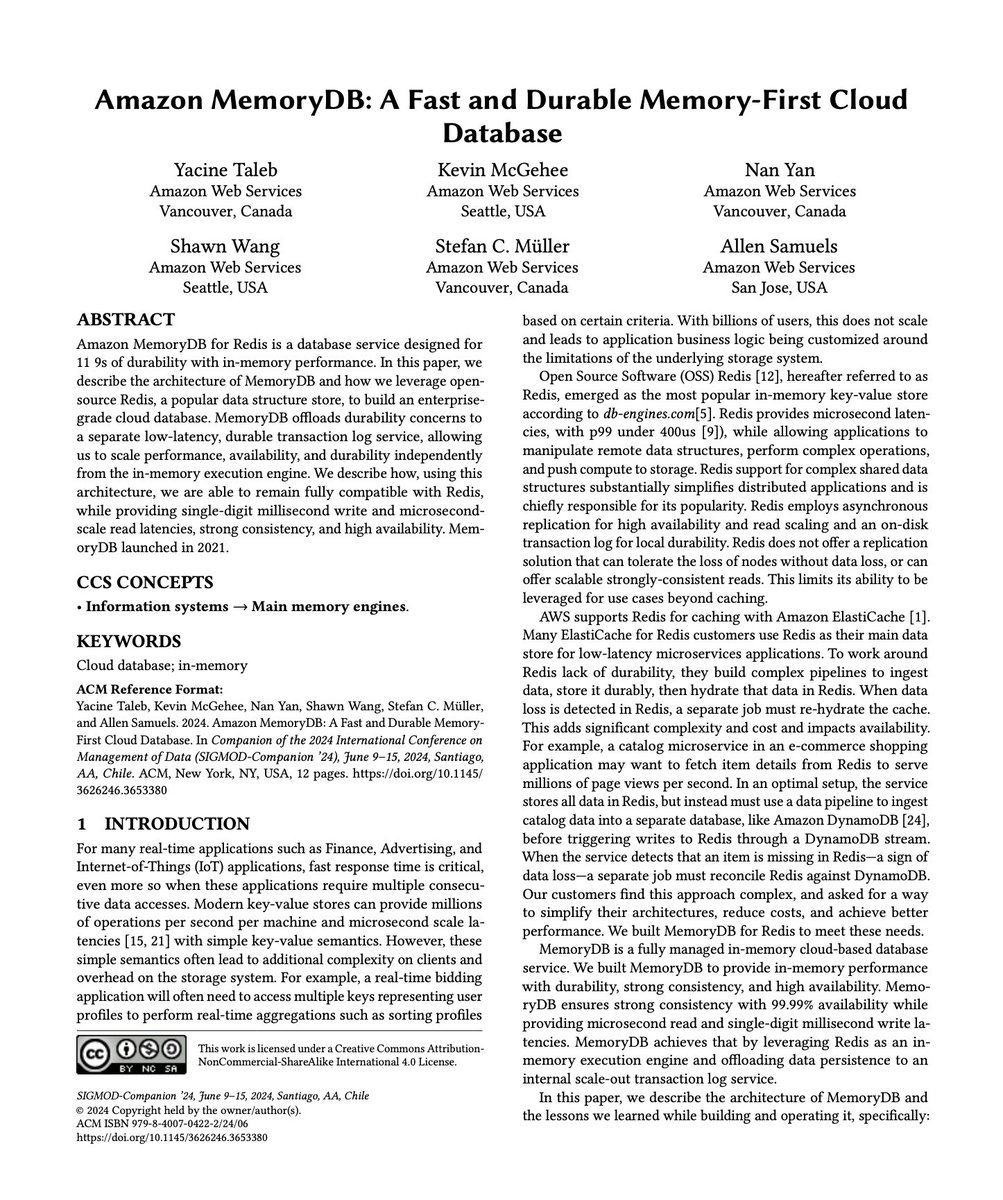
I was reading this paper on Amazon MemoryDB and just finished it. One of the things I love about reading systems papers is that you go in curious about a technology and come out appreciating the engineering decisions behind it.
Amazon MemoryDB: A Fast and Durable Memory-First Cloud Database -
https://t.co/KSy1mPk7PC
The question that caught my attention was this: how do you build something that takes advantage of the speed of memory without compromising on durability?
RAM is incredibly fast, but it's volatile. Building a database that is fast is one thing. Making sure it can recover from failures, preserve committed data, and remain highly available is a whole different challenge.
MemoryDB approaches this by using Redis as its in-memory engine and a separate, distributed transaction log for durability.
What I found interesting is the thinking behind the architecture. It's not just about squeezing out more performance; it's about deciding which responsibilities belong where and understanding the trade-offs that come with those decisions.
That led me to explore this AWS collection on in-memory databases, which connects some of these ideas to real-world systems:
A few resources I'm adding to my reading list:
→ Yahoo: Processing 1.3 million advertising events per second
https://t.co/hlTYGKmAC1
→ Building real-time applications with Amazon MemoryDB
https://t.co/iYBDjXgLMa
→ Samsung SmartThings and Amazon MemoryDB
https://t.co/9mpTNMDlV3
→ Amazon ElastiCache learning resources
https://t.co/uFIO9WW4zQ
Here's the full AWS roundup that brought these resources together:
https://t.co/5eFy0Lqyli
I always find it worthwhile to read the paper first and then look at how the ideas translate into actual systems. The theory becomes much more interesting when you start thinking about the failures, workloads, and constraints engineers have to deal with in production.
If you're interested in databases or distributed systems, I'd recommend giving the paper a read. It's a good reminder that some of the most interesting engineering work happens in the decisions users never see.
#DistributedSystems #Databases #SystemDesign #AWS