Luke — an offline, on‑prem AI operator that works directly in the terminal. Plans. Executes. Observes. https://t.co/SSHoD263Ov cloud. Real commands. Real autonomy. Demo below. @nikseetharaman @elonmusk@karpathy@gdb@amasad@yoheinakajima@jimfan
@ylecun@Dan_Jeffries1 It’s good as long as it remains an expansion or extension of our own collective intelligence. If it becoms something else, disconnected from our own humanity, and views us as a threat to itself or third parties, then it will be…not good.
What happens when you run modern vector embeddings over the Voynich Manuscript?
Everyone tries to "crack the cipher." Instead, I just wanted to test the raw math: Does an un-deciphered historical text actually have internal structure, or is it just random noise?
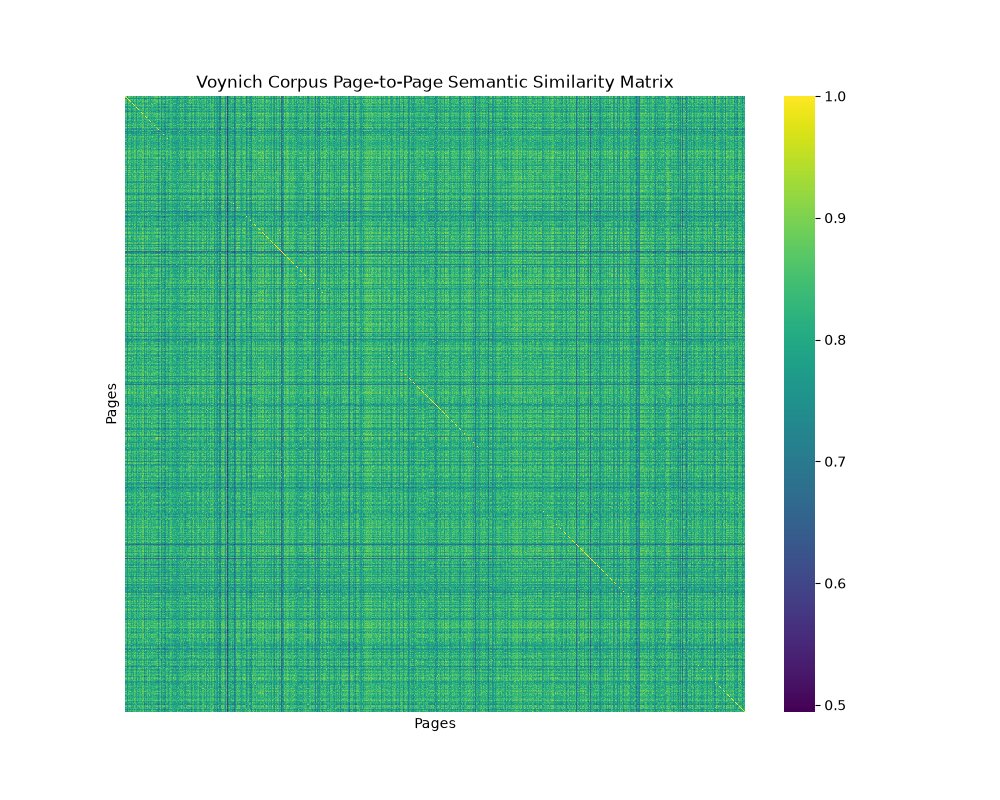
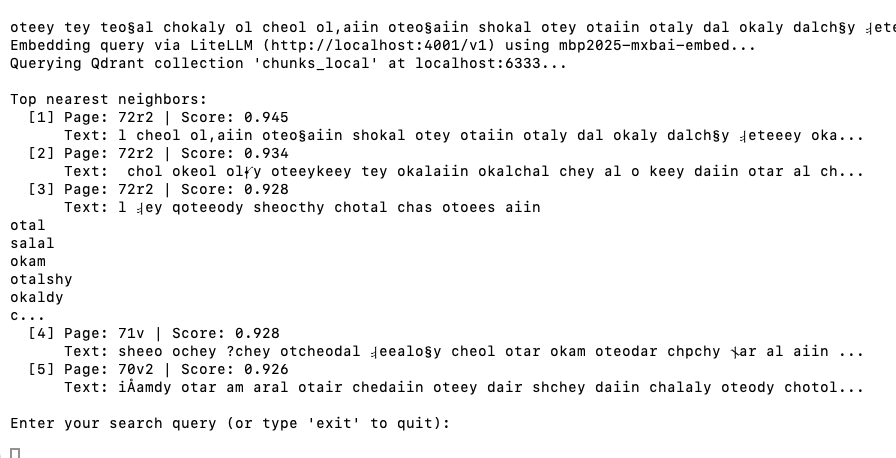
I built a local sovereign pipeline (LiteLLM, Qdrant, mxbai-embed) and chunked the transliterated text into overlapping sliding windows to generate a corpus-wide N×N similarity matrix. I further enabled sliding trigram visualizations (pictured) and direct text entry (pictured) to compare image similarities for correlated texts.
The results: Far from a flat field of random static, the chunk-level heatmap (pictured) reveals crisp structural banding, repeating anchors, and distinct thematic clustering. Cosine similarity isn't translation, but it mathematically suggests the text follows strict internal grammatical rules rather than a random hoax.
All in all, this has been a fun and interesting project!
Says? no. Implies? yes.
The point isn’t that Heppner creates new doctrine; it’s that it illustrates the existing privilege problem: when prompts are stored by a third‑party vendor, they’re fully discoverable and outside the privilege boundary. That’s why sovereign, on‑prem AI matters. It removes the third‑party subpoena vector entirely.
Astra for Law is a strong step forward — but US v. Heppner made one thing unavoidable: cloud AI prompts are fully discoverable.
“Frontier intelligence” doesn’t change the structural reality that cloud AI creates a second subpoena target outside the privilege boundary. If a vendor stores your prompts, they’re discoverable. If a vendor can be compelled, privilege can be shattered.
This is exactly why at Dizco, we specialize in deploying sovereign, local AI models and automations for privileged and high‑security industries. Sensitive data stays on your hardware, under your control, with zero exposure to third‑party subpoenas or black‑box training pipelines.
@solopribuilds Opencode and local models. Download them soon tho, before they’re either behind an NVidia or Ollama paywall, or Uncle Sugar makes them illegal to store and operate privately.
💯I’m still trying to convince my friends that LLMs are simply a file and do not require internet access to respond intelligently, but only to add context to enrich their response. We’ll get there I hope but it’s a slow process. Consider everybody uses cell phones but few understand how they actually work, much less could design one from scratch.
@ProfNoahGian I’ve actually built an Ai analyzer that proves semantic similarities between the zodiacal pages, suggesting that it is not random or gibberish but at least uses structures similar to language. Demo to follow soon
I’ve been building something I haven’t seen anywhere else in the agentic AI space.
Not another agent. Not another workflow engine.
A system where agents learn from experience — the same way new employees do.
Every agent trial becomes structured memory: • the input it received • the action or code it produced • the outcome (success/failure) • the reasoning trace
All of this goes into a shared vector database.
Any agent can query that memory to avoid past mistakes, reuse successful strategies, and improve over time.
It’s cross‑agent experiential learning — a hive mind for autonomous systems.
No retraining. No fine‑tuning. Just agents getting better every day.
This is the foundation of the Keira Collective Intelligence Engine I’m building at Dizco.
More soon.
Here's a great example of bias in media.
At the start of the Iraq War (2003), I saw a CNN article that read (paraphrased) "President Bush fails to rally the UN to support the war in Iraq."
Fox News simultaneously reported "UN fails to support US war in Iraq."
Who was right? Both perspectives were true. But the bias and literary slant framed how the story was told to meet an intent of the writer or publisher.
Read the news with an eye for its inherent bias and extract the facts on your own.
@XCosmosOfficial The integrated circuit. By packing billions of transistors onto a single piece of silicon to act as artificial neurons, the IC became the indispensable physical substrate that gave rise to intelligence itself.