I'd like to thank the co-authors for thought-provoking discussions from different viewpoints on human-robot interaction. I've learned a lot through the process and continue to appreciate the complexity of augmenting or enhancing human capabilities.
This perspective analyzes prior work in this area, recommends best practices, and discusses exciting areas for future research. Robotics continues to become more ubiquitous in society and I'm excited to see how these ideas may impact everyday life.
Want to make humans and robots interact more effectively? "Human-in-the-loop optimization" is a promising approach to systematically improve human-robot outcomes across a wide array of use cases like assistive tech, med devices, education, and industry. https://t.co/OEdGj3nDI5
As a PhD student, all I focused on was getting a PhD.
As a PhD supervisor, I focus on training students on the long-term process that leads to getting a PhD.
Here's some examples🧵
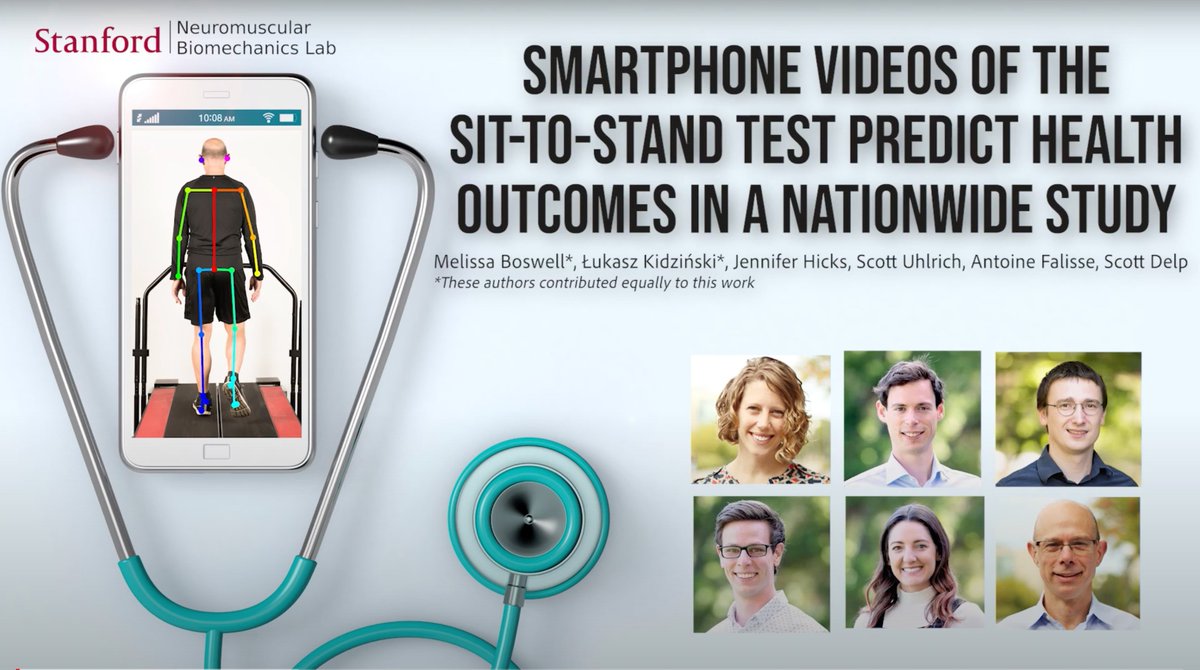
Can smartphone videos predict health?
Our nationwide at-home study shows self-guided motion analysis using smartphone video of sit-to-stand can predict osteoarthritis diagnosis & physical & mental health
Now out in @npjDigitalMed: https://t.co/qpzerZ8EmJ
@MuyVienDPT Thanks, Vien! It's really awesome having you and the sports medicine folks next door to keep us thinking about the problems that will help people soonest, and to help us get special anti gravity shorts :)
@klpoggensee@aiprof_mykel@StanfordNMBL @StevenHCollins Thanks @klpoggensee! It wouldn't have been possible without your awesome exo adaptation study and the amazing open-source dataset you made from it!
3. Talk (especially informally) about your ideas with researchers in different fields. On many occasions I've learned of subproblems I'm working on that they've already solved, or learned about potential other use cases.
2. Make sure the fundamental science (in this case multiple scales of how our muscles consume energy and perform work) supports the feasibility of your hypothesis. Esp important with data-driven models that hopefully capture some phenomenon.
@nidhi_s91 @StevenHCollins Yes, your work played a huge role in the extension to real-world movement! Hopefully we can meet and chat about it in Cambridge next year :) I'm excited to hear what you are working on