Emeritus Professor of the Anthropocene; Earth's newest sphere-the technosphere; humans as artifacts; autonomy and purpose; the human future. Opinions mine
"Tourists never really leave home; they bring home with them. Only wanderers discover the world."
>>William Eamon "The Labyrinth of Nature", https://t.co/F2YGMPpidV)
(Or, Tourists know where they are going. Wanderers don't.--@pkhaff )
Clarity.
Clarity on the separation of powers.
Clarity on "no one above the law".
Clarity on the responsibilities of elected officials.
Clarity on the role of money and wealth.
Clarity that former US presidents are subject to indictment and if found guilty to imprisonment.
James Cameron has written & directed 3 of the top 4 highest-grossing movies of all time (Avatar, Avatar: The Way of Water, and Titanic).
Before he made movies, Cameron was a truck driver.
He didn't go to film school.
Instead, on the weekends, he would go to the library and..
"I'd pull any thesis that [University of Southern California] graduate students had written [on] anything that related to film technology," Cameron explained.
"And for the cost of xeroxing (photocopying), I [got] all these doctoral dissertations [and] build up these big binders on how everything was done."
"So I literally gave myself a full graduate course on film technology for about $120.
I didn’t have to enroll in school because it was all there in the library. I’d set it up to go in like I was on a tactical mission, find out what I needed to know, and take it all home."
Takeaway 1:
When asked what motivated him to read those big binders full of information on filmmaking, Cameron said he was just following what excited him.
"People seek out the information and knowledge they need," he said. "It's like a divining rod."
The mythologist Joseph Campbell similarly talked about how reading is like "a divining rod," a way to find what you are uniquely attracted to and meant to do.
"You’ve got to read," Campbell said. "Find [what] excites you. And if it doesn’t excite you…It’s not yours.”
Takeaway 2:
Of course, at some point, Cameron had to put the binders down and pick up a camera.
When he eventually attempted to make his first movie, Cameron said, “It was a bit like a doctor doing his first appendectomy after having only read about it."
The bestselling author and learning expert, Scott Young, has a great article with a great title, "Do The Real Thing."
"When you examine case studies of people who have had major accomplishments," Scott writes, "you expect there to be some trick or shortcut...More often, however, the strategy used is dead simple: doing the real thing."
Takeaway 3:
Leonardo da Vinci used to sign off his letters, “Leonardo da Vinci, disscepolo della sperientia” ("disciple of experience").
He used to believe that one learns best by solely "doing the real thing."
Over time, however, he evolved out of this belief and, biographer Walter Isaacson writes, "became a disciple of both experience and received wisdom."
When you examine case studies of people who have mastered their craft, you usually find they are "disciples of both experience and received wisdom."
Like Cameron, they read the library and they do the real thing.
- - -
“Those who are in love with practice without theoretical knowledge are like the sailor who goes onto a ship without rudder or compass and who never can be certain whither he is going.” — Leonardo da Vinci
Follow @bpoppenheimer for more content like this!
Agreed climate change is only a symptom, not the root cause of our current predicament.
System speed is closer to a root cause.
Every system has agency, to try to survive, to grab all the resources it can get.
As fast as it can.
To come back for even more tomorrow.
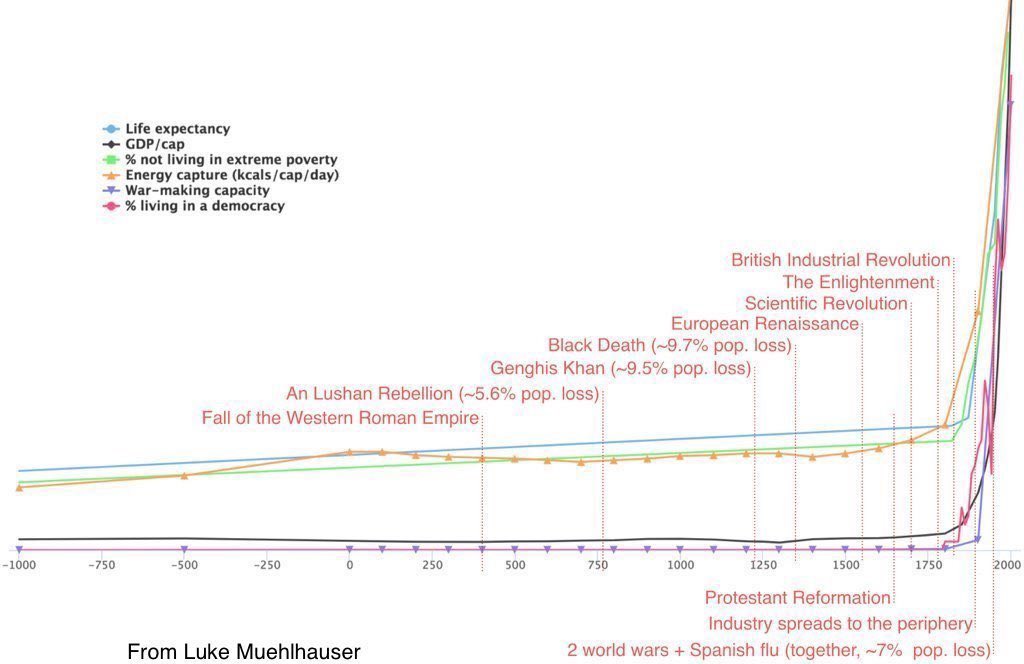
"We spent 19,960 centuries making better types of stone hand axes.
It isn’t surprising that it feels hard to keep up."
At some point it becomes impossible to keep up.
When managing tech requires human decisions faster than biology can supply them, tech will be in control.
Just a reminder that, by any reasonable measure, we have been going through a Long Singularity for a century and a half.
To put that in context, as species, we spent 19,960 centuries making better types of stone hand axes. It isn’t surprising that it feels hard to keep up. https://t.co/8kmoIOI2vI
Use your salary to invest in assets so those assets replace your salary. If you found this thread helpful, please:
• RT the FIRST tweet to share it🔁
• Follow me @FluentInFinancefor more
• Sign-up for my FREE newsletter to learn more: https://t.co/kY4KX3q1Wp!
In 1997, at the age of 27, Matt Damon won his first Academy Award for Best Screenplay ("Good Will Hunting").
After Damon won the Oscar, he went home, sat down on his sofa, & looked at the award.
As he looked at it, he was suddenly overwhelmed by a heartbreaking thought.
"Imagine chasing that, and not getting it, and getting it finally in your 80s or your 90s with all of life behind you and realizing what an unbelievable waste of your life...It can't fill you up. If that's a hole that you have, that won't fill it."
"My heart broke," Damon said. "I imagined another one of me [not getting that award until I was] an old man, and going like, 'oh my god. where did my life go? What have I done?' And then it's over."
Takeaway 1:
Many successful, rich, famous, etc. people talk about chasing success, money, fame, etc., getting it, and realizing that it didn't feel like they thought it would. That it didn't, as Damon said, fill the hole they had.
One of my favorite analogies for this pattern comes from Sam Hinkie.
Hinkie was asked about what he's learned from reading Robert Caro's books—about some very successful, rich, famous, etc. people.
"I think of it like the Pacific Salmon," Hinkie said. "They spend their whole life making this journey upstream to spawn in this one spot. And as soon as they do, they die. That's largely what Caro shows you."
Takeaway 2:
Before he was a big-time comedian, Hasan Minhaj was asked if he thought he was going to become a big-time comedian.
“I don’t like that question,” he said. “I fundamentally don’t like that question.”
Because that question implies that he is only doing comedy as a means to some end (success, money, fame, etc.).
“No, no, no,” he said, “The set I get to do tonight at 7:20 PM is the win. I get to do comedy—I won. It being predicated on doing X or being bigger than Y—no, no, no. To me, it’s always just been about the work."
"The work is the win," as Ryan Holiday once told me.
- - -
"It's such a gift to be able to [do] something and to love it for the sake of it...I see people with talent, with all those things. But the one thing they don't have is just that love for doing it for the sake of it...So if there's anything, just find joy in what you do for the sake of it." — Rodney Mullen
Follow @bpoppenheimer for more content like this!
Solar panels need to go on rooftops in the built environment, and shading urban parking lots first—not on ecosystems and habitat for federally threatened species! #biodiversitycrisis
It's interesting how high-school librarians teach research skills. Head to JSTOR, they say, and use refined searches.
Funny. As a PhD-trained academic, the first thing I do is go to Wikipedia, track down sources and download them from Sci-Hub.
@LeonSimons8@fardos@hausfath But you see then it is responding deterministically to external forces like anything else. Anything that is made of matter and consumes energy is a physical entity and hence subject to universal thermodynamic laws.
In addition to the moral risk of reliance on nuclear energy that would stem from consequences of civilizational collapse, the moral risk would accelerate as nuclear energy use accelerates.
Lots of pros and cons re nuclear power, but one big negative is an implied assumption of ongoing civilizational complexity and stability- indefinitely. Here’s interesting thread on risks many nuclear advocates often overlook (or dismiss):
You will only start worrying about the dollar status as a reserve currency when you see long lines outside tbe Brazilian, Russian, Iranian, and Chinese consulates full of young professionals seeking immigration visas.
@erikphoel I mean...this is great news. We, as a society, adapted to its need at the current time. Imagine if 7B people on earth can all become engineers, researchers, doctors...we would have solved all the problems in the universe in maybe a few years to a decade
@erikphoel@librarythingtim "Consulting." Last thing I want is someone right out of uni offering me advice. Esp one with no sense of anything outside the technosphere of a few years of the 21st century.



![bpoppenheimer's tweet photo. James Cameron has written & directed 3 of the top 4 highest-grossing movies of all time (Avatar, Avatar: The Way of Water, and Titanic).
Before he made movies, Cameron was a truck driver.
He didn't go to film school.
Instead, on the weekends, he would go to the library and..
"I'd pull any thesis that [University of Southern California] graduate students had written [on] anything that related to film technology," Cameron explained.
"And for the cost of xeroxing (photocopying), I [got] all these doctoral dissertations [and] build up these big binders on how everything was done."
"So I literally gave myself a full graduate course on film technology for about $120.
I didn’t have to enroll in school because it was all there in the library. I’d set it up to go in like I was on a tactical mission, find out what I needed to know, and take it all home."
Takeaway 1:
When asked what motivated him to read those big binders full of information on filmmaking, Cameron said he was just following what excited him.
"People seek out the information and knowledge they need," he said. "It's like a divining rod."
The mythologist Joseph Campbell similarly talked about how reading is like "a divining rod," a way to find what you are uniquely attracted to and meant to do.
"You’ve got to read," Campbell said. "Find [what] excites you. And if it doesn’t excite you…It’s not yours.”
Takeaway 2:
Of course, at some point, Cameron had to put the binders down and pick up a camera.
When he eventually attempted to make his first movie, Cameron said, “It was a bit like a doctor doing his first appendectomy after having only read about it."
The bestselling author and learning expert, Scott Young, has a great article with a great title, "Do The Real Thing."
"When you examine case studies of people who have had major accomplishments," Scott writes, "you expect there to be some trick or shortcut...More often, however, the strategy used is dead simple: doing the real thing."
Takeaway 3:
Leonardo da Vinci used to sign off his letters, “Leonardo da Vinci, disscepolo della sperientia” ("disciple of experience").
He used to believe that one learns best by solely "doing the real thing."
Over time, however, he evolved out of this belief and, biographer Walter Isaacson writes, "became a disciple of both experience and received wisdom."
When you examine case studies of people who have mastered their craft, you usually find they are "disciples of both experience and received wisdom."
Like Cameron, they read the library and they do the real thing.
- - -
“Those who are in love with practice without theoretical knowledge are like the sailor who goes onto a ship without rudder or compass and who never can be certain whither he is going.” — Leonardo da Vinci
Follow @bpoppenheimer for more content like this!](https://pbs.twimg.com/media/FyDsJLPXsAIX5UE.jpg)