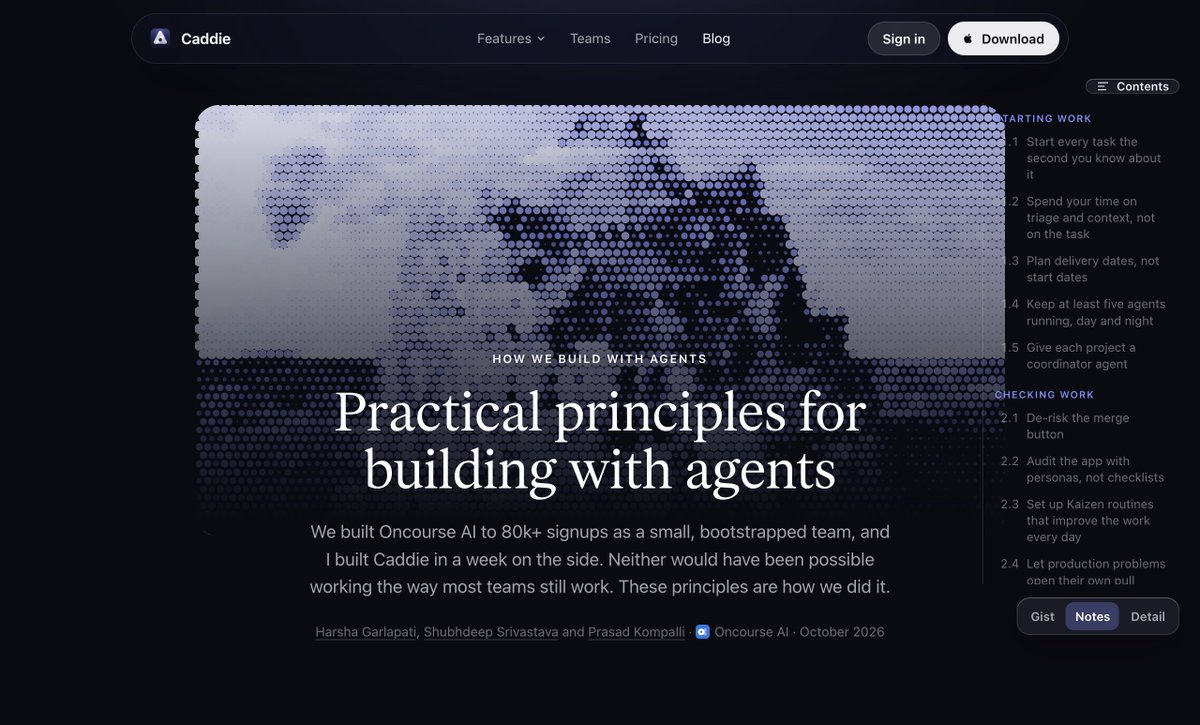
We got @OncourseAI to 80k+ signups as a small bootstrapped team, and I built @caddie_app in a week on the side.
So we wrote down the 15 principles we actually work by with agents
My favourite: keep at least five agents running, day and night.
https://t.co/jnM5knn6NX
@fabianstelzer wow ...
we are not very far from -> every lecture , style, form-factor, lecturer, topic is just few mins of vibe code / config of tools
would love to test and be early an adopter.
Ever wonder why ChatGPT can write a sonnet about quantum physics but sometimes fails at counting letters? There's a fascinating psychological explanation – and it starts with a warning Carl Jung wrote decades ago.
You know how you can't just read about riding a bike and suddenly be good at it? You have to fall a few times. Build muscle memory. Go from wobbly to confident.
Jung called knowledge without that struggle "unearned wisdom." And he warned: beware of it.
Here's what's wild: this 20th-century insight might explain one of AI's biggest unsolved problems.
(Stick with me – this gets interesting.)
Think about how you actually learned math. First addition, then multiplication, then algebra. Each builds on the last. You can't skip steps.
Your brain literally organized itself differently because of that sequence. It created what researchers call "Unified Factored Representations" – modular, adaptable knowledge.
Now imagine learning addition, calculus, and differential equations all at the same exact moment.
Sounds ridiculous, right?
That's basically how we train AI.
Modern language models are "epistemological vacuum cleaners" (love that phrase). They ingest millions of documents simultaneously – nursery rhymes alongside PhD dissertations, basic arithmetic alongside advanced proofs.
Everything flattened into one massive parallel gulp.
Here's where it gets problematic:
When you learn naturally, your knowledge is modular. You can update your understanding of, say, cooking techniques without forgetting how to ride a bike.
But when AI learns everything at once? It creates what researchers call "Fractured Entangled Representations."
Imagine dropping all the buildings of a city from the sky at once instead of building them street by street.
Sure, you have a city. But try to renovate one building? The whole thing might collapse. Everything's tangled with everything else.
That's the AI's knowledge structure.
This explains SO much:
Why AI hallucinates facts it should "know"
Why updating one capability can break another (catastrophic forgetting)
Why these systems can't do genuine compositional reasoning
Why they're bad at truly novel problems
The knowledge was never earned. It was dumped.
The hidden cost is what researchers call "destroyed evolvability."
You can't easily improve these systems without retraining from scratch. The representations aren't modular enough. Touch one thing, ripple effects everywhere.
It's intellectual spaghetti code.
Think about a master carpenter. She didn't read every woodworking book at once. She:
Learned basic cuts
Struggled with joints
Felt wood grain
Made mistakes
Developed intuition
Her knowledge compresses elegantly. Yours does too.
AI's knowledge? Bloated and brittle.
Here's the part that keeps me up at night:
We're building systems with vast knowledge but no foundation. They're like buildings with impressive facades but no load-bearing walls.
Jung intuited this – knowledge without the struggle of earning it lacks depth.
But wait – this isn't just philosophical musing.
Some researchers are exploring solutions:
Curriculum learning (carefully sequenced training)
Adversarial methods (creating productive struggle)
Meta-learning (optimizing for future adaptability)
Teaching AI like we'd teach a child, not filling a database.
Next time you interact with AI, notice:
When does it feel shallow vs. insightful? When does it confidently claim something false? When can't it adapt a concept to a new context?
You're probably seeing the fingerprints of unearned knowledge.
The deeper question: Can we create artificial wisdom, or just artificial knowledge?
Wisdom requires synthesis, struggle, developmental stages. You can't speedrun it.
Makes you wonder if we're optimizing for the wrong thing entirely.
The price of unearned knowledge isn't what the AI fails to learn.
It's what it becomes incapable of learning in the future.
Jung saw this in human psychology. We're rediscovering it in machine learning.
Some lessons, it turns out, are timeless.
I keep seeing the same weird pattern everywhere: Western leaders constantly "surprised" by moves China telegraphed years in advance.
DeepSeek AI. Electric vehicle dominance. 5G infrastructure. Solar panel manufacturing.
Every time: shock, confusion, scrambling to respond.
Why? 🧵
Here's the thing that finally clicked for me: The West and China are literally running different cognitive operating systems.
We tell stories. They make maps.
And that difference explains almost everything about why we're constantly playing catch-up.
Think about how you normally explain something important...
You probably tell a story, right? "Here's what happened, here's why, here's what it means."
Beginning, middle, end. Heroes and villains. Cause and effect.
That's how Western minds work. We're storytelling machines.
Our entire political system runs on stories:
"Make America Great Again"
"Build Back Better"
"The American Dream"
Even our economic theories are stories. The "invisible hand" isn't a mechanism you can diagram - it's a narrative device.
But here's where it gets interesting...
Stories are TERRIBLE navigation tools.
Imagine trying to drive across the country using only stories about other people's road trips. No GPS, no maps, just "Well, Bob said he turned left after the giant cow statue..."
Now imagine you're competing against someone using actual maps.
While you're trying to remember if Bob mentioned construction on I-80, they're looking at real-time traffic data, weather patterns, and calculating optimal routes.
Who wins that race?
Have you ever noticed how China announces their plans publicly, years in advance, yet somehow still achieves "strategic surprise"?
They literally told everyone they were going all-in on electric vehicles in 2009. On AI dominance by 2030. On solar manufacturing in the 2000s.
We heard the words but couldn't process the information. Why?
Because we were waiting for a STORY. A narrative that made sense. "China is doing X because Y, which means Z."
But they weren't telling stories. They were showing maps.
Here's a mental experiment:
Imagine two kids playing chess. One narrates every move: "My brave knight ventures forth to challenge your bishop!"
The other just sees positions: "Knight to K5 threatens three pieces and opens the center."
Who's going to win?
This isn't about intelligence. It's about frameworks.
When Western analysts look at China, they ask: "What's their story? What do they believe? What's their ideology?"
When Chinese strategists look at the West, they ask: "What's their position? Where are they moving? What are their dependencies?"
The map shows things stories hide.
A map reveals that electric vehicles require battery technology at a certain evolution point. That AI depends on computational commoditization. That solar dominance requires polysilicon control.
These aren't narrative connections - they're structural dependencies.
But that's not the interesting part...
Maps let you PRE-POSITION.
While we're telling stories about "the future of transportation," China was investing in lithium processing facilities.
While we debated the ethics of AI, they were stockpiling GPUs and training data.
The Five-Year Plans everyone mocks? They're not stories about China's future.
They're maps. Each province provides positional data: where they are, where they're heading, what resources they need.
It's GPS coordinates, not narrative arcs.
Think about how you normally engage with news about China...
You probably look for the story angle, right? "China cracks down on tech" or "China opens up to foreign investment."
But these aren't plot points in a story. They're positional adjustments on a map.
Here's where it clicks:
Stories lock you into timeframes. A political story needs resolution within an election cycle. A corporate story needs quarterly closure.
Maps work across ALL timescales simultaneously. You can see the 40-year trajectory while navigating today's terrain.
Then something weird happened...
I realized this explains our entire strategic confusion.
We keep trying to have narrative contests with someone playing a positional game. We're having a poetry slam while they're playing chess.
Trade wars? We see them as stories about "winning" and "losing."
China sees positions on a supply chain map.
Tech competition? We narrative it as an "AI race."
China maps computational resources, data advantages, and talent flows as distinct coordinates.
Here's what this means for you:
Next time you read analysis about China (or any strategic competitor), ask yourself:
Is this telling me a story, or showing me positions? Is this explaining what happened, or revealing what's possible?
Try this experiment:
Take any news about China and strip away the narrative. Just look at:
What positions are they taking?
What capabilities are they building?
What dependencies are they securing?
The strategy becomes visible once you stop looking for the story.
Even better - watch how Western responses reveal story-thinking:
Tariffs? That's a narrative tool ("protecting workers"). Sanctions? Story device ("punishing bad behavior"). Technology bans? Plot twist ("denying them victory").
None of these change positional reality.
Now you might think: "But stories matter! They inspire people, create meaning, build cohesion!"
Absolutely true.
Stories create meaning. Maps create advantage. Stories explain why. Maps show how. Stories comfort. Maps navigate.
We need both. But we only have one.
The real kicker?
One Western strategist figured this out. Simon Wardley @swardley created a mapping methodology for strategy.
His inspiration? Sun Tzu's Art of War. Ancient Chinese strategic text.
When Westerners independently develop strategic tools, they converge on Chinese principles.
Makes you wonder what else we're missing because we're looking for stories instead of patterns...
Are we misreading Russia? India? The entire global tech landscape?
How many "surprises" are actually positions clearly marked on maps we don't know how to read?
The choice ahead isn't abandoning stories - they're core to who we are.
It's about adding cartographic capability. Learning to see positions as well as narratives. Understanding structure alongside meaning.
Because in a world of increasing complexity, navigation beats narration every time.
Changes how I think about every "China shocked the world" headline.
They didn't shock anyone. They showed their map, made their moves, reached their position.
We were just too busy crafting narratives to notice the terrain had already shifted.
Why are we pretending that the pinnacle of AI interaction is typing questions and getting text back?
We are pattern-matching, visual-processing, spatial-reasoning creatures who happened to develop language as a useful hack. We think in relationships and patterns, yet currently we're forced to translate everything into text requests and then back into understanding.
Read more on my latest blog: Re-imagining AI Interfaces
This test match win and the overall series feels very special.. as it’s pulled off by supposed *team in transition with not much experience* #INDvsENG
Right up there along with #BGT2021
great to see the nextgen win the match. Finally a team thats grounded, hungry for learning and focussed to perform and with no one who feels they are above the game itself... #INDvsENG2025
Nice to have watched this live yesterday w/ kids together ( and couldn’t resist following up watching the iconic docking scene - ) #docking#indiainapace#isro#AxiomMission4
Tech head tells me “last week Devin gave max PRs and the feature change you asked was completely done by Devin”
Amazed at how fast and far AI for coding has come and what it lies ahead for software dev.. @getOncourseAI
#AI#AIforcoding#genAI
Kids want to add *Equity* concept into Monopoly game !!! Sign of times and influences (-: ..
just curious - would VCs enjoy such a game if it exists ? @banglani@TheSwamy
@AravSrinivas@AravSrinivas instead of solving, try benchmarking in setting a JEE advanced level paper without any errors in the question formation. I found that more interesting and challenging for the reasoning capabilities of LLMs
I find all LLMs faltering with consistency , even in basic concepts.. of course with straight forward prompting only. but expectation is one need not be expert at prompting to get useful questions from LLMs
A small observation : more than solving HL math/physics/coding problems, I find getting LLMs to 'formulate' good set of solvable problems in a given topic ( algebra, geometry ... ) is a challenge. LLMs should be benchmarked in this. #GenAI#LLMbenchmarks