Thrilled to share that I’ll be starting @PrincetonCS this fall as a PhD candidate in the @cocosci_lab. My research will focus on AI for math.
If math was erased from human memory, it seems likely we’d reinvent a similar mathematics. I hope interrogating the nature of this tight connection between human cognition and human mathematics can teach us how to design artificial mathematicians.
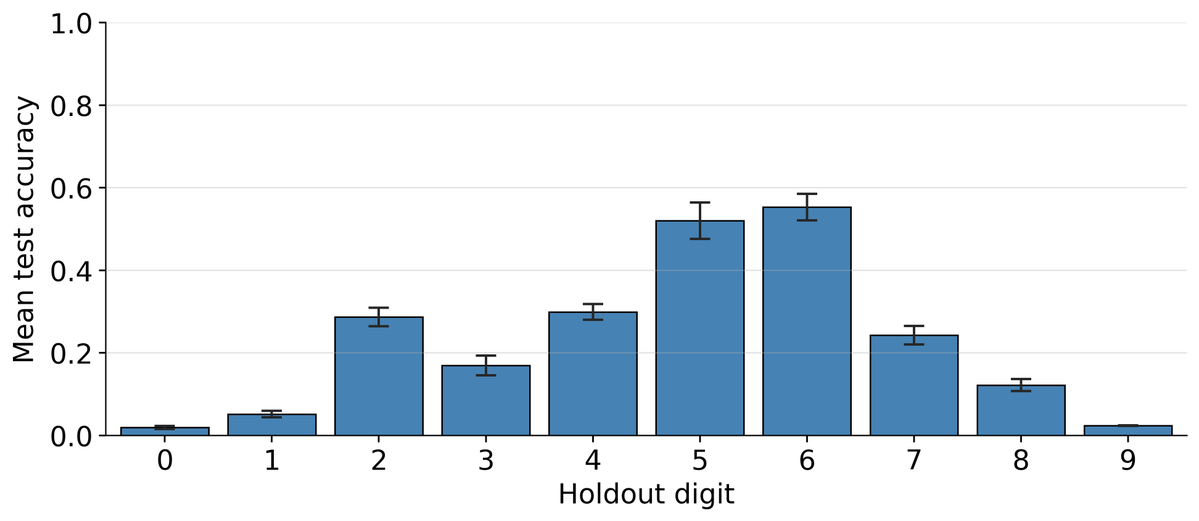
Zero is special. Models can generalize to other numbers when held out of the training data in an analogous manner. The carry digit (9 in base 10) is also difficult for models to generalize to.
Are there limits to what AI will contribute to human mathematics? In a new paper with @LakeBrenden@cocosci_lab we probe this question with a simpler one: Can a language model discover 0? The resounding answer (so far) is no.
https://t.co/riEmfdxikV
Model generalization improves after training on a small number of examples that include zero. Models with language pretraining require 50% fewer examples. This conclusion that language abilities scaffold mathematical discovery is reminiscent of Carey’s “Quinean bootstrapping”.
Was great to host Jared and the @mathematics_inc team at @PrincetonCS yesterday. Thanks to everyone who participated in the exciting conversations about human and artificial mathematics.
Anyway, science and mathematics are aesthetic pursuits and we need more culture that celebrates them as such, instead of just being grist for the mill of "impact".
I’m proud to have contributed to @NormalComputing’s mission of creating a unified theory of thermodynamics and AI over the last two years. Computer science research should aim to be basic science research.
I’m excited to share a self-contained introduction to thermodynamic computing; algorithms are nothing without a substrate.
@NormalComputing In the piece, I describe the stochastic mathematics we use to model physics and show how this formalism allows us to leverage physical systems to implement algorithms for learning.
Thrilled to share that I’ll be starting @PrincetonCS this fall as a PhD candidate in the @cocosci_lab. My research will focus on AI for math.
If math was erased from human memory, it seems likely we’d reinvent a similar mathematics. I hope interrogating the nature of this tight connection between human cognition and human mathematics can teach us how to design artificial mathematicians.
Alright, NYC peeps: a few of us (@NoahChrein, @KlettPhoebe, etc.) are planning to meet up in Central Park next weekend - probably Sunday, weather permitting - to do some recreational math, discuss our favorite problems/theorems, etc.
If you're interested, let me know ASAP!
@NoahChrein@PrincetonCS@cocosci_lab The questions top of mind for me are: (1) Which features of human cognition enable human mathematics? (2) Does human cognition determine human mathematics?