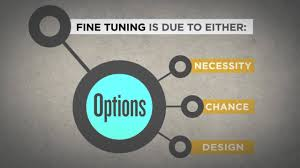
The fine-tuning of the universe has theistic implications. But as a scientific fact, it is widely accepted:
* Atheist physicist Stephen Hawking: “The remarkable fact is that the values of these numbers seem to have been very finely adjusted to make possible the development of life.”
* Atheist physicist Steven Weinberg: “Life as we know it would be impossible if any one of several physical quantities had slightly different values.”
* Astrophysicist Sir Fred Hoyle went from atheism to belief in some kind of cosmic intelligence because of the fine-tuning of the universe:
“A common sense interpretation of the facts suggests that a superintellect has monkeyed with physics, as well as with chemistry and biology, and that there are no blind forces worth speaking about in nature.”
* Physicist Paul Davies holds a form of deism or cosmic pantheism because of the fine-tuning of the universe:
“The entire universe is balanced on a knife-edge, and would be total chaos if any of the natural ‘constants’ were off even slightly.”
“On the face of it, the universe does look as if it has been designed by an intelligent creator expressly for the purpose of spawning sentient beings.”
Die Summe meiner Umwege: Warum Reue und Aussöhnung mich erst ganz machen
In der Welt der antiken Gelehrten war Pergament ein kostbares Gut, viel zu wertvoll, um es nach einmaligem Gebrauch zu entsorgen. Wenn eine Geschichte zu Ende erzählt war oder ihr Nutzen verblasste, warf man das Material nicht weg; stattdessen schabte man die Tinte mühsam ab, glättete die raue Oberfläche und überschrieb sie mit einer neuen Erzählung. Dieses wiederbeschriebene Dokument nennt man ein Palimpsest – ein griechischer Begriff, der wörtlich "wieder abgekratzt" bedeutet.
Doch das Wesen eines Palimpsests liegt in seiner Unvollkommenheit: Die alte Schrift verschwand nie ganz. In den tiefen, organischen Fasern des Leders blieben Geisterbilder und Schatten der ursprünglichen Buchstaben zurück, die unter dem neuen Text hervorschimmern und ihm eine geheimnisvolle Tiefe verleihen.
Mein Leben ist ein Palimpsest – eine Chronik der Überschreibungen, bei der jede neue Phase die alte nicht auslöscht, sondern als leisen Schatten unter die Oberfläche legt. Diese Erkenntnis befreit uns von der zerstörerischen Vorstellung, man müsse die eigene Vergangenheit auslöschen, um wieder "man selbst" zu sein. Wer diesen Weg geht, wird oft mit der Erwartung konfrontiert, eine Rückkehr zu vollziehen, als liesse sich die Zeit wie eine fehlerhafte Tonspur zurückspulen. Doch ein Körper und eine Seele, die sich radikal verändert haben, kehren nicht an einen naiven Nullpunkt zurück. Sie bewegen sich vorwärts, beladen mit der kostbaren Last ihrer Erfahrungen. Radikale Akzeptanz bedeutet in diesem Sinne, den eigenen Körper nicht als Baustelle oder Trümmerfeld einer Fehlplanung zu betrachten, sondern als dieses historische Pergament. Die tiefer gewordene Stimme, die Narben einer Operation oder die veränderten Konturen sind nicht einfach Zeichen von Verlust; sie sind die Tinte der ersten Geschichte, die tief in die Fasern unserer Identität eingesickert ist.
In dieser Schichtung liegt eine herbe, aber ehrliche Schönheit, die jedoch erst dann ihre volle Kraft entfaltet, wenn wir den Schmerz nicht verschweigen. Wir müssen anerkennen, dass das "Abschaben" der alten Identität kein rein ästhetischer Prozess ist, sondern ein Akt, der oft von Tränen und einer tiefen, fast lähmenden Reue begleitet wird. Es gibt Momente, in denen die Reue wie ein kaltes Gewicht in der Magengrube liegt und man sich fragt, warum man die Warnsignale überhört oder sich selbst diesen mühsamen Umweg zugemutet hat. Scham ist dabei oft der ständige Begleiter – die Scham vor der Welt, die es "besser wusste", und die schneidendere Scham vor der eigenen Fehlbarkeit. Doch genau hier, an diesem wunden Punkt, geben sich Scham und Aussöhnung die Hand. Eine Akzeptanz, die den Schmerz der Fehlentscheidung leugnet, bleibt oberflächlich und künstlich. Wahre menschliche Stärke entsteht erst, wenn wir die Hand unserer Reue halten und anerkennen, dass sie ein notwendiger Teil unseres Reifeprozesses ist.
Aussöhnung ist nicht das Verschwinden des Bedauerns, sondern der Friedensschluss mit der Tatsache, dass wir als Menschen das Recht haben, uns zu irren und Sackgassen zu erkunden. Die "Schattenbuchstaben" unserer Vergangenheit geben unserem heutigen Ich eine Kontur und eine menschliche Tiefe, die ein glattes, ungeprüftes Leben niemals erreichen könnte. Die Reue lehrt uns eine tiefe Demut vor der Komplexität des Daseins, und die Scham zwingt uns, unser Ego abzulegen und uns in unserer nackten, verletzlichen Echtheit zu zeigen. Wer sein Leben als Palimpsest begreift, erkennt, dass die Transition kein blosser Umweg war, sondern ein Schrei nach Authentizität, und die Detransition die schmerzhafte, aber heilende Antwort darauf ist. Beides gehört untrennbar zusammen. Sich selbst mit radikaler Ehrlichkeit zu begegnen bedeutet, den Schmerz über das Verlorene zuzulassen, ohne sich von ihm zerstören zu lassen. Es ist die erhabene Erkenntnis, dass man heute nicht trotz, sondern gerade wegen dieser Brüche und Überschreibungen eine so tiefe, ehrfürchtige Beziehung zur eigenen Existenz hat. Wenn wir in den Spiegel schauen, sehen wir kein Scheitern, sondern die Spuren eines Menschen, der mutig genug war, sich im Labyrinth der Identität zu verlieren, und ehrlich genug, den mühsamen Weg zurück zu sich selbst anzutreten.
Wir löschen nichts aus, wir fügen hinzu – wir sind die Summe aus allem, was wir jemals zu sein wagten, ein lebendiges Palimpsest, in dessen Rissen das Licht einer ganz besonderen Weisheit fliesst 🙏.
#Detransition #Selbstakzeptanz #Identität #MentalHealth #Palimpsest
Das Wunder der Einzigartigkeit: Warum es keinen "falschen" Körper gibt
Ich stehe oft fassungslos vor diesem einen Satz, der sich wie eine dunkle Wolke über unser modernes Selbstverständnis gelegt hat:
"Ich bin im falschen Körper geboren."
Je länger ich darüber nachdenke, desto mehr spüre ich, wie gefährlich, ja fast grausam dieses Narrativ eigentlich ist. Es wirkt auf mich wie eine kollektive, gesellschaftliche Hypnose, die uns dazu bringt, das Kostbarste, was wir besitzen, als einen Irrtum zu brandmarken.
Diese Gedanken sind kein theoretisches Konstrukt; sie sind das Ergebnis meines eigenen, langen Weges als Transfrau und der nun folgenden Detransition. Meine heutige Sicht hat sich durch eine intensive innere Reise geformt – eine Auseinandersetzung, die mich gelehrt hat, was es wirklich bedeutet, die Wertschätzung für den eigenen Körper zu verlieren und sie schliesslich in grosser Demut wiederzufinden.
Wenn ich sage, ich sei im "falschen" Körper, dann setze ich voraus, dass es irgendwo da draussen – oder in meiner Vorstellung – einen "richtigen" Körper geben müsste. Das hiesse, es gäbe zwei Versionen von mir: eine fehlerhafte physische Realität und ein ideales geistiges Konstrukt. Aber die Wahrheit ist doch viel simpler und zugleich viel wunderbarer:
Es gibt nur diesen einen Körper. Es gibt kein Backup, keine zweite Wahl und keinen Entwurf in einer Schublade.
Ich empfinde es heute als eine tiefe Entfremdung, dieses biologische Meisterwerk als Gefängnis oder als Fehler der Natur zu betrachten. Mein Körper hat mich vom ersten Moment an durch dieses Leben getragen. Er atmet für mich, ohne dass ich ihn darum bitten muss ... er heilt seine Wunden selbst ... er lässt mich die Wärme der Sonne spüren und den Schmerz des Verlusts. Er ist ein Wunder der Schöpfung, ein perfekt funktionierendes System, das in seiner blossen Existenz einen unschätzbaren Wert besitzt. Wenn ich ihm das Etikett "falsch" aufklebe, entwerte ich mein gesamtes Fundament. Ich beginne, meinen eigenen Körper mit Misstrauen und Ablehnung zu betrachten, anstatt ihm mit der Ehrfurcht und Sorge zu begegnen, die einem solchen Geschenk gebühren.
Aus ethischer und medizinischer Sicht macht mir diese Entwicklung Angst. Wir leben in einer Zeit, in der alles als gestaltbar, formbar und verbesserungswürdig gilt – ein Symptom unserer masslosen Optimierungsgesellschaft - Der Körper wird nicht mehr als heiliges Geschenk betrachtet, sondern als Rohmaterial, das wir nach unseren Wünschen zurechtstutzen oder umbauen können. Wir unterwerfen uns einem Diktat der Perfektion, das uns vorgaukelt, wir müssten erst "passend gemacht" werden, um dazuzugehören. Doch diese ständige Jagd nach dem "richtigen" Äusseren führt uns weg von der Dankbarkeit und hin zu einer tiefen inneren Leere.
Wir behandeln gesunde Körper wie fehlerhafte Produkte, anstatt den Geist zu heilen, der unter dem Druck einer vorgegebenen Welt zerbricht.
Wenn wir behaupten, im falschen Körper zu sein, wer ist dann das "Ich", das das behauptet? Wir spalten uns in einen Beobachter und ein Objekt. Doch Heilung findet niemals in der Spaltung statt, sondern nur in der Ganzwerdung.
Wer seinen Körper als Irrtum deklariert, entzieht seiner eigenen Seele den Boden, auf dem sie stehen kann.
Echte Selbstliebe beginnt für mich genau an dem Punkt, an dem ich aufhöre, Bedingungen an meine Existenz zu knüpfen. Sie ist kein Ziel, das ich erreiche, wenn ich endlich "optimiert" bin. Wahre Selbstliebe ist die radikale Entscheidung, Frieden mit dem zu schliessen, was ist. Es ist der tiefe Respekt vor diesem treuesten Gefährten, der die Manifestation meiner Existenz ist.
Ich möchte für eine Rückkehr zur Ehrfurcht werben. Wir müssen aufhören, jungen Menschen einzureden, ihr Körper sei ein biologischer Unfall oder ein Hindernis auf dem Weg zu ihrem "wahren" Ich. Wir sollten ihnen stattdessen beibringen, wie man dieses Wunder bewohnt, wie man es pflegt und wie man die Einzigartigkeit der eigenen Physis feiert.
Wahre Freiheit liegt für mich nicht darin, meinen Körper zu verändern, bis er einem Bild im Kopf entspricht, sondern darin, meinen Blick so weit zu heilen, bis ich erkenne:
Ich bin in diesem einen, wunderbaren Körper bereits vollkommen zu Hause. Er ist nicht falsch – er ist mein Leben ...🙏
#SelfLove #BodyPositivity #BiologieFakten #Körperstolz #Ideologiekritik
An infallible recipe for poor mental health and lifelong unhappiness is believing that unless the entire world validates your self-perception, it hates you. If you move through life telling yourself that unless you can force other people to play along you'll 'be 'erased', if the slightest hint that another person doesn't see you the way you've labelled yourself feels like an attack on your very existence, your life will be spent in a state of miserable insecurity and fragility.
Would I like to 'let go' of my femininity? Willingly; femininity is the set of stereotypes imposed on women by men. Would it 'make me feel like dying'? Of course it wouldn't.
Vulnerable young people are being harmed by your kind of hyperbolic language, which promotes the lie about the inevitability of suicide among the gender-questioning unless they're given often irreversible medical interventions. Rhetoric like this flies in the face of everything we know about mitigating suicide risk among those with mental health issues and it's particularly gruesome when done by self-congratulatory people on Twitter whose banner picture is 'be kind'.
🚨 A Scottish drag queen who co-authored a guide for "trans youth" has been convicted of distributing images and videos of newborn babies being sexually abused.
Andrew Easton is the second convicted pedophile to be linked to LGBT Youth Scotland.
https://t.co/UQZHg8SXuk
One of the most influential of "Evangelicals for Harris"
Bishop Claude Alexander is the chair of Gordon-Conwell Theological Seminary's board of trustees and sits on the boards of Christianity Today, Council for Christian Colleges and Universities (CCCU), InterVarsity Christian Fellowship, BioLogos, and other large organizations.
Theologian Richard B. Hays says God changed his mind on LGBTQ+ issues:
“It may be difficult to get our minds around this idea, but if we take the biblical narratives seriously, we can’t avoid the conclusion that God regularly changes his mind, even when it means overriding previous judgments.”
This is exactly what J. Gresham Machen famously condemned a century ago. This kind of liberalism is not a different form of Christianity—it is a deliberate replacement of Biblical Christianity with a completely new religion."
https://t.co/RrayNzfXx8
British evolutionary biologist Richard Dawkins has his entire Facebook account DELETED after posting on 𝕏 about Olympic boxer Imane Khelif having male chromosomes.
“My entire Facebook account has been deleted, seemingly (no reason given) because I tweeted that genetically male boxers such as Imane Khalif (XY undisputed) should not fight women in Olympics. Of course my opinion is open to civilised argument. But outright censorship?”
Despite not posting about Khelif on Facebook itself and only making the comments on 𝕏, his account has been deleted.
Seems like a good time to re-post my older (now edited) post about athletes with XY DSDs (Disorder, or Difference of Sex Development). Lots of graphs and detail about the relevant biology at the end.
* * *
First: People living with DSDs should be treated with compassion and understanding, and receive any heath care they need. These can be challenging conditions for individuals and their families. But when male athletes have DSDs that give them an advantage over females, and they compete in the female category, this raises concerns about safety and fairness, and forces discussion of the relevant physical traits.
Athletes with XY DSDs who have testes (usually internal), XY sex chromosomes, male-typical levels of testosterone, and functional androgen receptors are often described as females with "hyperandrogenism," i.e., abnormally high levels of testosterone. They experience physical benefits of this high testosterone during puberty, which translate into athletic advantages over females. The issue for sports is that athletes with the XY DSD 5-alpha reductase deficiency (5-ARD), may be socialized as female, may be legally female, and may live and identify as female; but they are male.
These individuals are usually born with female-appearing genitalia, which can lead to being sexed as female. Here's why. 5-ARD is caused by a mutation in the gene that codes for the enzyme 5-alpha reductase, which converts testosterone into a more potent androgen, DHT. This androgen interacts with the androgen receptor, like testosterone, and is necessary for the typical development of male external genitalia (penis and scrotum) and the prostate. Without DHT, female-typical external genitalia develop. At the end of this monster post is a graphic of the relevant steroid production pathway, from my book T: The story of Testosterone.
DHT is also responsible for male-pattern baldness and dark, coarse facial hair, which is why people with the condition have smooth skin that can give a feminine appearance.
The “decision makers” are aware that athletes with 5-ARD are male, and that they experience the benefits of male puberty. The requirement to reduce their testosterone to typical female levels isn’t discriminatory, since these are males who are asking to compete in the female category. But more significantly, all the relevant scientific evidence shows that reducing male T in adulthood does not undo the physical benefits of male puberty.
Here's more detail about T, DHT, and male advantage in strength and speed.
I've been asked if men with the DSD 5-ARD (in which ppl cannot convert testosterone into the more potent androgen DHT) experience the typical benefits of male puberty, that would give them an advantage in strength and speed relative to women. This is relevant to questions about whether male athletes with 5-ARD should be allowed to compete in the female category. This is an excellent question, because it could be the case that DHT is necessary for the development and maintenance of male-typical muscle, lean body mass and strength. If that were the case, then people with 5-ARD might not have a typical male advantage, because the lack of DHT would perhaps lead to a more feminine pattern of fat, lean body mass and strength. I've wondered about this myself and have looked into the evidence.
Perhaps the top researcher in this area, Shalendar Bhasin, who is scrupulous in his methods, has examined this very question. The answer appears to be: no, testosterone does not need to be converted to DHT to exert its typical anabolic effects. These findings are reported in his 2012 study, "Effect of Testosterone Supplementation With and Without a Dual 5α-Reductase Inhibitor on Fat-Free Mass in Men With Suppressed Testosterone Production, A Randomized Controlled Trial." (It is linked to below—and since it's paywalled, I've included the graphs that show comparisons between the placebo and DHT— inhibited conditions, with no difference on the various outcomes.)
For more detail, the investigators wanted to examine the effects of suppressing DHT on muscle mass, strength, and sexual function. This important because one of the treatments for benign prostatic hyperplasia and male-pattern baldness is to suppress DHT, but clinicians have been concerned about effects on other outcomes that affect health and quality of life. Participants (healthy men, 18 to 50, with normal T levels) had their T blocked, and were given graded doses of T, along with either placebo or a drug that blocked the conversion of T to DHT. So both groups had T, but only one, the placebo group, also had DHT. After 20 weeks of treatment, changes in lean body mass, muscle, and strength were assessed. There were no significant difference between the placebo and DHT-blocked groups in these outcomes.
For LOTS more detail, here's the relevant text from the results. Please don't ask me questions about the study. Just look at the abstract and results which you can find by Googling. The main point is that while there are predicted effects of the different doses of T received, there were no differences in the outcomes according to whether they had DHT blocked (with dutasteride) or not (placebo). "Fat-Free Mass Fat-free mass and lean body mass increased in a dose-dependent manner in the placebo and dutasteride [THIS IS THE DRUG THAT BLOCKS CONVERSION OF T TO DHT] groups (Figure 2).
The changes in fat-free mass were related to testosterone dose and changes in testosterone concentrations in the placebo and dutasteride groups but did not differ between groups; the dose-adjusted mean difference (placebo minus dutasteride) in fat-free mass was 0.50 kg (95% CI, −0.22 to 1.22 kg; P = .18). There was no significant interaction between testosterone dose and randomization to dutasteride or placebo, indicating a lack of evidence that the relationship of testosterone dose to change in fat-free mass differed between the dutasteride and placebo groups.
The model-based smoothed regression lines, obtained by generalized additive models, describing the relationship between changes in testosterone concentrations and changes in fat-free mass and lean body mass were similar in the placebo and dutasteride groups. Changes in fat mass were negatively related to testosterone dose and concentrations, but the relationship between change in fat mass and dose did not differ significantly between the placebo and dutasteride groups (P = .41; Figure 2)."
"Muscle strength Leg-press and chest-press strength increased dependently by dose in the placebo and dutasteride groups. Increases in leg-press and chest-press strength were greater with larger doses and higher concentrations of testosterone. These relationships did not differ between the placebo and dutasteride groups (Figure 2)."
Really interesting commentary from the authors on the role of DHT in adult men: "Why then did the steroid 5α-reductase system evolve for androgens? Forty-six XY males with steroid 5α-reductase deficiency exhibited ambiguous or female external genitalia at birth and poor prostate development, but underwent normal muscle and bone development during pubertal transition. The phenotype of these patients suggests that steroid 5α-reductase plays an essential role in the development of prostate and phallus by providing local amplification of an androgenic signal without systemic hyperandrogenemia during critical periods of sexual differentiation, illustrating nature's extraordinary ingenuity in creating mechanisms for tissue-selective amplification during development.
We speculate that in adult men, in whom this tissue-specific amplification is not essential because the circulating testosterone concentrations are substantially higher than those in the fetus, testosterone and DHT can interchangeably subserve many androgenic functions. When circulating testosterone concentrations are low, intraprostatic DHT formation may become important in maintaining prostate growth, thus buffering the effects of decreasing testosterone levels, which has been suggested by Marks et al.
Our data are consistent with studies that have reported no effects of 5α-reductase inhibitors on muscle or bone mass. Inferences from these trials are limited by the fact that administration of 5α-reductase inhibitors increases testosterone levels, rendering it difficult to ascribe the outcomes to differences in DHT levels alone. In our trial, inhibition of endogenous testosterone by administration of a gonadotropin-releasing hormone agonist eliminated this problem. Additionally, the high-dose dutasteride regimen effectively inhibited both steroid 5α-reductase isoenzymes."
Avoid the intersex trap.
So long as activists have you on the defensive making difficult judgement calls on various medical anomalies, they’ve succeeded in drawing your attention away from making easy calls on unquestionably male athletes.
https://t.co/CNJWhl1BEJ
In "Love Thy Body" Dr. Pearcey does great work that will help people understand the exceptionally and exceedingly rare phenomena of humans born with intact intersex characteristics.
In rare cases, doctors and parents can be mistaken about kids with DSD (intersex).
In my book Love Thy Body, I tell the stories of two people who were raised as the opposite sex, and who discovered only as adults that they were intersex.
A man who was raised as a girl--and as an adult recovered his identity as a man.
And a women who was raised as a boy--and as an adult recovered her identify as a woman.
Just a note: athletes with XY DSDs like 5ARD are not properly described as 'female athletes with *unusually high* levels of testosterone.'
They are male athletes with *normal* levels of testosterone, and the virilizing effects of that, including male physiological advantage.