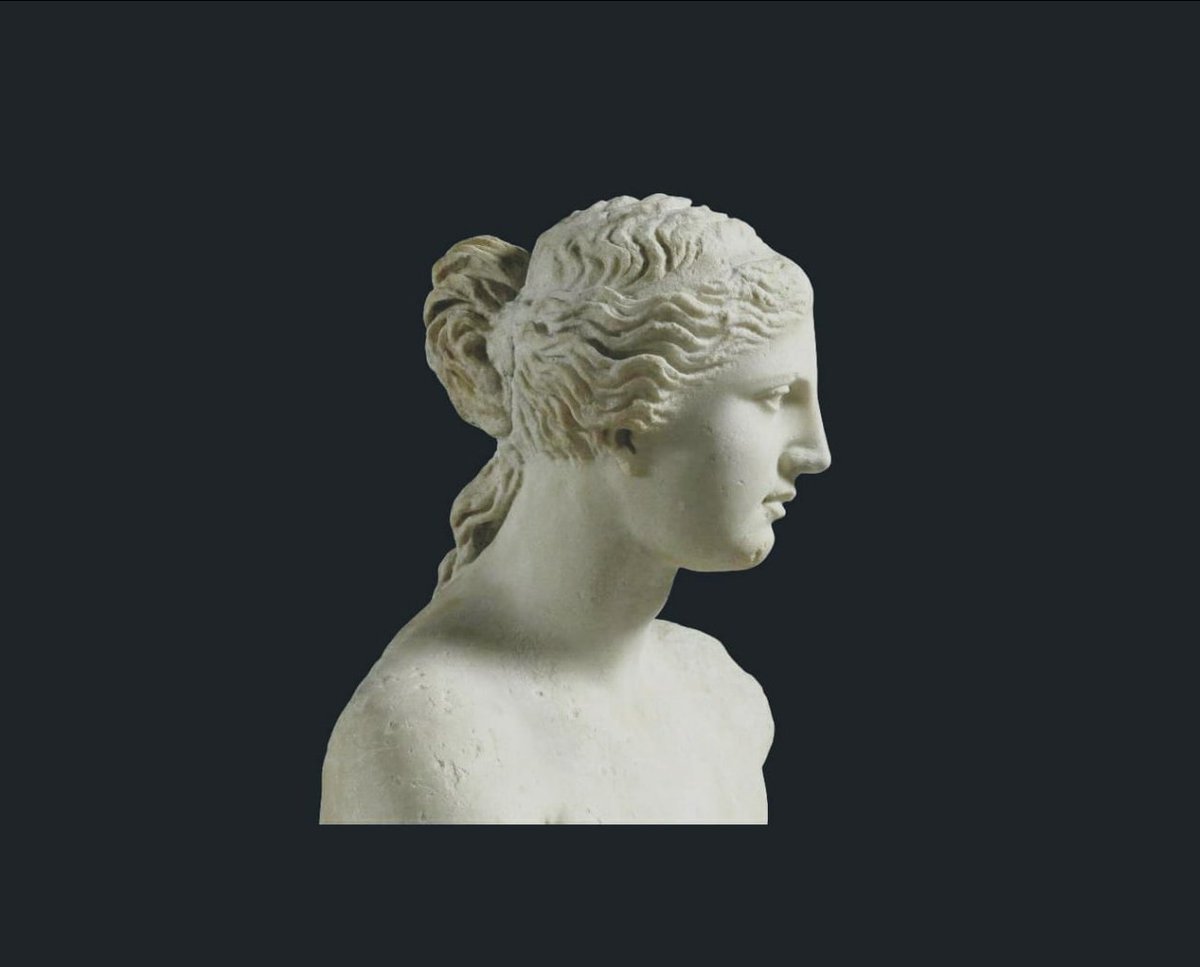
Phdr. 251a can be read as a small dramaturgy of recollection, in which the difference between one who has been initiated and one who has been corrupted consists not so much in whether or not one experiences desire, but rather in the orientation each gives to what he experiences.
The success of Christianity in the West can almost entirely be attributed to a Aristotelian, Platonic, and Hermetic core. Each time it had a revival (and I don’t mean the American kind), these were always at the forefront. Its dissolution in the West is endemic to Yahwism itself.
The hypostases for Plotinus per the Divided Line of Plato, are "levels of the self," different modes of cognising reality. Not a series of different "worlds." The material world is nothing other than the visibility of the Forms. No dualism between sensible/intelligible "worlds."
Rep 375e–376c. From the canine beast (θηρίου) to the noble dog (τῶν γενναίων κυνῶν), taming, or rather, correcting, the phaedric black horse. The multitude barks at reason; others ride.
We keep asking how the many come from the one, as if the many were a fall, a thinning, a coming-apart that has to be explained and forgiven. But look again at what the word divine even points to. A God (every God) is nothing other than the one as it is shared, as it holds a world together from within. The many are not the one broken up. The many are the one wherever it gives itself, and it gives itself fully each time.
Thales is getting more interesting all the time. I wasn't aware that Vassallo had read in one of the Herculaneum fragments that "this man [Thales] calls for the first time 'One' [the principle]," (Hermes 143.1 (2015), p. 103).
Let us suppose, then, that the smoke is only a longing, a dependency and nothing more. If it were so, would it not look the same wherever the longing turns up? Since the longing is one thing, the same hunger of the same body for the same plant. So does it look the same? Bring three men, smokers, into the room where a moment ago you were watching yourself and your pipe, and observe them. One of them is you.
Read the full essay in the replies.
There is a difference between saying a name and calling one. A description is said *of* a thing �� it holds whether or not anyone is listening, a word that points from outside. But some names do not point. They wait. They mean nothing until something turns and answers to them, and then they mean everything. So when we look for what is highest, perhaps we are not looking for the truest thing said *about* it. Perhaps we are looking for the name it answers to.
We assume that if two stories tell of the same thing in opposite ways, one of them must be lying — or that, at most, we are allowed to keep one and let the other go. But is it so? The rule that opposites cannot both stand holds for things that are what they are by standing against each other, here, in one place, at one time. Whatever pours out its powers across more than one order is bound by no such rule. So the quarrel was never between the stories. It was in us, asking them to share one place — when they don't belong there together.
Difference usually reads as falling-off. The further from the source, the more scattered, the more diluted — as if every distinction were a small loss of the original light. But watch what happens if you press it. A source that grows poorer the more it gives was never giving; it was leaking. The kind that stays whole while pouring out, that is more itself in each thing it becomes — for that one, difference is not the loss of unity. It is unity finally doing something.
Black metal taught me something the textbooks bury: that the harsh and the sacred are not opposites. Beneath the noise there is almost always a single held tone, a drone the chaos is built upon and keeps returning to — you stop hearing it until it stops, and then everything collapses. The din is not the enemy of the one note. It is how the one note fills a room. I have come to suspect the world is scored the same way, and that what sounds like dissonance is mostly our seat being too close to the strings.
So maybe what we are looking for is not some higher predicate after all. For, from what I can see, a predicate is said of something, that is, whether or not anyone hears it, it stays a word that says something. If my thought holds, then what survives every dissolution must be of some other "kind", not what is said of, but what is called upon, what only stands when something can answer. Put plainly: the name that lasts, if we can claim there is such a thing, would probably be a proper name, one that lives in the vocative.
But if we look more carefully, itself seems to say a kind of holding toward what is its own, that is, a sameness coming toward the one. And the moment sameness comes toward it, the one is plainly no longer simply one, but "becomes" a one that has undergone something — πεπονθὸς is the word Proclus uses — a one, so to speak, that has taken on a relation. So, if I follow this through, I think what survived the dissolution was not the prior, but the same dissolution one step further in.
@true_concinnity 4/4 I followed this further than three posts allow — the whole movement, and where the Alcibiades comes in — here, with your essay as its occasion: https://t.co/S85aTlTRRH
3/4 In the Alcibiades, Socrates says the eye sees itself only by looking into another eye, into the seeing in it; and the soul knows itself only by looking into what is most divine in another. A God is reached the same way — not by the description that would fit, but by the recognition of like for like, the divine in us turning toward the divine that was already there. The description arrives late, and finds someone already present.