Upcoming releases of FSD will remember your parking preferences, so that the car goes to the right location at your home, office, school drop off, etc.
Destination parking is by far the biggest reason people now intervene with FSD. Critical safety interventions are extremely rare.
@zerohedge True.
That is why Bitcoin is based on energy: you can issue fake fiat currency, and every government in history has done so, but it is impossible to fake energy.
Let's talk about women and higher education.
First, the argument that women need higher education so they can raise godly sons actually goes back to the French Revolution period. Proto-feminists and revolutionaries sought to destroy Christian families, so they used this nefarious line often: "A woman needs to have a university education outside the home if she is to raise godly sons."
This was a subtle maneuver. What they really wanted was to brainwash the girl whilst away from her Christian father's authority. This is why Marxists and Bolsheviks targeted and infiltrated education. Women off at school are easy prey for leftists.
Second, Scripture is clear that young women should not leave their father's protection/headship, which means his household, until she is passed on to the headship of the husband at the altar. There should not be a period of "single womanhood" wherein she lives outside the authority of a head.
Third, single women should not be encouraged to go get an advanced degree (you get a degree to get a job outside the home, obviously a man's domain, biblically speaking). If her main vocation/calling is motherhood, it's obvious you learn that in a home with a mother, not off at college. Let's be real: College is for training workers in the workforce. Women aren't called to do that.
This whole notion that you should get married, but until then go find a career so you don't waste your time, is not what women are called, biblically, to do. Now, this does not mean she "doesn't work." She can assist her father in myriad ways within the productive household, and her mother as well.
Fourth, young women should be instructed, in line with Paul (1 Tim. 5:14; Titus 2) to continue serving in the household, with headship, under a godly mother. The best place for her to learn how to be a mother is in the home, with a mother.
Fifth, her father should actively seek a husband for her. He plays a pivotal role in vetting suitors, even as Abraham sought a wife for his son, Isaac.
Sixth, when women pursue degrees, rack up debt, and then chase careers, this actually hurts their marriageable status—men would have to inherit a boss babe, debt, etc. They're also far busier advancing in business, which often prohibits them from spending time looking for a spouse. And they become wildly independent, which makes them unsuited for a role in which submission is the main ingredient.
“If your roadmap is longer than the gap between model releases, you're planning around constraints that may not exist by the time you ship.”
Read that a couple times and internalize it.
The PM job used to be "figure out what's possible, then plan around it for 6 months."
That assumption worked when the technology underneath your product moved slowly. Cat Wu runs product for Claude Code at Anthropic. She tested every new model by asking it to add a table tool to Excalidraw. Sonnet 3.5 failed. Opus 4 occasionally succeeded. Opus 4.6 does it reliably enough to demo live in front of thousands of developers. That progression happened in 16 months.
METR measures this with time horizons: how long would a task take a human expert that AI can now complete half the time? Sonnet 3.5 (new) in October 2024: 21 minutes. Opus 4.6 in February 2026: roughly 14.5 hours. A 41x jump.
If your roadmap is longer than the gap between model releases, you're planning around constraints that may not exist by the time you ship.
Her team's response is worth studying. They replaced long-term roadmaps with "side quests," short self-directed experiments anyone on the team can run. Claude Code on Desktop, the AskUserQuestion tool, and todo lists all started this way. Someone prototyped it, internal users liked it, they shipped it.
The most telling detail: when they first launched todo lists, the model couldn't reliably check off completed items. They added system prompt hacks to nudge it. Next model generation, the behavior came for free. They deleted the hacks. Their system prompt shrank 20% with Opus 4.6 alone.
This is the part most PMs miss. Every workaround you build to compensate for a model limitation becomes dead weight the moment the next model drops. The simpler your implementation, the faster you absorb the next capability jump.
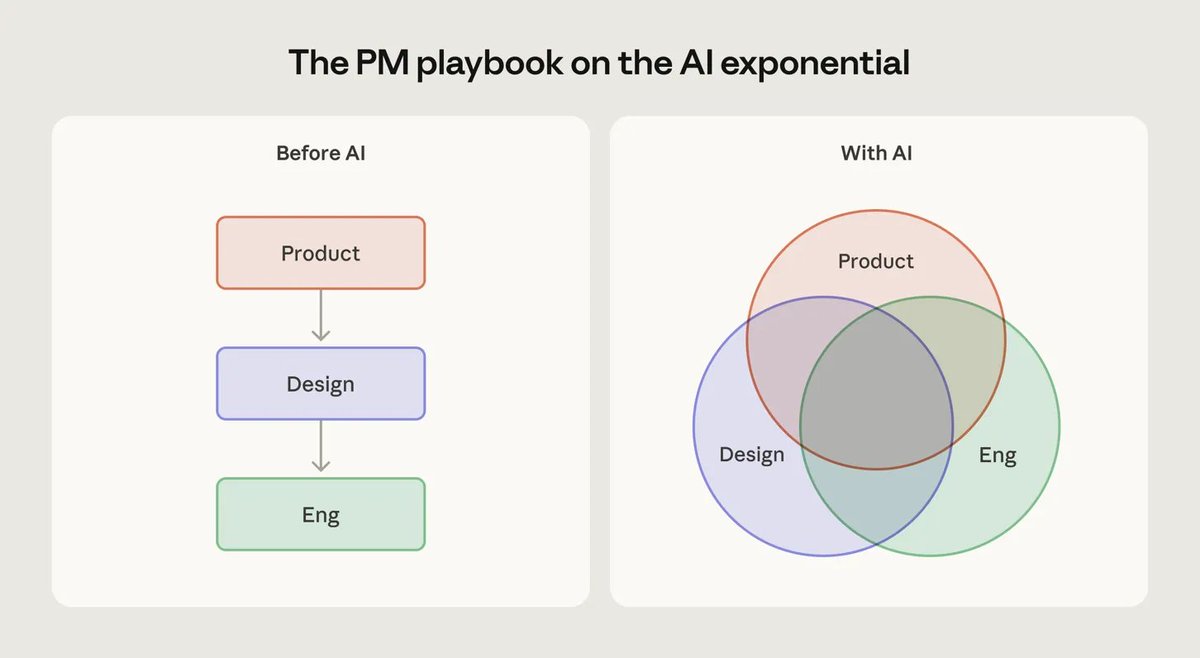
The Venn diagram in the image tells the structural story. Before AI: Product hands to Design hands to Eng, sequential. With AI: all three overlap. Designers ship code. Engineers make product calls. PMs build prototypes. The handoff chain collapses because the cost of building a working demo dropped to an afternoon.
Any PM still writing 30-page PRDs before touching a prototype is optimizing for a world where building is expensive. That world ended about 12 months ago.
In the depths of the 2022 crypto winter, our average cost basis was $30K while $BTC traded nearly 50% below it at $16K. What did we do? We bought more.