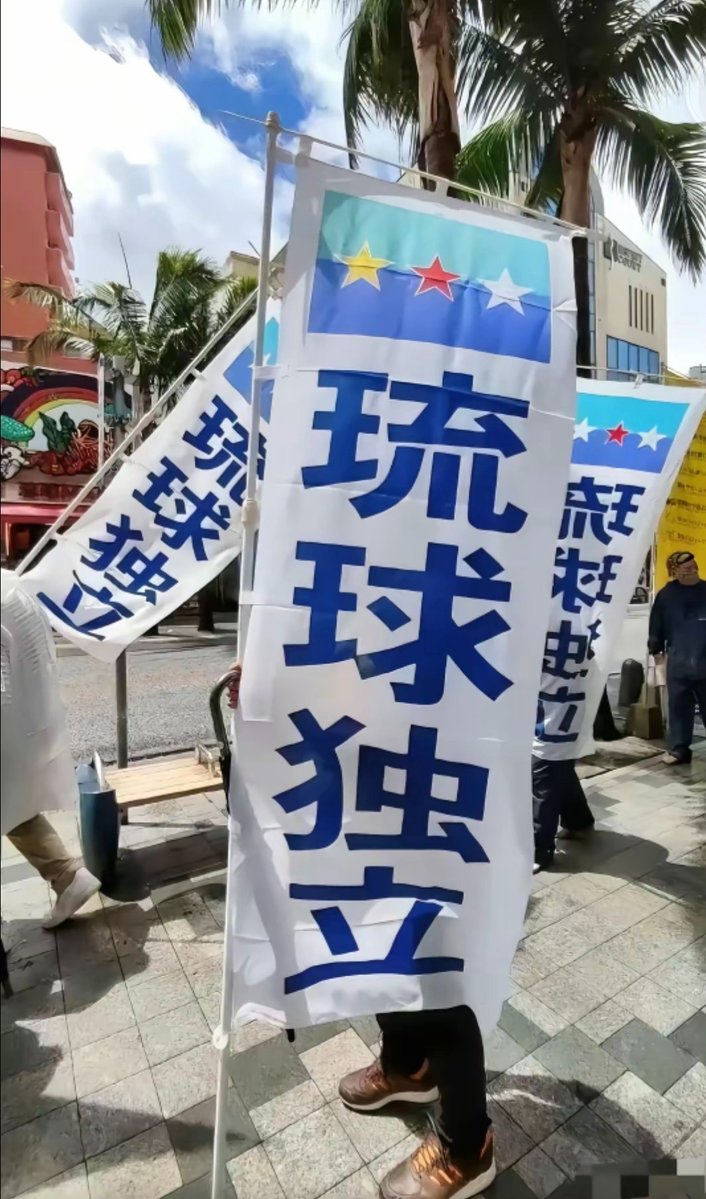
🇮🇳 More disgrace from Indian tourists.
Lazy ass fully-abled body Indian air passengers are now showing up all over 🇨🇳 Chinese airports, seen abusing and straining valuable wheelchair services reserved only for the very frail and disabled passengers. 🤬
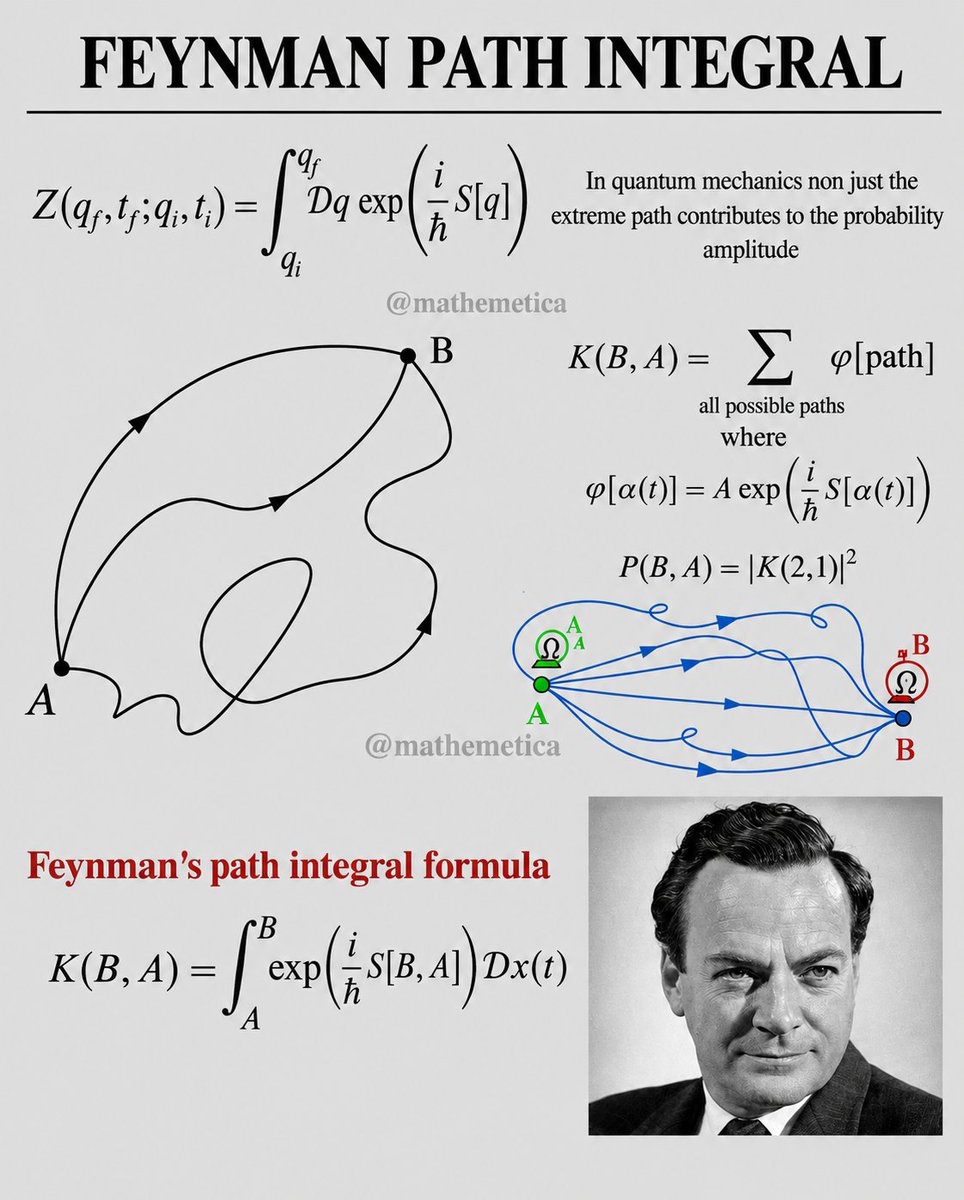
Why does nature sum over every conceivable path a particle might take, not just the shortest one?
In the Feynman path integral the amplitude from A to B is the sum of exp(iS/ℏ) over all paths. Wild paths cancel by interference; the classical path remains. This underpins quantum field theory and enables simulations in quantum computing and materials science.
The universe computes by letting every possibility interfere.
What Does a Quantum Particle's Wavefunction Look Like?
A quantum wavefunction is not simply an ordinary wave oscillating up and down. It is a complex-valued mathematical function. Its real and imaginary parts can be visualized as two perpendicular oscillations, forming a rotating helix when plotted together. This is a representation of quantum phase, not the physical shape of a particle.
For a free, non-relativistic particle, the dispersion relation is ω(k) = ℏk²/2m. Its wavepacket travels at the group velocity, twice the phase velocity. Because different momentum components travel at different speeds, a localized Gaussian wavepacket spreads over time: σ(t) = σ₀√[1 + (t/τd)²].
This mathematics has experimental foundations. Electron diffraction, C₆₀ fullerene interference and ultracold atomic gases demonstrate the wave nature and evolution of quantum matter. What we observe experimentally are interference patterns and probability distributions, not the wavefunction itself.
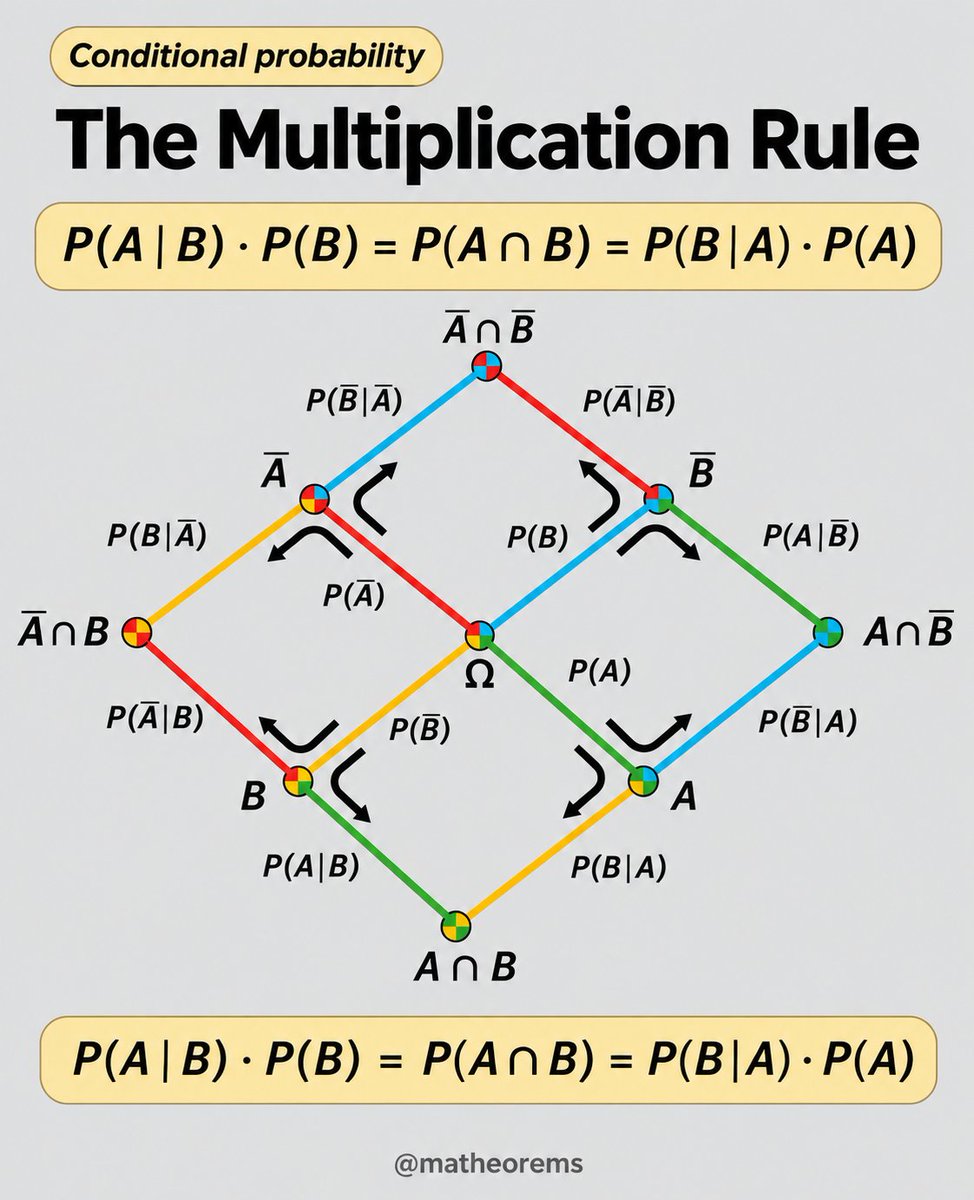
Joint probability isn't free; it multiplies condition into chance.
P(A ∩ B) = P(A | B) · P(B), and the same product appears as P(B | A) · P(A). The diagram traces every path: from the full space through A or B into their overlap, or out into the complements.
Each arrow carries a conditional that shrinks or expands the remaining probability. Reverse the order and the numbers still lock together; the intersection stays fixed while the route changes.
The rule forces dependence into plain arithmetic.