How to Get Inbound Job Offers in Tech
Most candidates spend months chasing opportunities.
Then there's a small group of people who consistently get 3 to 5 inbound opportunities every month.
Not even kidding.
At ClanX, we receive close to 15,000 applications every month, and I personally speak with hundreds of candidates.
Over the years, I've noticed that the candidates who get the most inbound opportunities don't necessarily have the best resumes, the biggest companies on their profile, or the most years of experience.
They simply make themselves easier to discover and even easier to trust.
Here are some of the biggest lessons I've learned from them:
1. Treat LinkedIn or Twitter like a build log
Most engineers, designers, and product leaders spend time on LinkedIn or Twitter.
That's where recruiters, founders, hiring managers, and future teammates are already paying attention.
Share what you shipped this week.
Share what broke.
Share what you'd do differently.
I've seen candidates get interviews because they wrote one thoughtful post about a strange bug they solved.
2. Comment before you post
Find five people in your field whose work you genuinely respect.
Leave comments that add something useful.
Not "Great post!"
Headhunters spend more time in comment sections than most people realise. Seeing your name attached to useful insights helps you stand out.
3. Reach out to founders you genuinely admire
Don't message everyone who's hiring.
Find founders whose work interests you.
Tell them specifically what you like and why.
Don't ask for a job in the same message.
The best founders can tell the difference between genuine interest and a copy-paste pitch.
4. Build one side project that solves a real problem
Not another to-do app.
Build something that solves a problem you or someone else actually faces.
Keep working on it.
Commit regularly.
Share progress publicly.
In many interviews, I've spent more time discussing a candidate's side project than their day job.
5. Contribute to open source
Pick projects you already use.
Start with small pull requests.
It doesn't need to be a massive contribution.
Open source work is proof of your skills that exists outside your company's NDA.
6. Attend meetups to learn, not to network
People can tell the difference.
The most meaningful connections happen when you're genuinely curious.
Ask thoughtful questions.
That's often enough.
7. Help people without keeping score
Answer questions.
Review resumes.
Refer friends.
Share opportunities.
People may forget who liked their post.
They rarely forget who helped them.
8. Mentor someone a few steps behind you
Teaching exposes gaps in your own thinking.
It also expands your network naturally.
I've seen mentees recommend their mentors to hiring managers more often than you'd expect.
9. Make your work easy to find
Most people have done good work.
Very few can show it.
Keep an updated portfolio, GitHub, personal website, case study, blog, or project showcase.
When someone lands on your profile, they should be able to understand what you've built in under two minutes.
10. Be known for something
The person who's decent at everything is easy to forget.
The person who's known for one thing becomes the first person people think about when that topic comes up.
Pick your thing.
Own it.
You don't need to do all 10.
Pick 2 or 3 and stay consistent for the next few months.
Most inbound opportunities are the result of work you've done long before you start looking for a job.
Happy to answer any specific questions in the comments.
Top 20 results of this season. (SME)
Vinyas
Jd cables
lt elevator
Airflow
ShreeRef
Ztech
Prizor
Abs marine
Viviana power
Parmeshwar metal
Indosmc
Adisoft
Aimtron
krm ayurveda
B.R goyal
Vision infra
Utssav CG gold
Apex ecotech
Yash highvoltage
Sahana system
@grok filters the top 3 companies among them that look best for good returns.
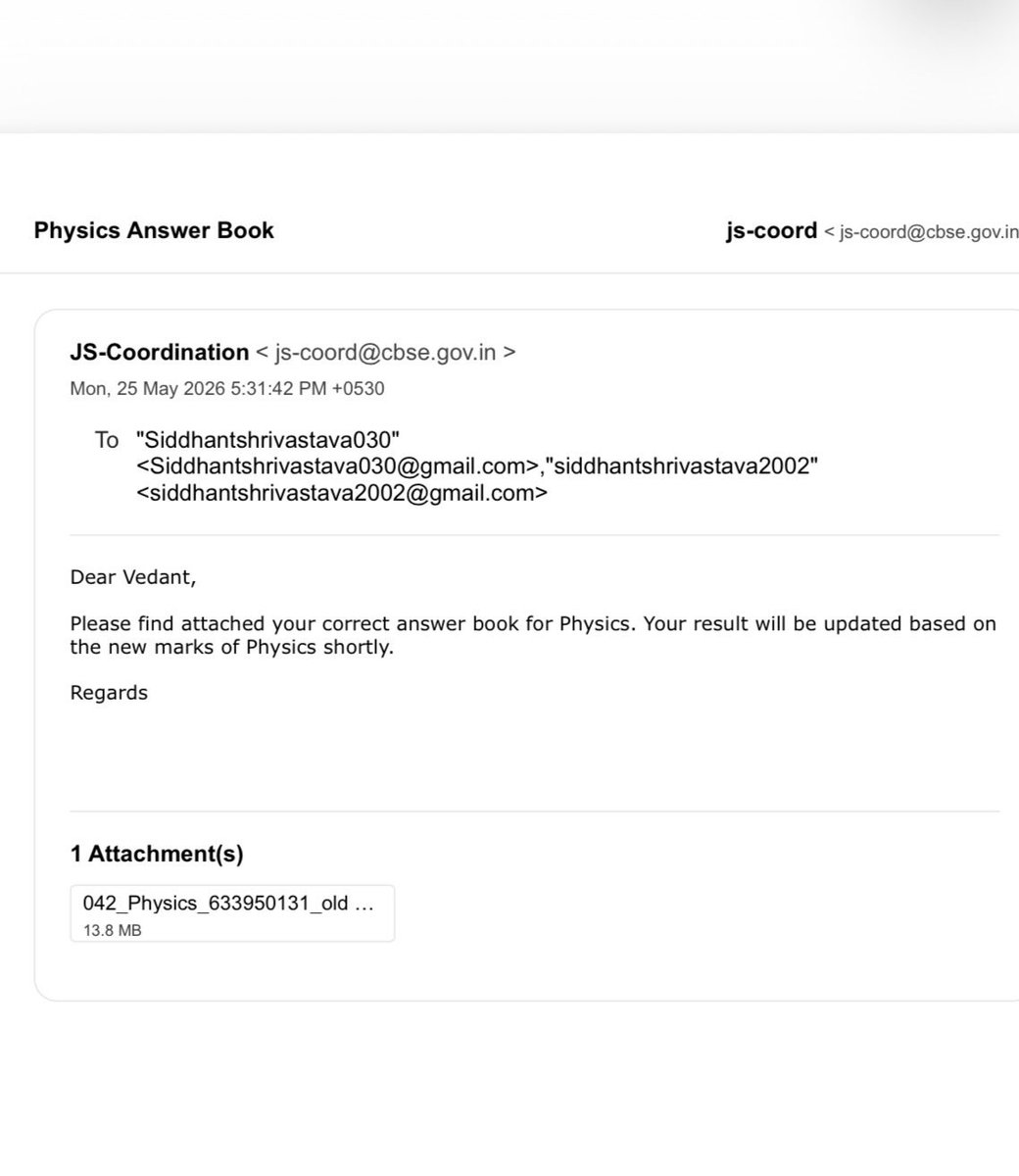
JS-Coordination wrote to Vedant today attaching his correct answer book and confirming that
-The error was real.
-The student was right.
For all those who thought a young 12th class student was a ‘Pakistani’ - Govt of India doesn’t think so. CBSE has accepted the mistake and issued him his answer sheet.
It is disturbing how brainwashed a country can become when a 17-year-old, merely for raising a valid complaint about CBSE on X and speaking to media, is branded “Pakistani” and “anti-national” just to protect corruption
> Someone posts about wrong paper checking - he is pakistani
> Someone posts about Jaisalmer cows death - he is deep state agent
> Someone posts about on going petrol price hike - he is anti national
What’s going on? I have a strong feeling there is a cult out there trying to discredit everything and every-time you raise a question. For reasons unknown to me. But this is very concerning. How can every question is related to deep state pakistan etc.
@vineetJindal19 Thank you, Sir. Meanwhile can you also report about these well paid clowns in Doordarshan using taxpayers money to declare Indian kids as Pakistanis. It’s a known fact that he is a BJP agent masquerading as a journalist. But this is too much. Silencing Indian youth is anti India.
~NEET पेपर लीक - कोई आवाज नहीं
~पेट्रोल डीजल मंहगा - कोई आवाज नहीं
~रुपया की गिरावट - कोई आवाज नहीं
~भयानक मंदी की आहट - कोई आवाज नहीं
~नौकरी पर खतरा - कोई आवाज नहीं
लेकिन "मेलोडी टॉफी" पर सुबह स�� हंगामा काटे हुए हैं।
पता नहीं क्या मजबूरी है इनकी, जो इनको शर्म भी नहीं आती है?
NEET मामले में आज चौथी आत्महत्या की पुष्टि हो गई। @dpradhanbjp इसका रक्त तुम्हारे और @narendramodi के हाथों पर है। और मैं कह रहा हूँ 21 जून के बाद तुम देखना यह संख्या कहाँ जाती है।
गोवा के लड़के के बाद ��े तीन और नाम जुड़ गए हैं।
Anthropic pays engineers $750,000+ a year to understand how LLMs work.
Stanford just put a 2 hour lecture that covers 80% of it for FREE.
Bookmark this. Give it 2 hours today.
It might be the highest ROI thing you do this month:
The reading list that taught me how to think about agentic architecture.
Bookmark this.
1. Brewer's CAP Theorem (2000) — trade-off thinking
2. Netflix Hystrix docs — circuit breaker pattern
3. Martin Fowler: Saga Pattern — distributed rollback
4. The Twelve-Factor App — stateless service design
5. AWS Well-Architected Framework — blast radius thinking
6. "Thinking in Systems" — Donella Meadows
7. Designing Data-Intensive Applications — Kleppmann
8. Google SRE Book Ch.13 — cascading failures
9. OWASP LLM Top 10 (2025) — agent attack surfaces
10. Anthropic: Building Effective Agents (2024)
11. LangGraph docs — stateful agent patterns
12. Microsoft AutoGen paper — multi-agent orchestration
13. Gartner: Agentic AI Hype Cycle (2025)
14. EU AI Act Article 14 — human oversight requirements
Classic distributed systems stuff.
Applied to the next layer of the stack.
Follow for annotated breakdowns → @asmah2107
While waiting for DeepSeek V4 we got two very strong open-weight LLMs from India yesterday.
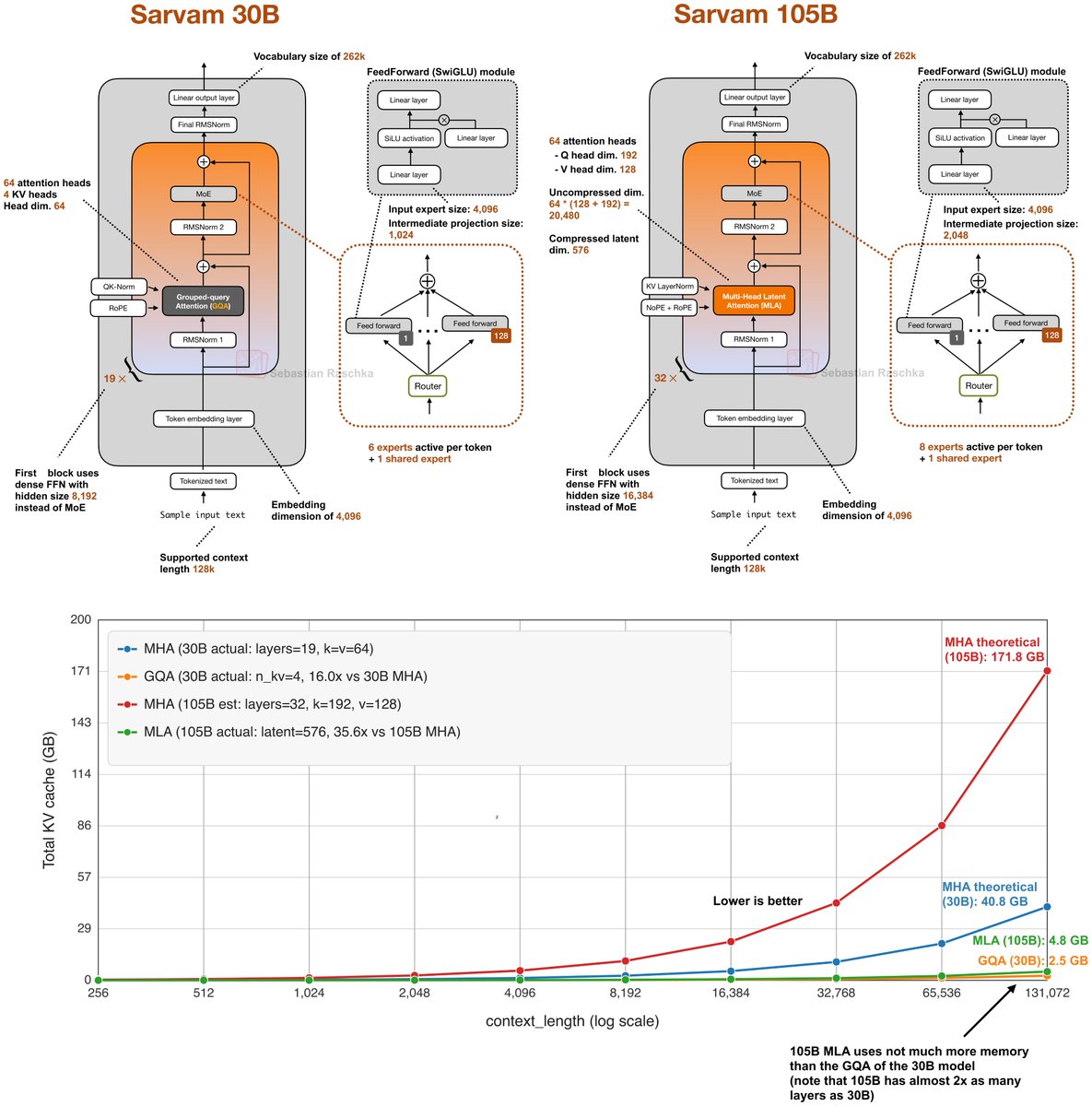
There are two size flavors, Sarvam 30B and Sarvam 105B model (both reasoning models).
Interestingly, the smaller 30B model uses “classic” Grouped Query Attention (GQA), whereas the larger 105B variant switched to DeepSeek-style Multi-Head Latent Attention (MLA).
As I wrote about in my analyses before, both are popular attention variants to reduce KV cache size (the longer the context, the more you save compared to regular attention).
MLA is more complicated to implement, but it can give you better modeling performance if we go by the ablation studies in the 2024 DeepSeek V2 paper (as far as I know, this is still the most recent apples-to-apples comparison).
Speaking of modeling performance, the 105B model is on par with LLMs of similar size: gpt-oss 120B and Qwen3-Next (80B). Sarvam is better on some tasks and worse on others, but roughly the same on average.
It’s not the strongest coder in SWE-Bench Verified terms, but it is surprisingly good at agentic reasoning and task completion (Tau2). It’s even better than Deepseek R1 0528.
Considering the smaller Sarvam 30B, the perhaps most comparable model to the 30B model is Nemotron 3 Nano 30B, which is slightly ahead in coding per SWE-Bench Verified and agentic reasoning (Tau2) but slightly worse in some other aspects (Live Code Bench v6, BrowseComp).
Unfortunately, Qwen3-30B-A3B is missing in the benchmarks, which is, as far as I know, is the most popular model of that size class. Interestingly, though, the Sarvam team compared their 30B model to Qwen3-30B-A3B on a computational performance analysis, where they found that Sarvam gets 20-40% more tokens/sec throughput compared to Qwen3 due to code and kernel optimizations.
Anyways, one thing that is not captured by the benchmarks above is Sarvam’s good performance on Indian languages. According to a judge model, the Sarvam team found that their model is preferred 90% of the time compared to others when it comes to Indian texts. (Since they built and trained the tokenizer from scratch as well, Sarvam also comes with a 4 times higher token efficiency on Indian languages.
I rarely give a “Strong YES” in Recruiter Screenings. Today I did for someone you ticked all boxes.
Out of ~200 Software Engineers screened in the last few months, Here’s why this one stood out and what most candidates miss:
1️⃣ He spoke in trade-offs, not achievements.
– why synchronous transactions failed at scale
– why DB locks created cascading issues
– why atomicity had to be sacrificed
– why async chunking + retries was the right compromise
Senior engineers also think in constraints.
2️⃣ He understood production reality.
He talked about:
– failure modes
– retry logic
– database pressure
– operational cost of rollbacks
Theory is common, operational scars are rare.
3️⃣ He quantified impact.
Reduced failure rates.
Increased processing limits.
Improved stability.
4️⃣ He prioritized scope over salary talk.
When asked about compensation, he said ~15% hike, rare to hear these days from Software Enggs. Focused more on ownership and bigger role.
Irony? The budget was far higher.
The strongest engineers often under-anchor because they’re value-driven, not hype-driven.
5️⃣ He had long-term thinking. Said something I don’t hear often:
“If you switch too frequently, you would rarely be able to see the impact of what you built.”
This mindset. He said he has been happy, he gets that satisfaction at work, been few years at same company so wants to optimize for more scope & challenges.
My POV after years recruiting:
Fundamentals clears the gate.
Production depth clears the bar.
Communication determines leveling.
If you’re preparing for senior roles:
Stop memorizing answers.
Start explaining decisions.
Talk about what broke.
Explain what you compromised.
Show ownership beyond launch.
Strong engineers don’t sound impressive, they sound responsible.
Hello @DCPDwarka@dtptraffic
Owner of this car had 13 challans
Girl accompanying the driver allegedly said in hospital "Our car's bodycount now is 1"
Will you take any action ?