���� There is a Brussels–Tisza deal: Brussels keeps Tisza in power, and in return Tisza creates a new “asset recovery office” that is in fact a communist-style political police, clearing the stage of those who defend the national interest and pushing Hungarian businesses aside for foreign capital. This is not renewal, this is recolonisation. We must oppose this and protect Hungary’s sovereignty!
The West is changing beyond recognition. We do not have to follow it into a sinkhole.
❌ No war.
❌ No mass migration.
❌ No gender ideology.
❌ No surrender of our Christian heritage.
That may be Brussels’ and Tisza’s vision for Hungary. It is not ours.
Hungary must chart its own course, not surrender to someone else’s twisted vision of the future.
Hungary must remain Hungarian. 🇭🇺
Brussels wraps centralisation in a cosy blanket of pleasant-sounding words. “Common foreign policy” sounds harmless enough, until you realise it means surrendering your own national interests.
Hungary’s foreign policy should be decided in Budapest, not Brussels. Sovereignty is non-negotiable. 🇭🇺
On September 11, 2001, The United States was attacked on its own soil and with it the West and its values.
Since that day, the world has never been the same.
Today, we honor the memory of the victims and the courage of the professionals who responded to the scene, and we reaffirm that freedom is a fundamental value that cannot be compromised.
A huge night for Germany and Europe!
Congratulations to @Alice_Weidel, @UlrichSiegmund and the entire @AfD on their landslide victory in Saxony-Anhalt!
Buckle up. This is just the beginning! 💪
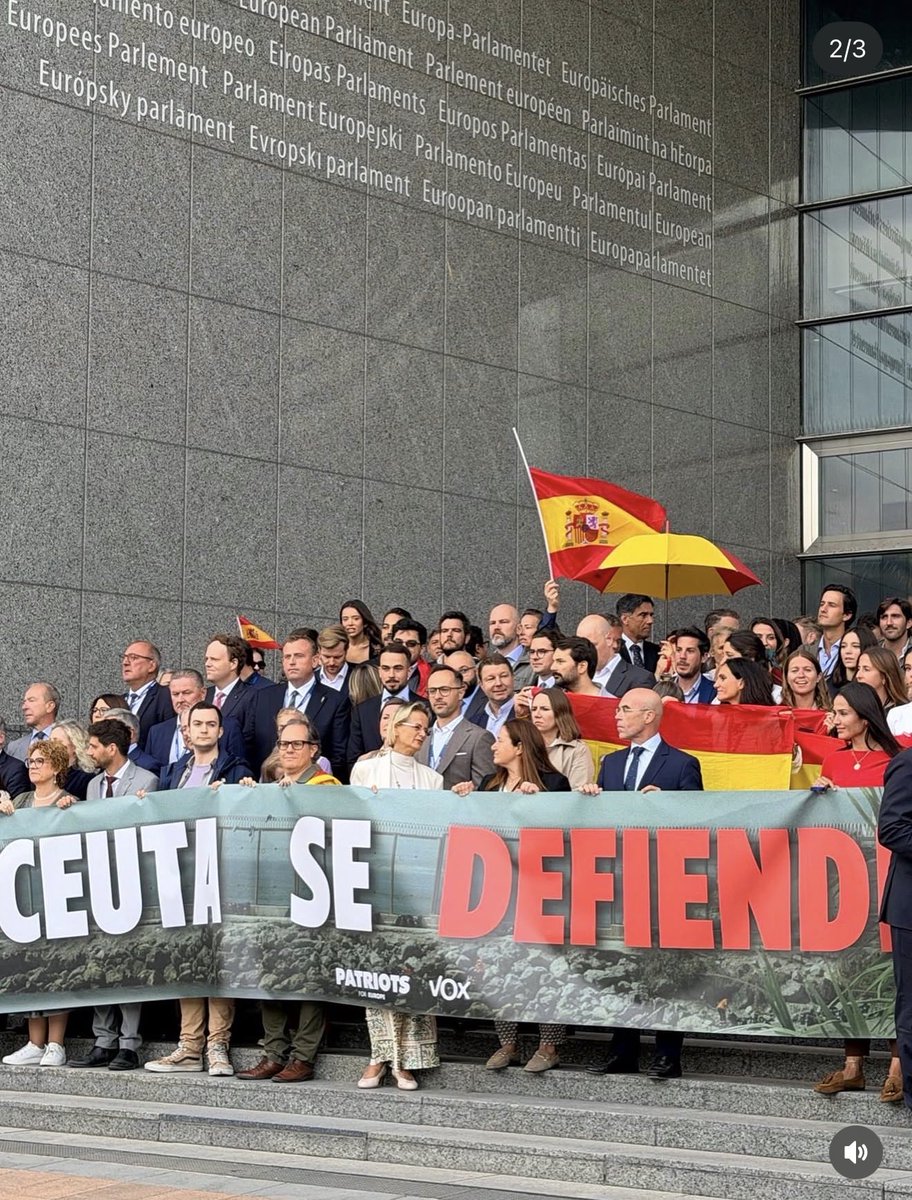
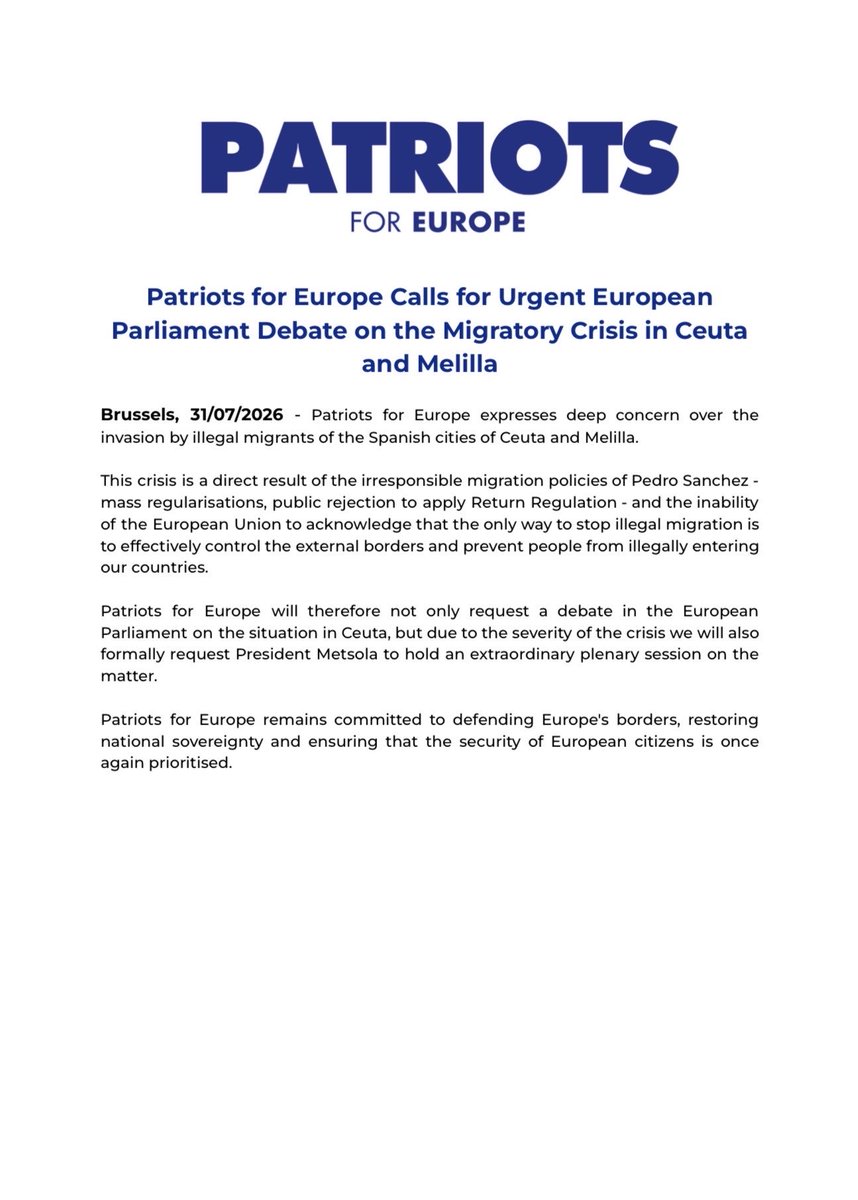
🇪🇸🇪🇺 What is happening in Ceuta is yet another reminder of why Spain, and Europe, desperately need a @vox_es government. Europe needs leaders who will defend its borders, restore order and put the safety of their own citizens first. @Santi_ABASCAL is ready to do exactly that. Vamos, Santiago!
What’s the National Cultural Fund (NKA) case really about?
❌ This is not a corruption investigation. It is an autocratic show trial designed to intimidate, punish and control.
Prosecutors claim they are examining how grants were awarded by Hungary’s National Cultural Fund (NKA), alleging that public funding was unlawfully distributed. In reality, this looks less like a good-faith effort to uncover wrongdoing and more like a political purge dressed up as law enforcement.
So far, 7 people have been arrested, including former NKA Vice President Balázs Bús and several ministry officials and administrative staff. Yet, many of the cultural projects in question have not even been completed or formally assessed. Authorities are treating recipients and administrators as criminals first and only asking questions later. Lower-level public servants and secretaries have been swept up and placed in pre-trial detention, with deprivation of liberty used as a blunt instrument to extract “cooperation” and confessions.
The continued detention of Balázs Bús has become a true symbol of political abuse. He is being held in one of Hungary’s toughest prison facilities, alongside murderers and prisoners serving life sentences, for a non-violent, financial matter. This is grossly disproportionate and clearly intended as psychological pressure rather than an investigative necessity. The message to the wider public sector is unmistakable: serve under the “wrong” leadership and you can be humiliated, isolated and broken.
At the same time, Prime Minister Péter Magyar has repeatedly announced that those responsible “will end up in prison” and has publicly singled out former Culture Minister Balázs Hankó, saying that “everyone around him has already been taken away.” This is not the language of a democratic leader. When the head of government publicly signals who is guilty and who should be imprisoned, prosecutors and judges are reduced to props in a script written by the ruling power.
The NKA case is not about cleaning up corruption. It is about consolidating control, sending a chilling signal to civil servants and normalising the use of criminal proceedings as a weapon against political and institutional opponents. In a democracy, independent courts, not politicians, determine guilt and decide who goes to prison. The NKA affair shows how far Hungary is drifting from that fundamental principle under the new government.
‼️ Illicit nationalisation? The new norm in Hungary.
Yesterday, the Tisza Party parliamentary majority approved the creation of the National Asset Recovery and Asset Protection Office (NVVH), a powerful new authority that paves the way for the illicit nationalisation of assets under the guise of asset recovery.
The legislation grants the office unprecedented access to bank records, official documents and other sensitive data. It is empowered to investigate companies, seize assets, and intervene in the operation of businesses where it alleges public assets have been misused. The office can exercise key powers without prior judicial authorisation, and its decisions cannot be appealed.
The creation of a single institution with powers this extensive represents a profound concentration of state authority. Vesting one office with such broad access to financial information, official records and investigative functions while reducing judicial safeguards raises serious concerns about political abuse.
This overreach evokes memories of the ÁVH, the communist-era secret police that became synonymous with political persecution, surveillance and fear. Creating a state body with such far-reaching powers over citizens’ finances, property and private information should alarm anyone who believes in the rule of law.
Democracy is not only about elections. It is about limiting the power of the state. When those in office continue to expand the state’s coercive powers while weakening institutional checks, the line between asset recovery and illicit nationalisation becomes unacceptably thin. History teaches us to pay attention.
🚨 “Balázs Hankó may be able to hide behind the subordinates he ordered around for a few more days, but no one can escape the consequences of their actions.”
That is how Péter Magyar publicly threatened former Hungarian Minister of Culture and Innovation Balázs Hankó, implying that he should be arrested.
Meanwhile, Tisza Party Vice President Márk Radnai declared that “Fidesz’s top leadership should end up on the defendants' bench.”
In a democracy governed by the rule of law, politicians must not be deciding who prosecutors or the police should arrest. Those decisions belong to independent law enforcement, not political opponents. Unacceptable conduct.
Today, democracy and the rule of law are being dismantled in Hungary in the pursuit of unchecked power. This is nothing short of criminal conduct.
Using retroactive, tailor-made legislation, the government has barred half of the opposition, including its strongest leaders, from politics. This marks the end of democracy. If it is not the people who decide who they vote for, but those in power who decide who the people are allowed to vote for, then democracy is finished.
Through a retroactive, tailor-made constitutional amendment, they removed the President of the Republic, dismissed the President of the Constitutional Court, and forced out the Chief Prosecutor. With that, they have dismantled the rule of law as well.
By using retroactive legislation to prevent us from standing in future elections, the government has crossed a line no democracy should ever cross. If it is not the people who decide who they vote for, but those in power who decide who the people are allowed to vote for, then democracy is finished.
⚖️ In the space of just a few days, Hungary has witnessed a breathtaking assault on the rule of law.
❌ First: After unconstitutionally removing the sitting President of the Republic, the government rushed to appoint a successor within hours, acting as though the presidency were nothing more than a political office to be filled at will. Even their own nominee ultimately refused to accept the position. In his own words, President Tamás Sulyok stated that “the democratic rule of law that emerged from the legacy of 1956 during Hungary’s democratic transition has ceased to exist.”
🖥️ Then: Under the pretext of an investigation into the Hungarian Cultural Fund, prosecutors seized Fidesz’s servers containing personal data and private correspondence. This was not a neutral law enforcement action. It was a politically motivated witch hunt designed to intimidate the opposition and demonstrate that state power would be wielded against anyone who challenges the current government.
⚠️ Now: The Chief Prosecutor has resigned, adding yet another chapter to a constitutional and institutional crisis that deepens by the hour. In his resignation, Gábor Bálint Nagy warned that “the Prosecution Service must not become an instrument in the struggles of political actors, nor can it become an arena for day-to-day political interests or power games.”
This is how democratic safeguards are dismantled: piece by piece, institution by institution, until the checks and balances that protect a nation exist only on paper.
🇭🇺 Hungary deserves better than rule by political vengeance. The rule of law cannot survive if constitutional limits are ignored, state institutions are weaponised against political opponents, and the independence of public office is sacrificed for partisan interests.