Here is an interesting new paper about tidal energy in Puget Sound - have you every wondered how to separate incident and reflected tidal waves? https://t.co/toTd3cvT4h
Wondering if your particle tracking scheme is giving reliable results? Here is a new paper comparing several schemes using ROMS output: https://t.co/TYRdmKeQJ6
A defining characteristic of Puget Sound is that it is an estuary. That means it is a place where fresh water mixes with salt water. This mixing is important for species like salmon but also has a profound impact on water circulation. Here's how it works. https://t.co/TKLw6ZQUfT
I'm writing a paper. I got most of the way through the Introduction, looked at the References, and found I had not cited a single female lead-author paper. There were plenty I could have. Embarrassing.
Jilian Xiong, my postdoc, has a great paper out, open for public comments: Intercomparisons of five ocean particle tracking software packages https://t.co/d0oi1ArwKI
DYK that on average, it takes about two months for water to circulate through Puget Sound (some places more, some places less)? We've prepared a new infographic showing how it all works. #PugetSoundFactBook https://t.co/FPdD1IcagL
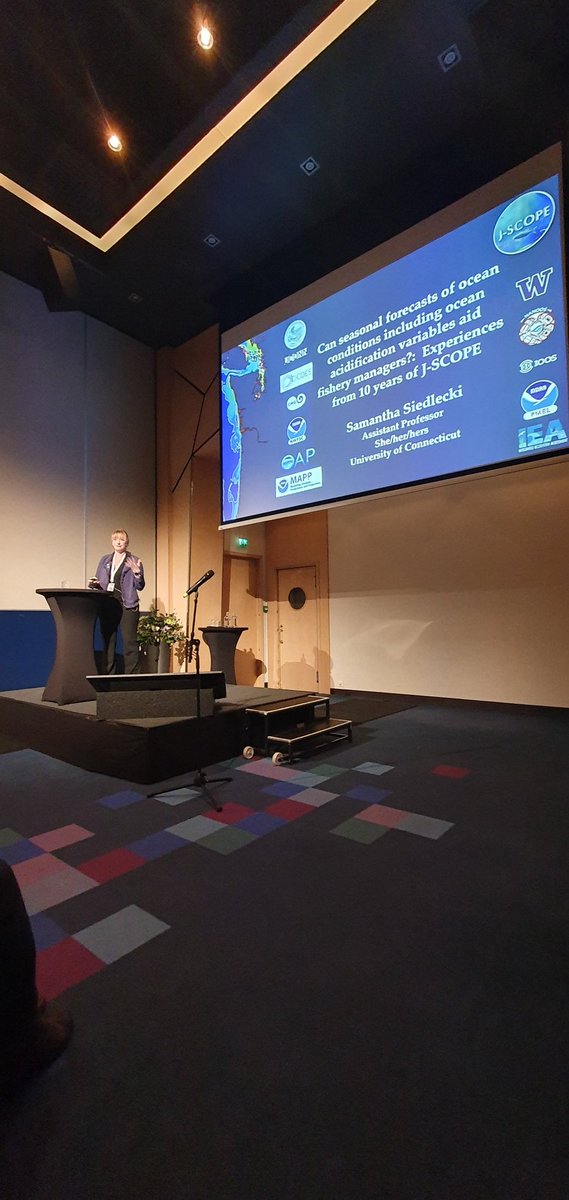
Session 19 kicked off with the presentation by invited speaker Dr Siedlecki @OceanForecaster on whether seasonal forecasts of ocean conditions including ocean acidification variables aid fishery managers, based on experiences fom 10 years of J-SCOPE
In new research, scientists used hydrodynamic modeling to predict the best way of using moored instruments to measure water flows in three large natural estuaries.
https://t.co/Jiam7Gqio3
Come join our interdisciplinary team investigating the carbon sequestration potential of Canada's coastal oceans! Visit https://t.co/pr87pNzF4j to learn more. Find the full job description and information on how to apply here: https://t.co/GHvJtzBrwj
What drives Puget Sound's 'underwater Amazon'? The interaction between fresh and salt water stokes an engine that drives water circulation throughout the entire basin, something intensely important to the understanding and management of Puget Sound. https://t.co/RtMQ5rMXuI
@ShaneKahn Good for you! Best way to switch to python is to write all new code using it. I use the TextMate text editor and a terminal window. IDE's add unnecessary complication.
@TrevorABranch I love organization. Spent a week recently curating all my folders called "Figures". Then my Chrome bookmarks. Finally put all my stray pdf's in EndNote with tags. Ready to retire!
Come join our team investigating the carbon sequestration potential of Canada's coastal oceans! $70K to $90K per year, benefits (including 4 weeks PTO and extended health), a relocation allowance ($5K+), https://t.co/JgTGtctnJe
Here is a new paper on mixing in the Salish Sea by my student Erin Broatch. Important results on numerical mixing in a realistic model! https://t.co/tHF7UAtF7Q
Contemplating today's terrible Supreme Court ruling limiting EPA power to regulate CO2. The recent history presented in the PBS Frontline documentary "The Power of Big Oil" is very informative on how we got here.
Question: how do you keep up with the literature in your field? I used to browse the journals in our (now closed) Oceanography library, and subscribed to a few print journals.