If 100 million foreigners were gone tomorrow, we would be in a depression.
But banks would be handing out homes to young Americans for pennies on the dollar.
Families would be formed, young men would have ownership of something worth keeping and building.
I promise you continuing on this path doesn’t end well for anyone other than private equity.
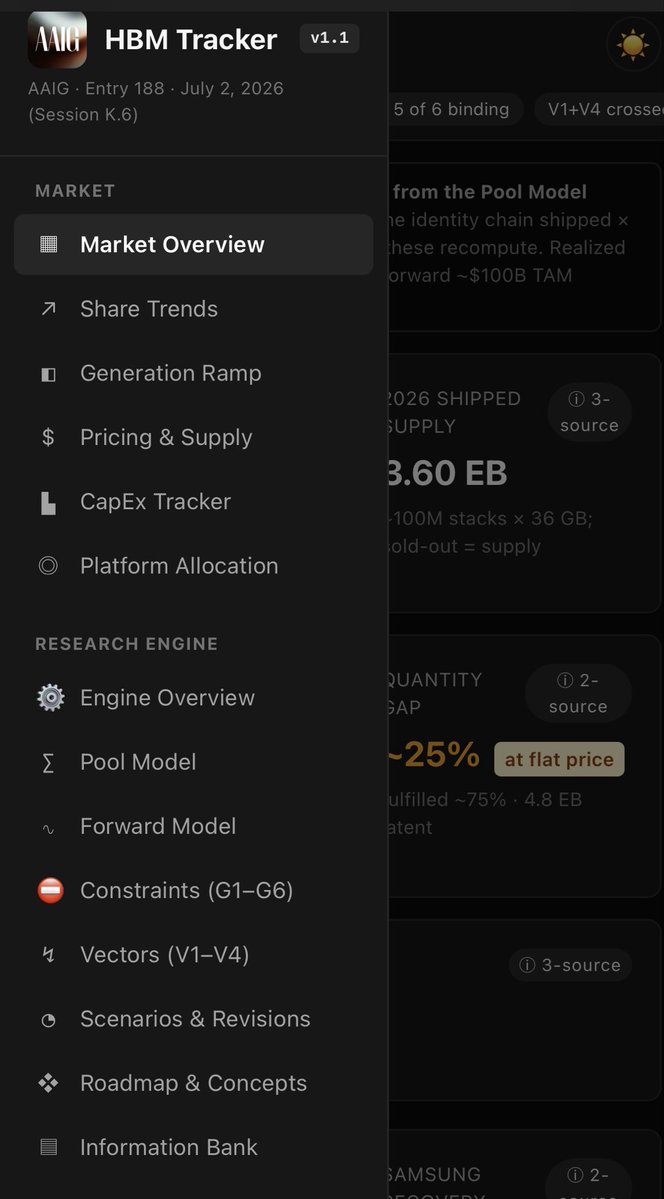
Okay guys, FINALLY follow-up on the HBM stress test. because I cracked my head on this topic way harder then I ever tought to do. Put so much time in this engine and learned also so much. So must read here!
Besides all the supply constraints that i mapped in other parts which are already as tight as it can be I looked at demand now and how it develops.
So four levers drive the supply gap. I pushed each to its worst realistic setting, one at a time, and the shortage held every time… except one lever could flip it alone. Efficiency. How fast the industry learns to serve more AI per gigabyte of memory.
So we measured it. Properly.
First thing to understand… our base case already assumes brutal efficiency. Tokens are growing 4 to 7x a year (Google confirmed 7x at I/O), yet our memory demand line only grows ~40%. That wedge IS efficiency… roughly 30% per year, already priced in. MLA cutting KV-cache roughly 3 to 5x. FP8 to FP4 quantization. Sparse attention. All of it, already in this number.
To flip 2027–2028 into surplus, efficiency would need to run another ~25% per year ON TOP of that 30%.
The measured incremental rate? Around 5% a year. And decelerating… the big wins were one-time steps, mostly shipped in 2024–2025, and we are approaching hard floors. 4-bit precision. ~70KB per token on KV-cache.
Then the other escape hatch… “CXL pooling and flash tiers will fix it.” I ran that one too. Most memory tier below HBM serves the COLD side. CXL pools sit at hundreds of nanoseconds… good for cached prefixes and reuse. High-bandwidth flash is read-mostly, write endurance caps it at shared context. System RAM costs 10 to 50 milliseconds per fetch. But the hot decode set… the memory a GPU touches every single token… is pinned to HBM by latency. NVIDIA even built a separate GDDR7 chip for the part that can leave (Rubin CPX, prefill). The boundary is drawn in silicon. These tiers are additive, not substitutive. They grow what is servable… they do not shrink what needs HBM.
For the math people: balancing 2028 would need roughly three quarters of KV traffic off HBM. The physical ceiling is nowhere near that.
And here is the stat that settles it. No GPU generation has EVER shipped with less memory per system. 80GB… 141… 180… 288 and rising. Every byte the software saves gets spent immediately on longer context and bigger batches. Agent tasks now burn millions of tokens each. That is Jevons paradox in silicon.
Now the honest part, because there always is one. Nobody publishes memory-per-token over time, so the 5% is our inference… wide error bars. And I wrote down exactly what would change our mind: production KV compression clearing 5x+, a generation shipping lower memory per rack, or the flash tier proving it can hold the hot set. Low probability for all.
in my opinion the two escape routes everyone cites… efficiency, and moving memory off HBM… I measured. Neither runs fast enough.
$MU $005930.KS $000660.KS
$ASTS: 🚨🇪🇸 VODAFONE SPAIN AND ALMERIA TO TEST AST SPACEMOBILE SERVICE FOR APPLICATIONS IN THE AGRICULTURAL SECTOR
Vodafone Spain chooses Almería to test the first real applications of direct satellite connectivity to devices in the agricultural sector
7/1/26
Vodafone Spain will launch its first real-world satellite connectivity projects for agricultural devices in Almería, in partnership with CASI, Única Group, Coexphal, and Cajamar, through its Foundation.
The announcement was made during the summer course “Digital Transformation in Agriculture: Innovation, Competitiveness, and Sustainability,” organized by the University of Almería and co-directed by Antonio Hernando, Secretary of State for Telecommunications and Digital Infrastructure . The course addresses the role of connectivity, sensors, data, artificial intelligence, digital twins, robotics, and cybersecurity in modernizing the agricultural sector.
In collaboration with these leading entities in the Almería agri-food ecosystem, Vodafone will develop specific use cases for satellite-connected digitalization and the Internet of Things. These applications will allow sensors located on farms to be connected directly via satellite, adapting the technology to real-world production, monitoring, and farm management needs.
For these projects, Vodafone Spain will use its 900 MHz frequencies through a temporary authorization requested from the State Secretariat for Telecommunications and Digital Infrastructure. This collaboration exemplifies public-private cooperation to accelerate technological innovation and the development of new services for citizens.
The agricultural sector is one of the areas where connectivity can have the greatest impact, especially on farms far from urban centers, with extensive land areas, and in zones where terrestrial coverage is not always available. Direct satellite connectivity to devices opens up new possibilities for crop monitoring, irrigation control, sensorization of remote farms, traceability, emergency management, and the development of more efficient and sustainable production models.
José Miguel García, CEO of Vodafone Spain, stated: “Vodafone was a pioneer in bringing the latest network technologies to Spain, such as 4G and 5G, and we want to once again lead the next evolution of connectivity with direct satellite-to-mobile services. We are delighted to collaborate with CASI, Única Group, Coexphal, and Cajamar, through its Foundation, to develop and evaluate real-world, useful, and impactful applications before the commercial launch of Vodafone SAT.”
The selection of Almería recognizes the talent, the business community, and the ambition of a province that has established itself as an international leader in intensive agriculture and agri-food innovation. With these projects, Almería and Andalusia are at the forefront of the development of direct-to-device satellite connectivity.
An additional layer of coverage for the countryside:
Direct-to-device technology allows a conventional device to connect directly to satellites when terrestrial coverage is unavailable, without external antennas, special equipment, or additional SIM cards. This connectivity does not replace 4G and 5G networks, but rather complements them, providing a new layer of coverage, resilience, and security.
These projects are part of the commercial agreement reached by Vodafone Spain with Satellite Connect Europe—the Luxembourg-based joint venture between AST SpaceMobile and the Vodafone Group—and are an enabler of Vodafone SAT, the company's commercial offering of satellite services to businesses and individuals.
The service could be commercially available from 2027, subject to the development of the regulatory framework. In exceptional or emergency situations, this technology could be applied early, always with the corresponding institutional authorizations in force.
Full PR: https://t.co/GZQJ1C9yUH
Moriré en esta colina hasta el fin de mis días.
Pensad en la persona mas inteligente y más torpe que conozcáis.
Ambas casi seguro que son hombre.
La naturaleza puede arriesgar más en el hombre que en la mujer, porque él es más prescindible para la supervivencia humana.
Hoy jugaba la cabra. Había que estar ahí, había que verle en vivo. Y no defraudó. c/Rafael Calvo 39, 19:00 de un 12 de Dic, ya huele a Navidad, el público lo sabe y a las 18:52 ya no cabe un alfiler en el auditorio de la Del Pino. No suena el himno de la Champions, pero podría.
En España se está poniendo de moda celebrar el Día de Acción de Gracias norteamericano, mientras nos insultamos a nosotros mismos por el 12 de octubre. Hace falta ser gilipollas.
Pasos hacia el totalitarismo:
1. Crear la figura del “delito de odio”
2. Definir qué es odio (y qué nunca lo será) en función de la ideología del poder
3. Crear la fiscalía correspondiente
4. Empezar por prohibiciones a la libertad de expresión (Ud. está aquí)
5. Encarcelar (UK)