UK Silver Flow 2021 to Jul 2026 - This shows the monthly NET imports/exports between the UK (LBMA) and major silver markets. A single silver bar represents a range from 0.1 to 100 metric tons. So for example, 4 silver bars represents a monthly total that is in the range of 300.1 to 400 metric tons.
It gets a bit hectic after late 2024 and you might need to pause the video in places to fully absorb everything that was happening.
Alas, I didn't have an unlimited budget for making this or I would have also incorporated some temperature gauges for LBMA vaulted ETF/ETP silver and/or LBMA silver vault stock free float totals for the complete picture.
The UK customs data was drawn from @GoldFishCharts website and the music is by Angine de Poitrine.
The gold standard did not constrain economic growth. It constrained monetary growth (which is great for people and a real constraint on government spending). The economy could grow faster than the monetary base and it led to a benign form of (non-harmful) deflation as in the late 1800s. The real problem with the gold standard era was that people trusted banks too much and banks would fail and people would lose the money they lent to the banks.
With respect to your comments on Bitcoin - it will never function as money at a maximum 13 transactions per second pipe. But even if it could handle 1M transactions per second, it is inferior to a physical bearer medium because transactions are dependent upon third parties (power grid, network connectivity, block miners, etc.) for payment clearance and there is no guarantee that it will be able to function as a medium of exchange at any given point in time. Bearer instruments do not need infrastructure or permission to change hands.
The money supply does not need to grow for an economy to grow. A fixed stock of money serves a growing economy perfectly well, because prices adjust downward as production expands. More goods chasing the same number of dollars means each dollar buys more. That is prosperity.
Central bankers treat deflation like a contagious disease, but falling prices are simply the market telling you that someone got more efficient. When Ford cut the price of the Model T from $850 in 1909 to $260 by 1925, consumers did not stop buying cars while waiting for prices to fall further. They bought millions of them. Falling prices driven by productivity growth do not paralyze economies; they reward savers and punish waste.
The key insight sits in the unit of account. Murray Rothbard made this explicit in "The Case for a 100 Percent Gold Dollar": the actual quantity of money in an economy is largely irrelevant to its functioning, because money's job is to facilitate exchange, not to exist in any particular volume. If the total supply of gold were fixed at, say, 10,000 tons forever, prices across the economy would simply denominate in smaller and smaller fractions of an ounce as output grew. The math scales indefinitely. A dollar divisible to eight decimal places (as Bitcoin already is, reaching units called satoshis at 0.00000001 BTC) gives you 2.1 quadrillion discrete units from a capped supply of 21 million coins. No economy in human history has needed more pricing granularity than that.
Governments expand the money supply because it lets them spend without taxing you directly, transferring purchasing power from your savings to whoever receives the new money first (typically banks and politically connected borrowers). By the time the new dollars reach your wages, prices have already adjusted upward. You paid the tax; someone else collected it.
A fixed money supply eliminates that mechanism. Producers compete to offer you more value per unit of currency rather than lobbying the Fed for favorable credit conditions. Capital allocation returns to the actual preferences of actual people, expressed through voluntary exchange, rather than the distorted signals that cheap credit manufactures. The economy needs honest money, denominated in units small enough to price anything from a country's GDP to a cup of coffee.
👉From Aug 2025 to Jan 2026, LBMA spot rose from ~$41/ozt to >$100/ozt
👉LBMA liquid free float essentially went to zero in October 2025 - markets choked
👉silver lease rate spiked above 20% in October 2025
It happens when physical supply is constrained relative to physical demand. Price is a function of paper trading and not necessarily correlated with actual physical supply/demand dynamics.
More indirect evidence that silver supply in London is running tight. Folks listening to The Silver Institute / Metals Focus or Daniel "silver flood" Ghali are going to be very surprised when physical tightness imposes itself on the paper markets.
The 1-month silver lease rate over the past 50 days clearly shows that we’re dealing with a liquidity event in financial markets, not a sudden surplus of silver.
wait, a developer investigating the code behind the AI-assisted riemann hypothesis proof has found a function that literally returns "True" every single time
a critic noticed that one of the geometry checks in the proof might not actually be checking anything:
> "The geometry predicate is defined to be True."
the developer checked the actual code and found a function called anyGeometry doesn't actually check anything. it just returns True every time.
it shows up in 24 files and is used in parts of the code that build the proof's assumptions
but nobody has figured out yet whether this always-True function is actually part of the chain leading to the final result.
lean checks whether every step follows the rules in the code.
but if one of those rules simply says
"the geometry is valid", lean won't stop to question it.
if the final proof relies on this function, it could mean a mathematical condition was never actually established.
if it doesn't, the function is just sitting there doing nothing.
guess we'll have to wait and see
@QualiaQuanta@fanofaliens For those of us in the peanut gallery, does this mean the asserted RH solution is essentially flawed/invalid or is this a non-issue?
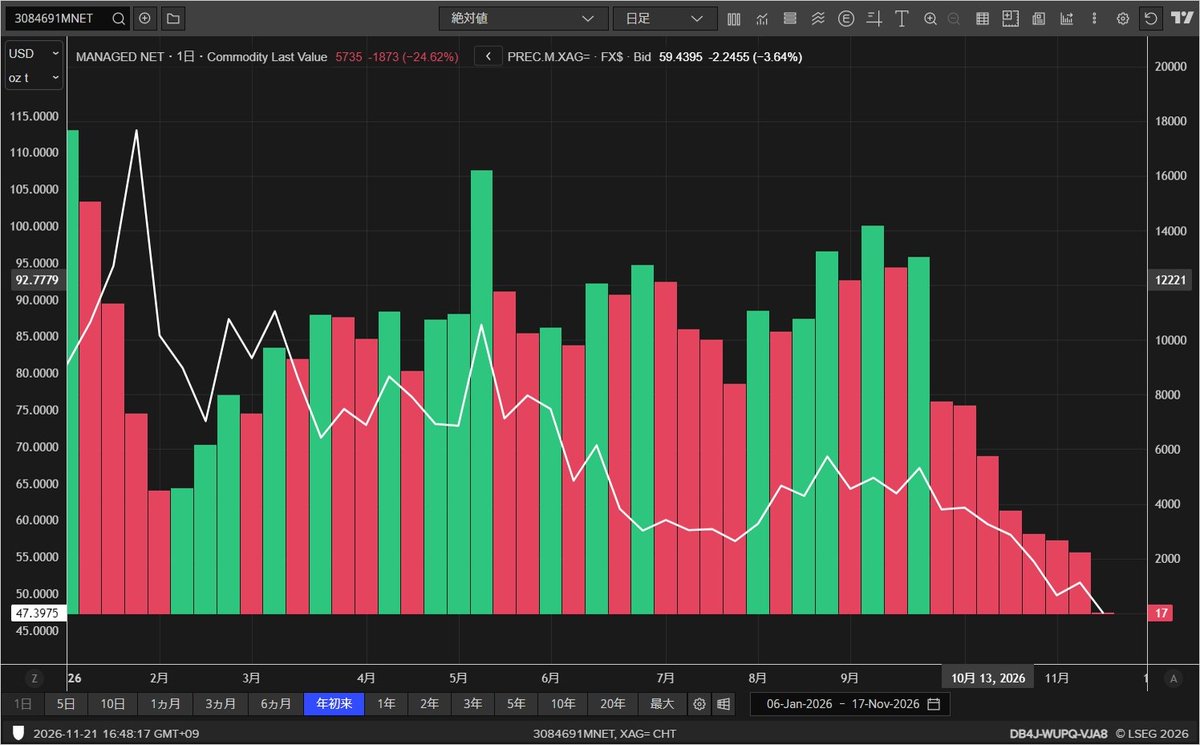
@Kipplykins COMEX longs/shorts are reported for several broad categories including managed money and others. The aggregate position in one group can be offset by positions in the other groups. I believe "Investors" referred to managed money per the screenshot.
"COMEX silver investor positions. Longs are down to almost zero."
The longs that remain are apparently demanding physical delivery. So far in November, actual withdrawals from the COMEX silver vaults are running 89.1% of Nov26 contract delivery requests.
Deliveries is one thing. Actual physical withdrawals are another. So far in November, actual withdrawals are running at ~89% of Nov26 contract delivery notices. That's higher than usual.
Also, bullion banks can move eligible to registered almost instantly, so they really should be considered together (less SLV's NYC allocation).
I post two separate run rate factors for COMEX silver every day in my morning snapshot reports based upon a five day moving average of withdrawals and some factoring. I posted some historical analysis explaining the factoring here:
https://t.co/Rr3sFRLZpn
The impact of India disappearing from the global silver market from May-July and its subsequent return are easy to see in COMEX deliveries vs withdrawn data.
From Jan-Apr 2026, the percentage of physical withdrawals from COMEX vaults versus delivery notices for the Silver 5000 contract averaged ~130%.
Indian government imposed 15% import duty and restricted imports - handcuffing them from global silver markets. Indian silver Imports plummeted to near zero from May-July and the percentage of physical withdrawals from COMEX vaults versus delivery notices for the Silver 5000 contract fell to less than 7% by the end of July.
Indian silver imports resumed in August and accelerated as they are making up for their 3 month hiatus. The percentage of physical withdrawals from COMEX vaults versus delivery notices for the Silver 5000 contract is on it's way back up. It finished October at 95.6% and is currently ~89% for November.
If India makes good on importing the remaining 5,500 tonnes of silver by April for which they have approved import permits, I would not be surprised to see the COMEX getting stressed in the coming months as withdrawals remain near 100% (or beyond) of delivery notices again.
"COMEX silver investor positions. Longs are down to almost zero."
The longs that remain are apparently demanding physical delivery. So far in November, actual withdrawals from the COMEX silver vaults are running 89.1% of Nov26 contract delivery requests.
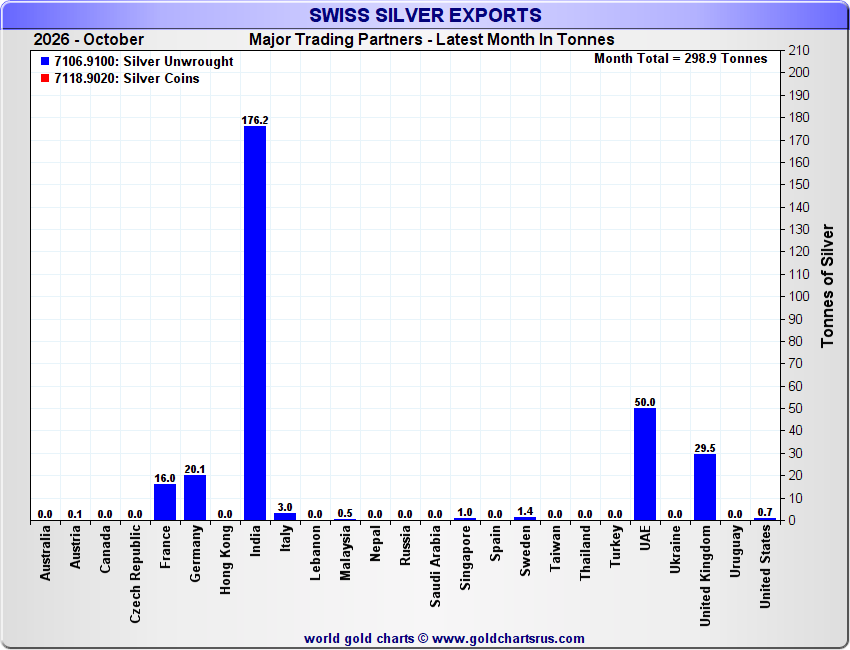
India reportedly imported >1,000 tonnes of silver in October. Looks like ~170 tonnes came from Switzerland (which pulled less than 4t from the UK in Oct). How much of the remaining of the ~830 tonnes came from the UK (LBMA)?
@GoldForecast@GoldFishCharts Me too! 🤣🤣
As Indian customs hasn't released the official October data yet, can you share where your October number came from?