@Adnkronos l'Italia è soffocata dalle tasse per spesa pubblica in parte inefficiente e in parte inutile che non produce alcuna utilità se non per coloro che percepisccono direttamente il compenso
BREAKING NEWS!
The engineer who built Claude Code from scratch just released a 28-minute video that's pure gold: how to write prompts that deliver ridiculously good results.
I've seen $300 courses that don't even come close to what he explains in the first 10 minutes.
CLAUDE.md files, memory shortcuts, parallel sessions, and prompting patterns that almost no one uses...
All in one single video.
Completely free.
No fluff.
Whether you're a developer, just starting, or have already been using Claude for months, this changes the game for you starting today.
Save. Watch. Share.
I’m locked on, @DavidSacks! We’re hiring 1,000 new grads & interns right now to ride the AI exponential. You are right they said AI would kill entry-level jobs. Meanwhile these grads & interns are building it — powering Agentforce & Headless360 at Salesforce. 🚀 New grads: Drop your resume to @salesforcejobs or [email protected]
#FutureForce #AI
I have changed my mind on how AI will impact jobs in America.
Previously, I believed AI would replace many entry level roles typically filled by young employees. The technology would then work its way up the organization and eventually reduce the total number of jobs in a company.
The data is saying something different, so when I get new information I am willing to change my mind.
The number of software engineers being hired has been increasing. The number of open software engineer roles is growing.
The number of new college grads who get hired has increased 5.6% over the last 12 months. The unemployment level for people aged 20-24 years old who have a college degree has fallen from nearly 9% to almost 5% as well.
The Wall Street Journal recently wrote “AI created 640,000 jobs between 2023 and 2025 in the U.S., according to an analysis by LinkedIn of job posting data, including new white-collar positions such as Head of AI and AI engineer.”
And I am starting to see companies throughout our portfolio aggressively hiring to keep up with the demand for their products and services.
If AI can make employees more productive, which is widely accepted as fact, then companies are going to want as many productive units of labor as possible. This is a key reason why I am changing my mind.
AI appears to be a magical technology that will make companies more productive and more profitable. The net result will be more corporations, more startups, and more jobs.
All three are big, positive wins for the American economy.
Harvard scanned meditators' brains and found something that should've made headlines everywhere.
10-20 minutes a day doesn't just "reduce stress," it physically grows new brain tissue, shrinks your fear center, and reverses age-related cortical thinning.
Here's the breakdown:🧵
Anywhere from $40 billion to $150 billion of leveraged loans packaged into US collateralized loan obligations could be disrupted by the AI boom, according to JPMorgan https://t.co/7oVOOHl11k
Watch Hard Lessons, as legendary investor Stan Druckenmiller sits down with Morgan Stanley’s Iliana Bouzali, sharing how he would construct a portfolio if he had to start over today, why contrarianism is overrated, and which stock he regrets selling too early.
Super interesting!
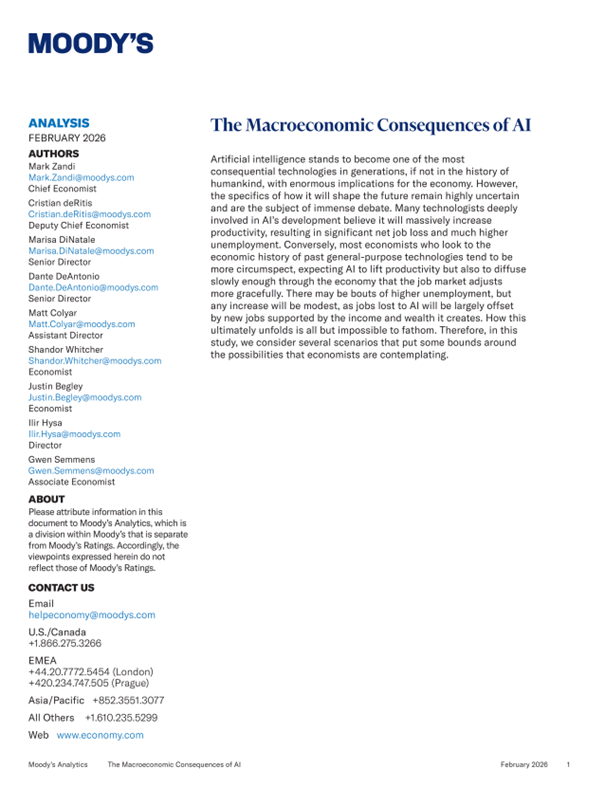
"The Macroeconomic Consequences of AI" by Moody’s (Mark Zandi, Cristian deRitis, Marisa DiNatale, Dante DeAntonio, Matt Colyar, Shandor Whitcher, Justin Begley, Ilir Hysa, and Gwen Semmens).
"Many technologists deeply involved in AI’s development believe it will massively increase productivity, resulting in significant net job loss and much higher unemployment. Conversely, most economists who look to the economic history of past general-purpose technologies tend to be more circumspect, expecting AI to lift productivity but also to diffuse slowly enough through the economy that the job market adjusts more gracefully. There may be bouts of higher unemployment, but any increase will be modest, as jobs lost to AI will be largely offset by new jobs supported by the income and wealth it creates. How this ultimately unfolds is all but impossible to fathom. Therefore, in this study, we consider several scenarios that put some bounds around the possibilities that economists are contemplating."
"We determine the macroeconomic consequences of these scenarios over the next decade through simulations of our large-scale model of the U.S. and global economies."
https://t.co/veZd9vZ6OZ
“Your success in life depends on your ability to make good decisions. Your happiness depends on your ability to not care about the outcomes.”
— Naval Ravikant
US BANKRUPTCIES ARE SURGING:
LAST WEEK, 9 LARGE U.S. COMPANIES WITH LIABILITIES OF $50 MILLION OR MORE FILED FOR BANKRUPTCY.
AT LEAST 18 MAJOR CORPORATIONS HAVE GONE BANKRUPT OVER THE PAST THREE WEEKS.
The K-shaped economy is real and the data is more alarming than this post suggests.
PwC analyzed a billion job ads across six continents. Industries most exposed to AI saw productivity growth nearly quadruple since 2022, jumping from 7% to 27%. Industries least exposed? Productivity actually declined. Revenue per employee is growing 3x faster in AI-intensive sectors. That gap didn’t exist three years ago.
Oxford Economics told Fortune last month that AI will reinforce the K-shape for at least the next five to ten years. The mechanism is specific: middle-skill jobs, the ones where you can substitute tasks with AI, are contracting. Employment growth is concentrating at the top (critical analysis, strategy) and the bottom (manual, physical work). The middle is hollowing out.
Here’s what determines which line you’re on.
Employer skill demands in AI-exposed jobs are changing 66% faster year over year. That was 25% last year. The acceleration itself is accelerating. And degree requirements are dropping. The share of AI-augmented roles requiring a degree fell from 66% to 59% in five years. The barrier to entry isn’t credentials anymore. The barrier is learning velocity.
The 56% wage premium for AI-skilled workers (PwC, 2025) doubled in a single year from 25%. That’s the fastest-growing skill premium in modern labor market history. But 88% of workers still haven’t taken a single hour of AI training. That’s the K right there. Not two “classes of people.” Two learning speeds.
What puts you on the right line: pick one workflow you do daily. Automate it. Not theoretically. Actually build it. Use Claude, use Cursor, use whatever tool fits. The point isn’t mastering AI. The point is developing the muscle of turning repetitive work into systems. People who do that once tend to do it ten more times within a month because the ROI is so immediate it becomes addictive.
The World Economic Forum projects 170 million new roles created by 2030 against 92 million displaced. Net positive by 78 million jobs. The jobs are coming. The question is whether you’re building skills fast enough to qualify for them.
Cuban is calling the IT services boom of the 2000s, but for intelligence instead of infrastructure. Every wave of business technology from PCs to cloud to mobile spawned a massive local services layer. The AI wave needs the same thing, and 33 million companies are waiting.
The AI consulting market was $11 billion in 2025. Spread across 33 million US companies, that’s $333 per business. The average custom AI integration for a 20-person company runs $50K-$150K. If even 10% of those businesses buy in, you’re looking at a $165B-$495B services opportunity sitting in a market currently sized for Fortune 500 engagements.
Here’s the constraint. Census Bureau data shows 8.8% of small businesses actually use AI in production. Goldman Sachs says 68% are “using AI,” but dig into what that means and it’s mostly prompting ChatGPT for email drafts and marketing copy. The distance between “I used a chatbot” and “AI runs my dispatch workflow” is where Cuban’s job wave lives.
And that distance requires humans to close. You can’t ship a Zapier template to a 15-person HVAC company and call it AI transformation. Someone has to sit with the owner, understand how they route their crews, map their customer data, build the integration, and come back when it breaks. That’s a Tuesday morning at someone’s office, not a SaaS subscription.
The money is tilted in the wrong direction right now. Large enterprises hold 63% of AI consulting spend. Accenture, Deloitte, and McKinsey are serving companies with 500+ employees. Cuban’s bet is that the real volume play is the other 32.8 million companies that can’t afford a Big Four engagement and don’t have an internal IT team.
The closest analog is what happened with Salesforce. One platform created 9.3 million jobs globally, most of them admin and integration roles that didn’t exist before the product shipped. AI touches every workflow in a business, not just CRM. The job creation multiplier should be significantly larger.
Mark Cuban on the next job wave.
Customized AI integration for small to mid-sized companies.
"Software is dead because everything's gonna be customized to your unique utilization. Who's gonna do it for them... And there are 33 mn companies in the US."