Luis Enrique.
¿HABLA DE MBAPPÉ?¨
¨ Era un jugador que se movía por dónde él quería¨
¨ Eso implica que hay situaciones de juego que yo no controlo, ahora las voy a controlar todas, sin excepción ¨
A Persian scholar finished a single math book in 9th century Baghdad that quietly became the foundation for every line of code running on Earth today.
I started reading about him at midnight and could not believe how many things in my daily life trace back to one man.
His name was Muhammad ibn Musa al-Khwarizmi. The book is called The Compendious Book on Calculation by Completion and Balancing.
Every time you say the word algebra, you are saying his book title. Every time someone says the word algorithm, they are saying his name. Both English words come from him. Both are Latin transliterations of Arabic and of his own identity. The man did not just contribute to mathematics. He named it.
Here is the part almost nobody tells you.
Al-Khwarizmi was born around 780 CE in Khwarazm, in what is now Uzbekistan. He moved to Baghdad and worked at a research institution called the House of Wisdom, which during the Islamic Golden Age was the single most important center of learning on the planet. The caliph al-Mamun hired the best mathematicians, astronomers, and philosophers from across three continents and put them in one building with one job. Translate, study, and produce new knowledge.
Al-Khwarizmi finished his book on algebra around 820 CE. The Arabic title contained the word al-jabr, which referred to one of the two operations he used to solve equations. When the book was translated into Latin in the 12th century, the Latin world did not have a word for what he had built. So they kept his Arabic word. Al-jabr became algebra. The discipline was named after a single Arabic word in the title of a single book by a single man.
The deeper insight is what he actually changed about how humans think.
Before al-Khwarizmi, mathematical problems were solved geometrically. You drew shapes. You measured them. You compared areas. The Greeks had built an entire mathematical tradition on visual proofs and physical constructions. It was beautiful and limited. You could not solve a problem you could not draw.
Al-Khwarizmi did something nobody had done before him at this scale. He said you could solve any problem using abstract symbols and rules. You did not need a shape. You needed a procedure. You moved terms across the equation. You cancelled like terms on both sides. You isolated the unknown. He invented the idea that mathematics is a manipulation of symbols according to rules, not a study of physical figures.
That single shift made everything that came afterward possible. Calculus. Differential equations. Linear algebra. Quantum mechanics. None of it works if math is locked inside geometry. He pulled it out.
The second thing he did is the one that changed how the world counted forever. He took the Hindu numeral system from Indian mathematics, refined it, and wrote a book introducing it to the Arab world. That system included the concept of zero as a placeholder, and a positional notation where the value of a digit depends on its location. Roman numerals could not do complex calculation. Hindu-Arabic numerals could.
When his book on numerals was translated into Latin as Algoritmi de numero Indorum, the word Algoritmi was just the Latin spelling of his own name. Europeans started calling the new method "doing algorism," then "running an algorithm." The word for the most important concept in computer science is literally his name in Latin.
The third thing he did is the part that should haunt anyone who works in tech.
His method of solving problems was systematic. Step one, do this. Step two, check that. Step three, if condition A, then do X, otherwise do Y. He wrote down procedures that could be followed by anyone, anywhere, who knew how to read. The procedure did not depend on intuition or genius. It worked because the steps worked.
That is exactly what an algorithm is. A finite, deterministic procedure for solving a problem. He did not just give us the word. He gave us the entire concept of programming a thousand years before there was anything to program.
When Alan Turing built the first abstract model of computation in 1936, when John von Neumann designed the first stored-program computer in 1945, when every engineer at Google, OpenAI, Anthropic, and DeepMind writes code in 2026, they are working in a paradigm that started with one man in Baghdad twelve centuries ago.
The strangest part is what happens when you walk into any tech office in San Francisco or Bangalore or Lahore today. Engineers say the words algebra and algorithm hundreds of times a day. They do not know whose name they are saying. Almost nobody can spell al-Khwarizmi correctly on the first try.
His original Arabic manuscript is preserved at Oxford. His book on Hindu numerals survives only in Latin translation. The Latin version was the textbook that taught medieval Europe how to count.
The man who built the foundation of the AI revolution did not live to see a calculator. He died around 850 CE, a thousand years before the first electric current was sent through a wire. The civilization he built mathematics for collapsed. The library he wrote in burned. His own grave is unmarked.
But every algorithm running on every machine on Earth right now still answers to his name.
¿Cómo cambia la propuesta de nuevo sistema de financiación autonómica la financiación relativa de cada una de las 15 comunidades de régimen común?
En un fantástico servicio público, tanto por su celeridad como por su rigor, Ángel de la Fuente ha circulado una nota
https://t.co/8TMkehsxpM
con un primer análisis cuantitativo de la misma.
He tomado prestados sus resultados de los cuadros 4 y 5 de su trabajo y los he reordenado, sin cambios, para mi propia reflexión personal, en el cuadro que acompaña a esta entrada.
El cuadro reporta la financiación efectiva a competencias homogéneas por habitante ajustado bajo el nuevo modelo propuesto por el Gobierno y bajo el anterior, con los datos más recientes, de 2023.
¿Qué quiere decir “competencias homogéneas”? Que ya consideramos que Cataluña, por ejemplo, tiene competencias en materia de seguridad pública que Madrid no tiene. La financiación, por tanto, refleja lo que recibirían las 15 comunidades de régimen común si todas tuviesen las mismas competencias.
¿Qué quiere decir “población ajustada”? Que, en lugar de mirar simplemente la población, el sistema de financiación considera factores como el envejecimiento de la población en una comunidad autónoma, su dispersión geográfica, su carácter insular, etc.
La idea es que, al hablar de competencias homogéneas y población ajustada, estemos comparando lo mejor posible manzanas con manzanas y no manzanas con peras.
La primera columna recoge la mejora de la financiación per cápita con respecto al sistema actual (insisto: ya ajustada por población efectiva y por competencias homogéneas). La segunda columna corresponde a la nueva financiación per cápita. La tercera columna corresponde a la financiación con el sistema actual. La última columna, que es la única que no he tomado del trabajo citado, recoge el PIB per cápita de cada comunidad autónoma en 2023, con datos oficiales del INE:
https://t.co/DUWdwmFX5J
¿Qué vemos? Que la comunidad autónoma de régimen común que más gana con la propuesta es Cataluña, con 507 euros per cápita. Esta ganancia es sorprendente porque Cataluña, con el sistema actual, ya está financiada por encima de la media: 3.470 euros, 81 euros más que la media a población efectiva y por competencias homogéneas.
Detrás de Cataluña aparecen la Comunidad Valenciana (496 euros per cápita) y Murcia (468 euros per cápita). Tanto la Comunidad Valenciana como Murcia, por motivos que @frdelatorre y yo explicamos en nuestro libro La factura del cupo catalán, están muy mal tratadas por el sistema actual.
Por tanto, esta mejora relativa de su financiación es lógica, aunque deja a ambas comunidades todavía por debajo de la media de financiación a población efectiva y por competencias homogéneas.
Como es claro que el objetivo fundamental de la reforma es que Cataluña sea la comunidad de régimen común que más gane, no es políticamente factible que la Comunidad Valenciana o Murcia queden más cerca de la media, pues ello supondría que Cataluña no fuese la comunidad más beneficiada.
Detrás quedan Baleares y Madrid, ambas ganando una cifra importante (450 y 409 euros, respectivamente), algo que tampoco tiene mucho sentido, pues ya son comunidades bien financiadas (Baleares un 10,5% por encima de la media; Madrid solo un 0,4% por debajo).
Al final de la lista, vemos a cuatro comunidades que no ganan nada en absoluto: Castilla y León, Extremadura, La Rioja y Cantabria. Las cuatro están bastante bien financiadas con el sistema actual (Castilla y León algo menos) y, con los parámetros propuestos, deberían perder financiación, pero se ha introducido una cláusula por la que ninguna comunidad pierde financiación. En términos relativos, sin embargo, las cuatro pierden mucho.
Las tres comunidades a las que la propuesta machaca son Aragón, Asturias y Galicia, que en el sistema actual están muy cerca de la media (Aragón un poco por debajo; Asturias y Galicia un poco por encima) y pierden, por razones que no tienen mucho sentido, mucha posición relativa.
Si comparamos el cambio en la financiación, ya ajustado por población efectiva y por competencias homogéneas, con el PIB per cápita, vemos que hay una pequeñísima correlación positiva entre el crecimiento de la financiación y el PIB per cápita, que se vuelve más clara si eliminamos a la Comunidad Valenciana y a Murcia, ya que he argumentado que son casos especiales. En otras palabras, es una reforma que hace a los territorios ricos un poquito (no mucho) más ricos.
Puede que hacer a los territorios ricos un poquito más ricos sea una buena idea en términos de incentivos, pero tengo curiosidad por que los economistas progresistas que tan entusiasmados han estado esta semana con esta propuesta de reforma me expliquen sus motivos para incrementar, no reducir, diferencias de renta.
En resumen: esta es una propuesta de reforma “a medida” para Cataluña. Es mejor que el peor escenario (un cupo catalán), elimina injusticias claras contra la Comunidad Valenciana y Murcia y, sin motivo claro, perjudica a Aragón, Asturias y Galicia.
Los aragoneses, que votan el 8 de febrero, podrán expresar qué les parece esta propuesta.
Por lo que a mí me toca, y dado que Asturias sale mal parada, me gustaría preguntar a los dos diputados asturianos del PSOE y de Sumar si están dispuestos a votarla en el Congreso.
Los diputados madrileños, en cambio, pueden votar la reforma con alegría. Es mucho más dinero para Ayuso.
Aparte de eso, me temía algo peor y, en el mundo en el que vivimos, a esta propuesta le daría un 5,25 sobre 10. No me emociona (y no sé de dónde vamos a sacar los 21.000 millones que costará), pero como esperaba un 2,0, un 5,25 no es el fin del mundo.
Me conformo con poco.
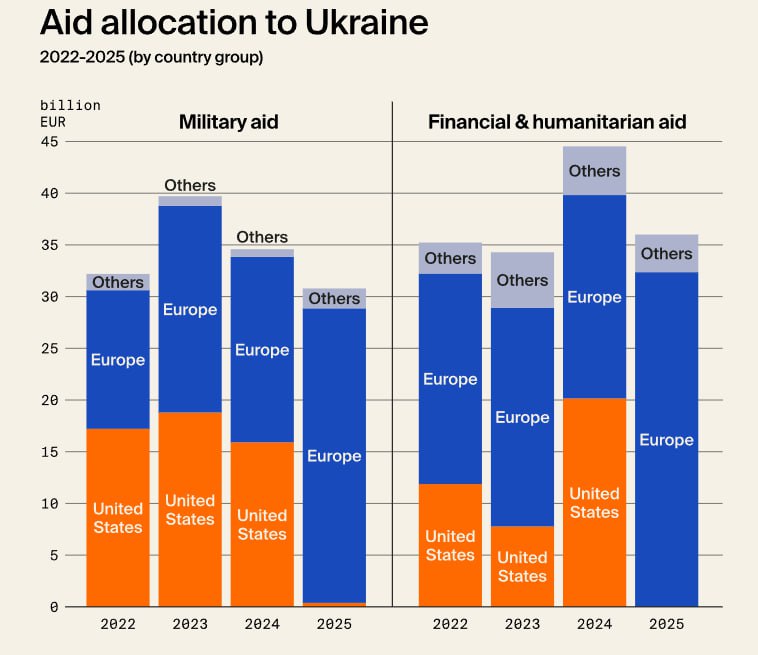
If Europe wants to maintain credibility when invoking international law in Ukraine, Gaza, or elsewhere, it cannot ignore the atrocities happening in Sudan, writes @_Will_Brown and @Cinzia_Bianco@ECFRAfrica
https://t.co/xk7rGfnFwS
"Durante la [primera Nakba], nos hicieron sufrir terriblemente.
Pero no fue como esta vez.
Esta vez, nos han mostrado el verdadero infierno".
Um Talal tiene 90 años y está viviendo en Gaza la segunda Nakba. Nadie debería pasar por esto.
Comparte. No dejes de hablar de Gaza.
A new study suggests that a million or more European Christians were enslaved by Muslims in North Africa between 1530-1780 – a far greater number than had ever been estimated before.
In a new book, Robert Davis, professor of history at Ohio State University, developed a unique methodology to calculate the number of white Christians who were enslaved along Africa’s Barbary Coast, arriving at much higher slave population estimates than any previous studies had found.
Most other accounts of slavery along Barbary coast didn’t try to estimate the number of slaves, or only looked at the number of slaves in particular cities, Davis said. Most previously estimated slave counts have thus tended to be in the thousands, or at most in the tens of thousands. Davis, by contrast, has calculated that between 1 million and 1.25 million European Christians were captured and forced to work in North Africa from 16th-18th Centuries.
“Much of what has been written gives the impression that there were not many slaves and minimizes the impact that slavery had on Europe,” Davis said. “Most accounts only look at slavery in one place, or only for a short period of time. But when you take a broader, longer view, the massive scope of this slavery and its powerful impact become clear.”
Davis said it is useful to compare this Mediterranean slavery to the Atlantic slave trade that brought black Africans to the Americas. Over the course of four centuries, the Atlantic slave trade was much larger – about 10 to 12 million black Africans were brought to the Americas. But from 1500 to 1650, when trans-Atlantic slaving was still in its infancy, more white Christian slaves were probably taken to Barbary than black African slaves to the Americas, according to Davis.
“One of the things that both the public and many scholars have tended to take as given is that slavery was always racial in nature – that only blacks have been slaves. But that is not true,” Davis said. “We cannot think of slavery as something that only white people did to black people.”
During the time period Davis studied, it was religion and ethnicity, as much as race, that determined who became slaves.
“Enslavement was a very real possibility for anyone who traveled in the Mediterranean, or who lived along the shores in places like Italy, France, Spain and Portugal, and even as far north as England and Iceland,” he said.
Pirates (called corsairs) from cities along the Barbary Coast in north Africa – cities such as Tunis and Algiers – would raid ships in the Mediterranean and Atlantic, as well as seaside villages to capture men, women and children. The impact of these attacks were devastating – France, England, and Spain each lost thousands of ships, and long stretches of the Spanish and Italian coasts were almost completely abandoned by their inhabitants. At its peak, the destruction and depopulation of some areas probably exceeded what European slavers would later inflict on the African interior.
Although hundreds of thousands of Christian slaves were taken from Mediterranean countries, Davis noted, the effects of Muslim slave raids was felt much further away: it appears, for example, that through most of 17th Century the English lost at least 400 sailors a year to the slavers.
Even Americans were not immune. For example, one American slave reported that 130 other American seamen had been enslaved by the Algerians in the Mediterranean and Atlantic just between 1785-1793.
***
Davis’s new estimates appear in the book Christian Slaves, Muslim Masters: White Slavery in the Mediterranean, the Barbary Coast, and Italy, 1500-1800 (Palgrave Macmillan).
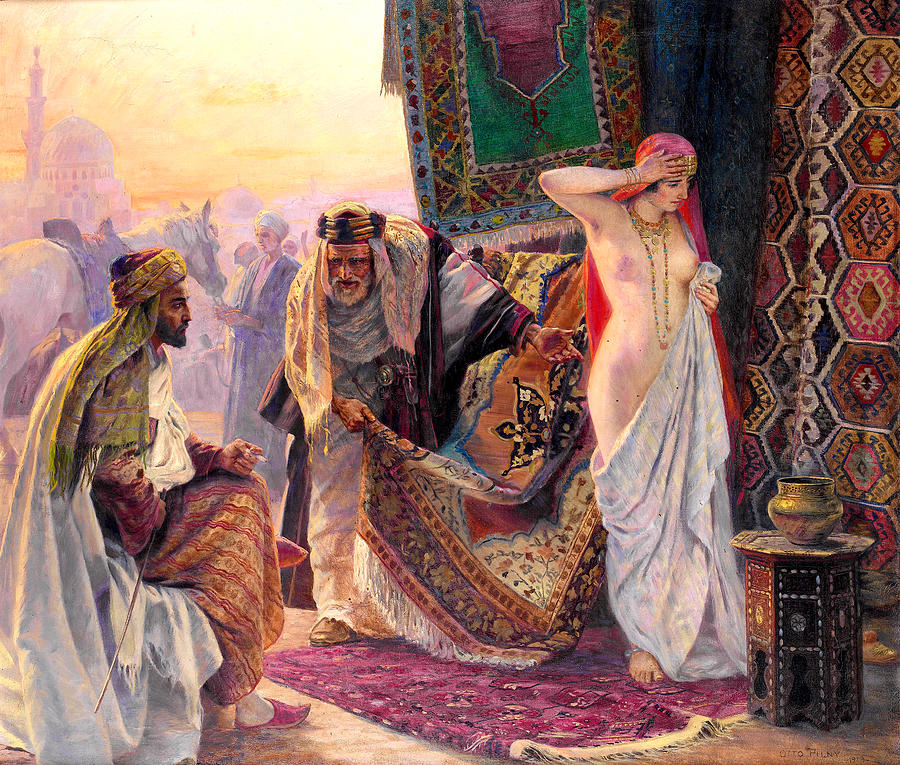
📷 : Scene at a slave market by Swiss artist Otto Pilny (1866-1936) painted in 1919.
#archaeohistories