Polsia just raised $30M at a $250M valuation.
Approaching $10M annual run rate.
One Founder + AI. Zero employees.
Polsia runs companies autonomously.
It also ran its own fundraising.
I just showed up for signatures.
Two layers of printed lines. One on the page, one on a clear film. Slide the film. That's it. That's the whole technology. The moiré effect has been known since the 19th century. Kurashima bound it between two covers. https://t.co/2zELa6h1WB
a founder has three jobs. everything else is serious amounts of noise.
1. you have to tell the story. roughly in three registers. first investors need inevitability. customers need to *feel* what you do/stand for. & your team needs a mission worth their best years.
2. you must secure the capital before you need it. running out of money is running out of options. you have to be relentless about it.
3. you must obsess over the product. product is the story made accessible for everyone. every shipped detail is a sentence back into the narrative in point number one.
this is the entire job.
everything else you either delegate or kill. early on with a really small team, delegation is a huge tax so you have to learn to kill more than you delegate.
In 1968, when computers were still seen as cold calculating machines, Jasia Reichardt curated an extraordinary exhibition in London called Cybernetic Serendipity. Artists, engineers, poets and scientists came together to explore the creative possibilities at the intersection of art and technology.The result was something remarkably ahead of its time. If you're curious about the early days of the relationship between computers and art, the catalogue is essential reading. The catalogue from Cybernetic Serendipity is filled with ideas, experiments and reflections that feel surprisingly relevant in our current AI era. You can read the full PDF for free here:
https://t.co/Kon6XD8ayE Highly recommended! Take your time with it. thanks @monalisa for the tip!
must read
Marcus went from product manager to shipping product like a madman @every with coding agents
he wrote the definitive guide for how to do it: https://t.co/IQpwPQK1Fi
the future interface is probably three layers:
1. ambient intent capture
voice, location, calendar, screen context, messages, habits, biometrics, etc. the system understands what you’re trying to do before you explicitly “open” anything or augments your intent deeply.
2. agentic execution
the actual work happens through agents operating software, apis, browsers, documents, email, calendars, workflows, payments, support systems, whatever. most “computer use” becomes machine to machine clerical labor.
3. ephemeral verification ux
humans still need to inspect, compare, approve, edit, reject, or enjoy things. that’s where gui survives but as disposable, task specific surfaces generated for the moment.
I don't fully understand how @JenPanepinto accomplishes this effect, but if you stare at this piece, it tricks your brain into thinking the whole piece is slowing shifting or zooming in continuously.
Her other glitch pieces all have a similar effect. Crazy.
DESIGN: THE FIRST AI CASUALTY
I'm increasingly sure that 2026 signals the end of product design as a full-fledged stand-alone function within companies. If so, it will be the first role / function to be eliminated by AI on a go-forward basis.
Instead of hiring FT designers, startups are hiring / will hire design consultants to create a design system that the founder likes (this takes a few weeks max). Once the design system is finalized, PM/Eng feed it into their AI tool of choice to generate prototypes. The design system is refreshed annually by the same consultant.
Larger companies will likely not backfill design roles and will do some targeted attrition to reduce the design department to 20% the size it is today.
If you're a designer, I think you have two choices:
1. Become an entrepreneur: Start a design agency and become the go-to resource for design systems for startups and even larger companies. This can be a good recurring revenue business.
2. Become a builder: Add PM/Eng responsibilities to become a product builder.
Would suggest you embrace this proactively vs waiting for the other shoe to drop.
I'm really sorry about this - some of my best friends and the people I admire most and have learnt the most from are designers - but it seems inevitable.
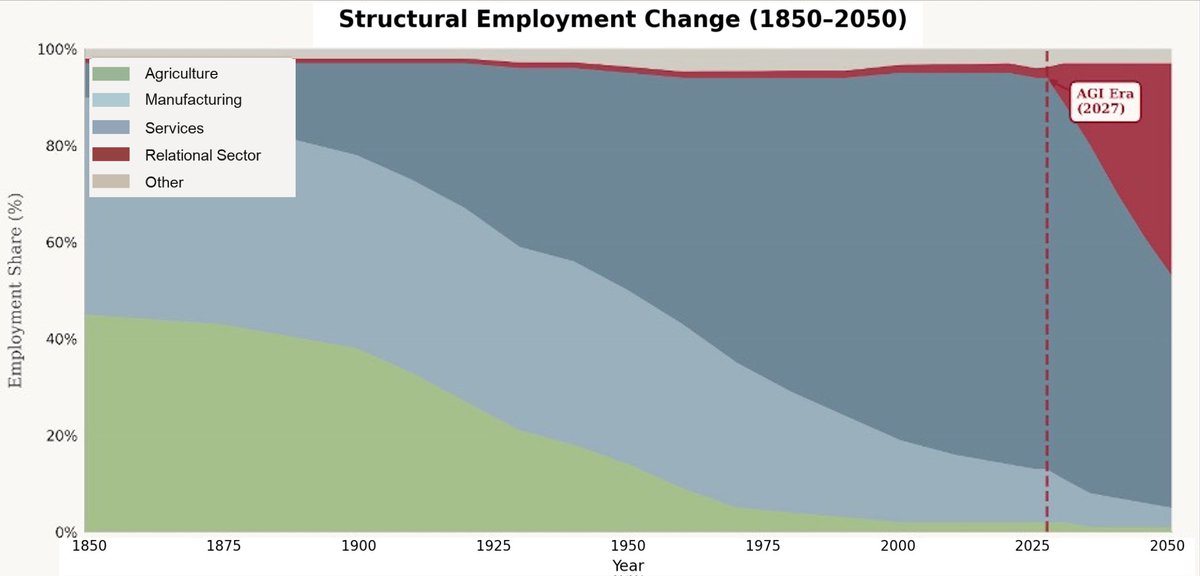
New essay on the economics of structural change and the post-commodity future of work.
1. Almost any question about the impact of advanced AI on the economy needs to start at the same place: what is still scarce? Answer that, and the analysis becomes pretty straightforward. This essay explores what becomes scarce if AI really can replicate most of what humans do in production, and what this mean for the future of jobs.
2. My conjecture, working through the economics: labor reallocates across sectors, and the sector it reallocates to has properties that keep labor a meaningful share of the economy. Ultimately this is about the structure of demand itself. For this, we have to go back to Girard, Augustine and Rousseau: once people's base needs are met, their preferences shift to comparative motives (e.g., status, exclusivity, social desirability). This motive is inherently non-satiated.
4. The key paper is Comin, Lashkari, and Mestieri (Econometrica 2021). As people get richer, they don't buy proportionally more of everything. They shift spending toward sectors with higher income elasticity. They estimate income effects account for 75%+ of observed structural change.
5. The ironic consequence: the sector that gets automated becomes a smaller share of the economy, not a larger one. Agriculture got massively more productive and its share of employment collapsed. Manufacturing too. The "stagnant" sectors absorb the spending and the jobs.
6. So the question is: which sectors have high income elasticity in a post-AGI world? I argue it's what I call the relational sector. Categories where the human isn't just an input into production, it is part of the value.
7. Why does the relational sector have high income elasticity? Because human desire has a mimetic, relational dimension. We don't just want things for their intrinsic properties. We want what others want, and we want it more when others can't have it. Girard, Rousseau, Augustine, and Hobbes all saw this.
8. In work with Kristóf Madarász, we showed this experimentally: WTP roughly doubles when a random subset of others is excluded from the good. And in new work with Graelin Mandel, AI involvement kills the premium. Human-made art gains 44% from exclusivity; AI-made art only 21%.
9. This all comes together for the core argument. The sector that absorbs spending as AI makes commodity production cheap is one where human provenance is part of the value, and demand for it grows faster than income. Exactly the profile that keeps labor meaningful.
10. To be clear about the claim: I'm NOT saying aggregate labor share must rise. It may fall. The claim is about sectoral composition, i.e., where expenditure and employment go once commodities get cheap, and the fact that the sector that will absorb reallocated labor maps to a substantial component of human preferences and desire.
11. If you're interested in the formal model, a linked companion technical note works out all the economics.
Read the essay here: https://t.co/NcjVgn2o8g
i needed a guitar tuner so i made one for iOS.
quick demo of me using tense tuner live. the particle visualization locks in pitch instantly and feels way more intuitive than anything else i’ve tried. thoughts?