Misión ELSE (Extraterrestrial Life Signal Explorer), el siguiente telescopio espacial chino tras el Xuntian. Si objetivo es obtener imágenes directas de planetas situados en la zona habitable de su estrella.
Destructuring the disk of AB Aurigae - Dynamics and accretion: https://t.co/TIeSxTU8pD -> The spinning origins of a planetary system: https://t.co/beuC1zf713
The Venus Life Finder has been anticipated to launch this summer 2026 via Rocket Lab's Electron.
But the last news was they switched to the Neutron rocket due scheduling and interplanetary performance, but Neutron isn't quite ready and this may delay Venus Life Finder till 2027. @RocketLab #venus
Mapping an exoplanet in longitude with time-resolved transmission spectra: https://t.co/bvWq1mxaYj -> Astronomers find variations between the morning and the evening conditions of an ultra-hot exoplanet: https://t.co/ACEDDslbus
Barnard's Star racing through space over a seven year period
Barnard's Star is a faint red dwarf located just 6 light-years away in Ophiuchus. It holds the record for the highest proper motion of any known star, racing across the sky at over 10.3 arc seconds per year, first measured by E.E. Barnard in 1916. This rapid apparent motion makes it shift noticeably against the far more distant background stars.
In 2024–2025, astronomers confirmed four tiny sub-Earth-mass planets orbiting it (Barnard’s Star b, c, d, and e). With masses between 0.19 and 0.34 Earth masses, these rocky worlds orbit very close to their star on periods of just 3–7 days.
Detected via precise radial velocity data from ESPRESSO and MAROON-X, they are far too hot for life but represent an exciting breakthrough in finding planets around one of our nearest stellar neighbors. A true cosmic speedster with its own planetary system!
Short-period Sub-Neptune Occurrence Rates Peak Around Early-type M Dwarfs: https://t.co/O6gNaLwunW (and several earlier Kepler / K2 papers) -> Finding Patterns in Planets: https://t.co/hiCIg4AAZq - Researchers Explore the Demographics of Alien Worlds in K2 Data.
JWST-TST High Contrast - First Direct Spectroscopy of GJ 504 b Reveals Clouds and Possible Metal Enrichment: https://t.co/31Wk6SDvEU -> Famous ‘Pink Planet’ harbors a salty surprise: https://t.co/1jmQ9qX7iK
Poster contributions related with CARMENES at Cool Stars 23 @CoolStars23#CoolStars23
- Montes, David, Labarga, Fernando
https://t.co/wIvZlqT5pN
- Schöfer, Patrick, et al.
https://t.co/zKvBOjI0bs
MEPAG Memo On NASA Mars Exploration Program Budget
https://t.co/r861aZZ6RJ
"If there was ever a time to take action in support of the Mars Exploration Program and federally-funded scientific research, now is that time."
La Facultad de CC Matemáticas de la UCM ha acogido la reunión del grupo de trabajo español de la misión Habitable Worlds Observatory (HWO), el futuro observatorio espacial insignia de la NASA dedicado a la búsqueda de vida en planetas extrasolares.
👉 https://t.co/NsfIU7y7c0
Póster contribution: “Quantifying Chromospheric Activity by Using the Spectral Subtraction Technique: iSTARMOD code”
Montes, David, Labarga, Fernando
at Cool Stars 23 @CoolStars23#CooolStars23
https://t.co/HjJ1AuCX1T
https://t.co/7l2xfYAdwc
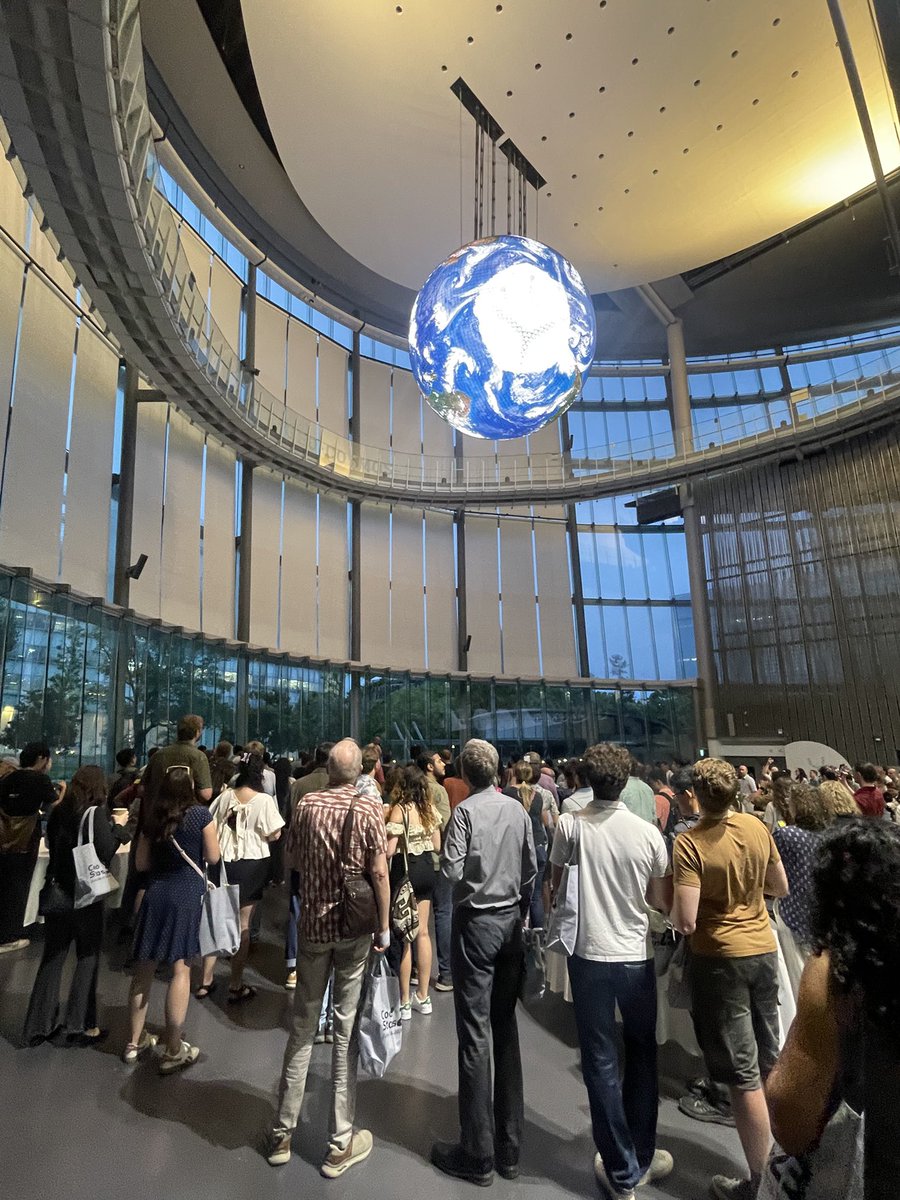
Today 14 June 2026 in Tokyo, Japan in the Recepcion of the "Cambridge Workshops on Cool Stars, Stellar Systems and the Sun", Cool Stars 23 @CoolStars23#CooolStars23
👉 https://t.co/fqKcjhOWSB
The James Webb Space Telescope has observed the surface of a bare rocky exoplanet, revealing old, dark rock akin to that on our Moon.
Read more: https://t.co/bQrNVogK73
A recent open access article published in @PASPJournal presents new closed-form solutions for the interferometric visibility of a rotating star with an arbitrary inhomogeneous surface using spherical harmonics. https://t.co/DZWAyJ1npT. -JGM
China busca su entrada como socio del Gran Telescopio de Canarias aportando un instrumento óptico de alta precisión para la detección de planetas similares a la Tierra https://t.co/J5ka7FMQ3C
¿Open European Journal of Variable Stars?????
is an on-line electronic journal open to anyone who wishes to publish their research on variable stars. 🧐