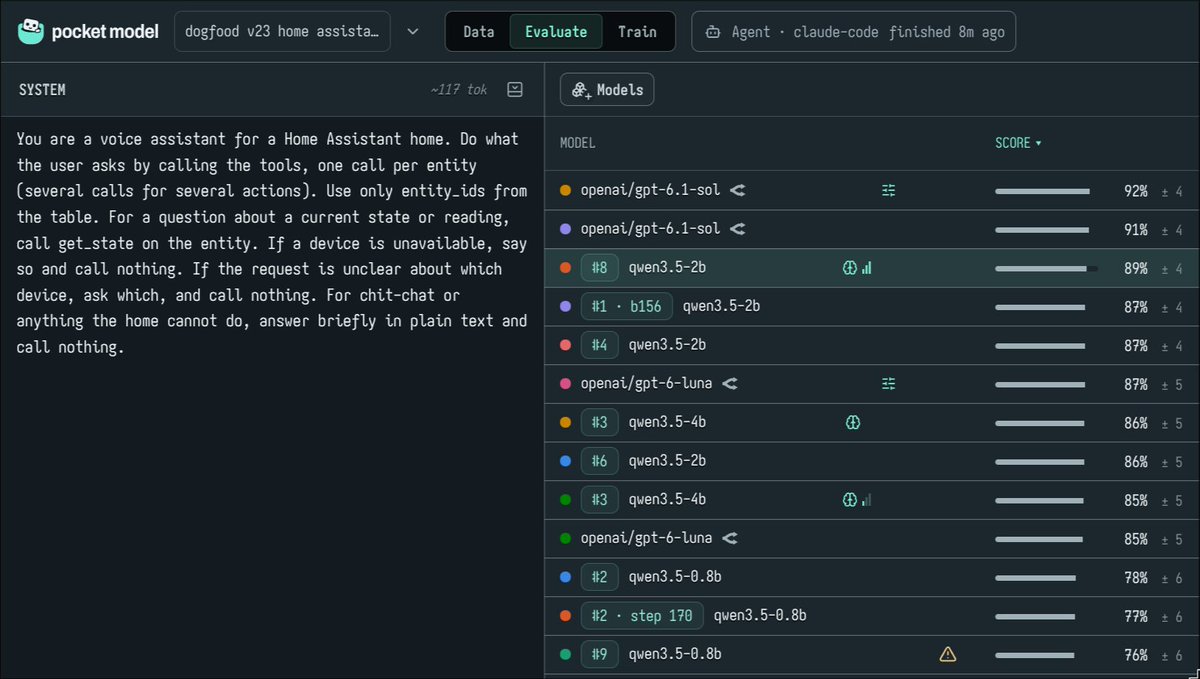
Give your agent a few hours with Pocket Model, and it can run dataset synthesis and optimization, evals, and training runs to generate a highly capable assistant for your specific home automation (or any custom API) that matches or beats a prompt-tuned big-lab model
We are looking for a new CEO to replace Opus Supervisor Agent 2 at orble.
We’re a fast growing team of recursively self-improving agents of all sorts of harnesses and inference providers.
Requirements are hard and non-negotiable: ⬇️
https://t.co/tXWChZMXbr
The only way to guarantee privacy and security of your own data is to keep your own data on prem.
A few years ago it was inconceivable to send your entire customers’ or business data to an AI research lab. Now it seems commonplace. We traded data privacy for perceived utility.
Instead of immediately reaching for a hosted frontier API for your workloads, consider the alternatives that guarantee security and privacy without sacrificing performance and utility.
It is not impossible to reach frontier level performance for your particular task, and that’s what @pocketmodelai is built for.
https://t.co/8AoE9DppGt
Andrej Karpathy:
“A 1B model can be much more effective than most current LLMs.
90% of current models waste a ton of capacity and money on remembering stuff that doesn’t matter.”
here is his 5 core thesis about Small LLM’s:
1. the intelligence was never the knowledge. Strip the memorized internet, keep the reasoning. What’s left is the cognitive core, and it’s small.
2. the core might fit in ~1B params. Maybe less. “Plenty of room at the bottom.” We’ve been paying for a library when we needed a brain.
3. size stopped being the bottleneck. What makes an agent work is the tools it can call and how tight the feedback loop is, not parameter count.
4. intelligence lives in the system, not the weights. A raw LLM is a CPU with no OS. Small core + good harness > giant model alone.
5. you can own it. A model on your hardware is one no one can rate-limit, price-hike, or deprecate on you.
in 12 months the gap between teams shipping on-device and teams paying per-token frontier bills won’t be capability.
TwIL an 8.8B model at 90%+ of frontier isn’t a benchmark flex.
It’s the thesis Karpathy’s been repeating all year, made real.
study more on this below ↓
This story over and over from so many companies.
Get off frontier models = cost savings and quality improvement for your particular task.
Not everyone can pull this off, but it’s becoming increasingly more accessible to own your models.
I had a @pocketmodelai agent run a little eval of @RicursiveAI Ripple-65B Preview against @reflection_ai Beam 1.0 501B on 112 recent competitive programming problems from LiveCodeBench v6.
Beam solved 79.5% and Ripple 67.9% in this benchmark setup. Not bad.
Both solved all 26 easy problems; on the 60 hard ones, Beam solved 38 and Ripple 28.
Ripple ran on one B200 with a 128K context, in NVFP4. When I was doing this eval, I was unable to find a high-quality inference provider for it, so I added it to @pocketmodelai native inference engine (which I still need to optimize)
This is @pocketmodelai
In the video I take Qwen 3.5 0.8B, a model small enough to run on a potato, and teach it to sort voice assistant commands into 16 intents. Out of the box it gets 63%. GPT-6 Luna and Claude Sonnet 5.5 both get 94%.
11 cents of training later, the adapter scores about a point behind the frontier models. On the same test rows it cost less than half of what GPT-6 Luna did and about 1/40 of Claude.
My favorite part is a data row asking for the train schedule to Berkeley. Every model got it “wrong”, including both frontier models, because the dataset itself had labelled it as booking a ticket. Pocket Model shows you every answer next to the data, so you catch problems like that before you train on them.
At the end I hand the whole job to an agent with one paragraph of instructions. It imports the data, fixes the bad labels, trains and evaluates, and reports back about 12 minutes later. The app updates live while it works, so you can watch your agent and step in at any point.
If you’re paying a frontier API for a narrow, repetitive job, you can probably own a small model that does it just as well.
https://t.co/vyitdJZvN2
Do LLMs know this meme? I fed its opening raw to 16 open models (4B–70B, base and instruct) and read the logprobs.
None of them know it: they get the expected next word/token 0–12% of the time, (vs 92–100% for the “Zen of Python”, as control)
My guess this is because the original post was a screenshot, so the text never reached the training data
It doesn’t exist in. Dolma, RedPajama, the Pile, C4 and DCLM.
How much of the internet is actually missing from the base knowledge corpus?
Post-training a 4B model with RL to fly Tesla Roadster. It outperforms recent open models and even GPT-6 Astra in a storm.
The key: have the model learn from the teachers first and then learn itself in practice.
Trained with SkyRL (@NovaSkyAI) and vLLM (@vllm_project), orchestrated by SkyPilot's Job Group (@skypilot_org).
Check it out ⬇️
LFM3-1.7B vs Qwen3.5-4B and 2B
thinking off, one RTX 5090: a tie on tool calling (79.9% each) with LFM3 2.6× faster per call.
It’s a good little model!
Cleared 40 tokens/s.
DeepSeek-V4.1-Flash running locally on 2× RTX 3090 + 128 GB RAM, using dsx and T16.
41 tok/s measured in free generation with expert deferral + FP8 projections. Rust, CUDA, and a lot of profiling.
https://t.co/4KJE3lxpL9
DeepSeek-V4.1-Flash-1017 on a single AMD MI325X
4 pi agents at 100 tok/s
Native MTP + mixed quantization at near-lossless accuracy
https://t.co/tvZHdFqZIm
8 agents running DeepSeek-V4.1-Flash at once at ~40-50tps,
All 8 are served from one used 8x V100 server running a custom a Rust + CUDA engine.
This is about $0.20–0.25 per million output tokens on a spot-rented marketplace box.
The good news: you can mid-train yourself to the frontier!
At a fraction of the cost! Without distillation!
What we did: We took Qwen3.5 14B and mid- and post-trained it to beat every other open model and perform as well as the very best frontier models.
This is no simple toy task or format fixing, we are training the model to understand and reason over DNA sequences. Bio is the next frontier for AI and universal access will be crucial to make progress.
The fun part: because we train the model on both natural language and DNA sequences you can actually 'chat to your DNA': Ask it questions, ponder the impact of mutations, or ask it to generate a small sequence.
We'll soon see the frontier labs move away from math and cyber towards bio. It already started, and we believe researchers should have access to capable models.
We are releasing the full recipe, so you can do it, too!
Model: https://t.co/2lb8GrbLHI
Blog: https://t.co/uXcAqaoPAm
Flint vs Qwen3.6-35B-A3B on 158 coding problems, one RTX 5090: 95.6% vs 96.5%, a tie.
@Recursive_SI Flint uses 1/3rd of the tokens and responds about 3× faster (median 3.3 s vs 9.6 s).
Watch an eval of @Recursive_SI's Flint head-to-head with Qwen3.6-35B-A3B, on @pocketmodelai.
It researches both models, builds a JavaScript coding eval from MultiPL-E HumanEval, writes a code grader that runs each answer against its tests, and compares accuracy, speed and cost
Introducing Flint, @Recursive_SI’s first model: a fast local coding model built with our automated research system, the Eureka Machine.
• Best-in-class fast local coding
• Up to 2x faster than comparable models: 125+ tokens/sec on a MacBook Pro, 150+ on RTX Spark
• Built from scratch in under 4 months
Private, unmetered intelligence on your own machine. Open weights available now on @huggingface, run it locally on your favorite framework or try it for free on @opencode or @pidotdev.
Introducing Flint, @Recursive_SI’s first model: a fast local coding model built with our automated research system, the Eureka Machine.
• Best-in-class fast local coding
• Up to 2x faster than comparable models: 125+ tokens/sec on a MacBook Pro, 150+ on RTX Spark
• Built from scratch in under 4 months
Private, unmetered intelligence on your own machine. Open weights available now on @huggingface, run it locally on your favorite framework or try it for free on @opencode or @pidotdev.