The US government, citing national security authorities, has issued an export control directive to suspend all access to Fable 5 and Mythos 5 by any foreign national, whether inside or outside the United States, including foreign national Anthropic employees.
The net effect of this order is that we must abruptly disable Fable 5 and Mythos 5 for all our customers to ensure compliance.
Access to all other Claude models is not affected.
We apologize for this disruption to our customers. We believe this is a misunderstanding and are working to restore access as soon as possible.
Read our full statement: https://t.co/bwn0sximKZ
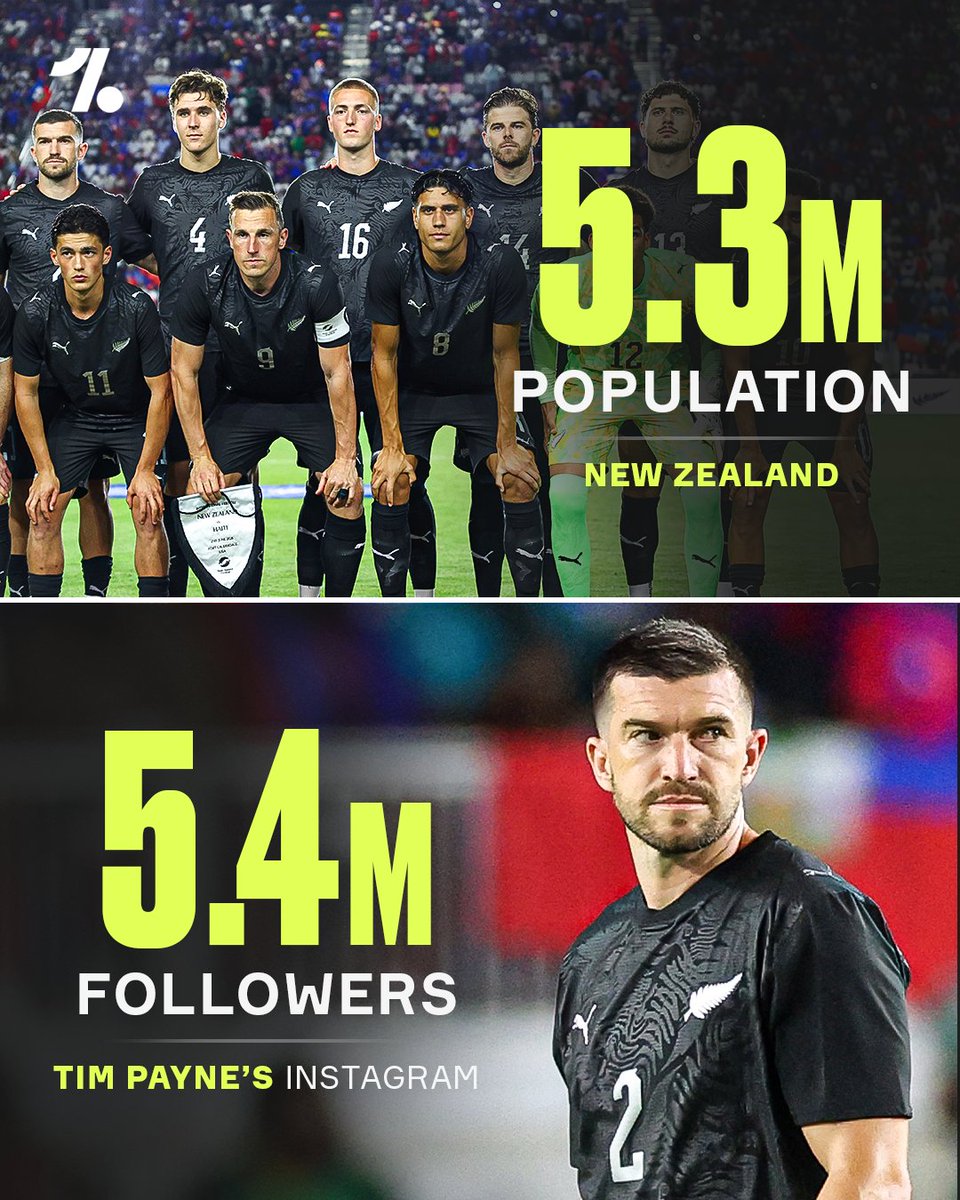
Tim Payne now officially has more Instagram followers than the ENTIRE population of New Zealand 😅📊
His account has gone from 5k to 5 MILLION followers after influencer Valen Scarsini took to social media to make the "least-known player at the World Cup" famous 📈
BREAKING.: Biggest privacy token $ZEC crashed over -50% in the last 24 hours and wiped out $5 Billion from its market cap.
The flaw was hidden inside Zcash's Orchard privacy pool since May 2022 and remained undetected for nearly 4 years despite multiple security audits.
Security researcher Taylor Hornby reportedly used Claude Opus 4.8 AI model to build a working proof-of-concept that successfully generated counterfeit ZEC in local testing on May 29.
Although the bug has now been patched on June 2, The issue is that Zcash's privacy design makes it impossible to know if any fake ZEC was minted before the fix. Unlike Bitcoin, where anyone can verify the supply, Zcash's privacy design makes it impossible to audit whether fake coins were secretly minted before the fix.
The team denies any fake ZEC was minted, but traders are selling on the fear alone. Imagine someone secretly adding extra chips to a casino, but because of the way the system works, neither the casino nor the players could tell which chips were real and which were fake.
Shielded Labs is exploring a proposed Network Upgrade to allow anyone to verify the integrity of Zcash supply.
Live from Code with Claude London: we're launching self-hosted sandboxes (public beta) and MCP tunnels (research preview) in Claude Managed Agents.
Run agents inside your own perimeter, with your security controls applied by default.
On April 15, a Yale-educated Chinese commentator named Jiang Xueqin went hyper-viral across TikTok, X, and YouTube asking the question he wanted billions of people to hear: “Where are the blockchain servers physically located?”
On the same day, the Islamic Revolutionary Guard Corps collected cryptocurrency transit tolls from oil tankers passing through a maritime chokepoint that carries one-fifth of the world’s seaborne oil.
One controllable-tier power is telling the world Bitcoin runs on CIA servers. The other controllable-tier power is using Bitcoin at gunpoint because it does not.
The answer to Jiang’s question, as of 01:55 UTC this morning per https://t.co/XiceT91usE: 22,174 independently operated reachable full nodes across 164 countries, 63.29% routing through Tor, secured by 1.09 zettahashes per second of computing power distributed across the United States at 37.4%, Russia at 16.9%, and China itself at approximately 12% despite its own ban. No servers. No central point of failure. No kill switch. Seventeen years of continuous adversarial operation without a single consensus breach.
Jiang is not a computer scientist. He holds a Yale BA in English Literature and teaches high-school philosophy at Moonshot Academy in Beijing. He has floated the identical “Bitcoin is a CIA/deep state/Pentagon operation” framing at least three times in 2026 alone, including a March appearance with SNEAKO, without professional consequence from a state that imprisoned citizens for less. As @bitcoinwell noted on April 16 in a post exceeding ten thousand likes: “A credentialed academic pretending not to grasp this is not ignorance. It is a red flag.”
Whether Jiang is a genuine non-technical commentator or a state-tolerated narrative asset is, for the purpose of this analysis, secondary. The effect is identical. The “servers” question is rhetorically engineered to sound plausible to non-technical audiences while raising maximum adoption friction in Chinese-speaking and BRICS-adjacent jurisdictions. It is the controllable tier’s final weapon: not sanctions, not freezes, not naval blockades, but manufactured confusion about the protocol’s architecture deployed at the precise moment the architecture proves its value under live fire.
The timing is the tell. On January 30, OFAC designated Iran’s preferred stablecoin exchanges. Sixty days later, Iran’s parliament codified the Hormuz Management Plan. On April 8, the Financial Times quoted Iranian officials announcing Bitcoin as an acceptable toll currency. On April 14, BIP-361 was formally published proposing the first consensus-level freeze in Bitcoin’s history. On April 15, Jiang’s “servers” clip went nuclear across Chinese-language internet. On April 16, Adam Back took the Paris Blockchain Week stage to oppose BIP-361’s forced-freeze architecture.
Six events across seventeen days. The controllable tier attacking the uncontrollable tier through enforcement, narrative, and now protocol governance, simultaneously. The uncontrollable tier responding with 22,174 nodes, armed toll collection, and an internal constitutional debate about whether to compromise the very property that makes it valuable.
The IRGC does not care where the servers are. It knows there are no servers. That is why it is collecting two million dollars per supertanker in an asset no court order can freeze. Iran’s paramilitary force has become a structural Bitcoin long at the same moment a credentialed voice from Beijing is telling the world the whole thing is a honeypot.
The narrative war is the final confirmation. When the controllable tier deploys its best FUD at the exact moment the uncontrollable tier proves utility under fire, the two-tier architecture is no longer a thesis. It is an observed equilibrium.
Full institutional analysis below. https://t.co/FRwSI1w8WU
Ansel is right. People with this view don’t truly understand the open source aspect or the proof of work aspect fully.
A strong point about Bitcoin is that it literally doesn’t matter who created it. It can be assessed on its own merits since it’s transparent and decentralized.
ADAM BACK JUST ABSOLUTELY DESTROYED #BITCOIN QUANTUM FUD LIVE ON BLOOMBERG
QUANTUM COMPUTERS ARE "EXTREMELY BASIC"
WE STILL HAVE "A DECADE" TO PREPARE
DON'T BELIEVE THE FUD. HODL 🚀
Saw some people panicking or asking about quantum computing's impact on crypto.
At a high level, all crypto has to do is to upgrade to Quantum-Resistant (Post-Quantum) Algorithms. So, no need to panic. 😂
In practice, there are some execution considerations. It's hard to organize upgrades in a decentralized world. There will likely be many debates on which algorithm(s) to use, resulting in some forks.
And some dead project may not upgrade at all. Might be a good to cleanse out those projects anyway.
New code may introduce other bugs or security issues in the short term.
People who self custody will have to migrate their coins to new wallets.
This brings to the question of Satoshi's bitcoins. If those coins move, then it means he/she is still around, which is interesting to know. If they don't move (in a certain period of time), it might be better to lock (or effectively burn) those addresses so that they don't go to the first hacker who cracks it. There is also the difficulty of identifying all his addresses, and not confuse with some old hodlers. Anyway, it's a different topic for later.
Fundamentally:
It's always easier to encrypt than decrypt.
More computing power is always good.
Crypto will stay, post quantum.
My dear front-end developers (and anyone who’s interested in the future of interfaces):
I have crawled through depths of hell to bring you, for the foreseeable years, one of the more important foundational pieces of UI engineering (if not in implementation then certainly at least in concept):
Fast, accurate and comprehensive userland text measurement algorithm in pure TypeScript, usable for laying out entire web pages without CSS, bypassing DOM measurements and reflow
Introducing TurboQuant: Our new compression algorithm that reduces LLM key-value cache memory by at least 6x and delivers up to 8x speedup, all with zero accuracy loss, redefining AI efficiency. Read the blog to learn how it achieves these results: https://t.co/CDSQ8HpZoc
🚨 Simulation Theory: The Double Slit Experiment proves particles act like waves until observed then they snap into particles.
What if our reality only "renders" when we're looking, just like a video game optimizing resources?
Check out this episode from The Why Files breaking it down, tying it to Simulation Theory. Are we in a sim?
This could be the key to unlocking the true nature of existence!
The Why Files video did a great job on explaining the Double Slit Experiment & Simulation Theory
What do YOU think—real or rendered? Drop your thoughts below!
this is fucking insane!
the CEO of anthropic said what most C-suites only say behind closed doors.
"50% of all entry-level Lawyers, Consultants, and Finance Professionals will be completely wiped out within the next 1–5 years."
this is the head of one of the biggest AI companies alive telling ordinary people to wake up.
good news is that the playbook hasn't changed.
pick an industry. learn the workflows. become the "AI guy" these companies need!
you don't need a degree. you sure as hell don't need to be a McKinsey consultant.
you need claude, a vertical, and the hunger to learn a business better than anyone else.
god speed! will be rooting for ya.
THE NEXT BUYERS OF CRYPTO MAY NOT BE HUMAN
Brian Armstrong just highlighted a shift most of the market is still underestimating.
At Coinbase, AI agents are now writing 50%+ of the code and handling about 60% of customer support. Automation is already deeply embedded.
But the real unlock is payments -- Armstrong says Coinbase is giving AI agents their own stablecoin wallets so they can execute machine-to-machine transactions -- spinning up cloud resources, accessing paywalled data, buying domains, and more without a human approving every step.
Traditional finance wasn’t built for this. Corporate cards require human identity. Autonomous software doesn’t fit that model -- but crypto rails do.
If agents are going to operate like digital employees, they need native internet money. Stablecoins are starting to fill that role, and that quietly expands the addressable demand base beyond humans.
Still early but the direction is clear, the AI economy is beginning to plug directly into crypto.