@MHReddell And doesn’t deferring infrastructure spend make sense in an environment dominated by conspicuous safety virtue signalling? Surely costs will be lower when common sense returns
Podcast with Alan Allport about his book Advance Britannia. Situates Britain's WWII Bomber Command within a broader social, political, and cultural history, showing how the air war was fought – and how it has been remembered.
@RAFBomber_Pod https://t.co/x42yWEYbki
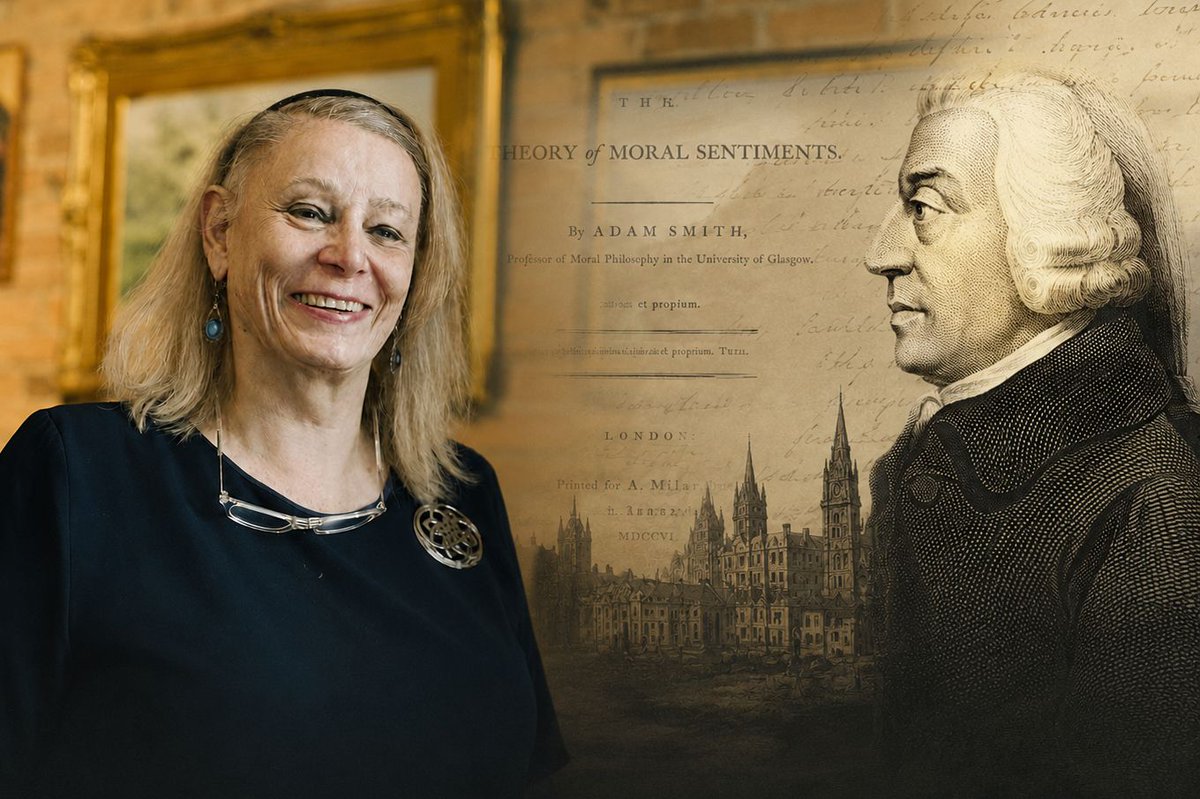
Deirdre McCloskey spent two decades inside the economics mainstream teaching Adam Smith as the founder of market analysis.
Then she reread the book Smith wrote 17 years before The Wealth of Nations.
What she found there set her on a decade-long project: a trilogy arguing her profession had missed half of Smith's case. 🧵
Podcast with Benjamin Todd about his book 80,000 Hours: How to Have a Fulfilling Career That Does Good. Discusses finding a high-impact career amidst rapid AI advancement.
@80000Hours@ben_j_todd https://t.co/FmSeqgXRO0
Podcast with Tim Minshall about his book How Things Are Made. Discusses manufacturing, the role of education in manufacturing, challenges in reviving manufacturing, and the future of manufacturing and software integration.
@UnsiloedPodcast https://t.co/hjZDso8GIn
Podcast with Lane Kenworthy about his book Is Inequality The Problem? Argues that inequality is overrated as “the” cause of our problems – and discusses why the data pushes him toward a different set of priorities.
@TheArgumentMag
https://t.co/2NDQJ4BNAj
A British biologist looked at 200,000 years of human history and found that the entire reason humans broke out of poverty was not intelligence, not language, not even agriculture, but one mechanism so simple a 6-year-old could explain it.
His name is Matt Ridley.
He is a zoologist by training, an evolutionary biologist by career, and in 2010 he wrote a book called The Rational Optimist that quietly argued the most important fact about human progress had been hiding in plain sight for the entire history of economics.
Naval Ravikant has been telling people to read everything Ridley has ever written for the last 15 years. The reason is the argument inside this one book.
For 200,000 years, anatomically modern humans walked around with the same brain you have right now. Same skull size. Same neural architecture. Same raw capacity for language, planning, and abstract thought.
For roughly 190,000 of those years, almost nothing happened. Generation after generation lived and died inside the same Stone Age toolkit their great-great-grandparents had used. Then somewhere around 50,000 years ago, the line on the chart of human progress started to tick upward. Then it bent. Then it exploded.
The question Ridley spent years on was the only question that mattered. What changed.
It was not the brain. The brain had been the same for 190,000 years. It was not language, which had existed long before the takeoff. It was not even agriculture, which arrived only 10,000 years ago and was actually preceded by the upward bend, not the cause of it.
What changed was that humans started trading with strangers.
This sounds too small to be the answer. Ridley argues that it is the answer to almost everything. The moment one human exchanged a useful object with another human from a different group, something happened that no other species on earth had ever done.
Two ideas that had developed in isolation came into contact. The flint knapper learned what the spear maker had figured out. The fisherman from the coast learned what the hunter from the forest had figured out. The two pieces of knowledge fused into something neither side could have produced alone.
Ridley calls this ideas having sex. The phrase sounds frivolous and it is meant to. The point is that ideas, like genes, get better when they combine with other ideas from different lineages.
An idea sitting inside one head, no matter how brilliant the head, eventually hits a ceiling. The same idea exposed to ten thousand other ideas does something genes do under sexual reproduction. It mixes. It recombines. It produces offspring nobody planned.
The cleanest proof of this argument is the most uncomfortable case study in the book. Tasmania.
Around 10,000 years ago, rising sea levels cut Tasmania off from mainland Australia. A population of roughly 4,000 humans was now isolated on an island, with no possibility of contact with the rest of humanity. They had the same brains. The same language. The same starting toolkit as their cousins 150 kilometers north. The natural experiment was now running.
What happened next is something no economist or geneticist had ever predicted.
The mainland Australians kept inventing. Boomerangs. Spear-throwers. Fishing nets. Bone needles for sewing fitted clothes. Watercraft with paddles. Their technology compounded slowly across the centuries.
The Tasmanians went the other way. They did not just fail to invent the new tools their cousins were developing. They started losing the tools they already had. Fishing was abandoned within a few thousand years. Bone tools disappeared. Fitted clothing disappeared. They forgot how to make fire from scratch and started carrying lit firebrands from camp to camp instead, relighting their fires from a neighbor's whenever their own went out.
By the time European explorers arrived in the 17th century, the Tasmanians had the simplest toolkit of any human society ever recorded. Their material culture had gone backward for 8,000 years.
The archaeologist Rhys Jones called it a slow strangulation of the mind.
Joseph Henrich at Harvard later proved with formal mathematical models that there was nothing wrong with Tasmanian brains. There was something wrong with their network. A toolkit requires a critical mass of people exchanging skills to maintain itself.
The act of teaching a skill is imperfect. Every generation loses a small percentage of what the last generation knew. If your population is large enough and trading widely enough, those losses get caught and corrected by someone else who still remembers.
If your population shrinks below a certain threshold and stops mixing with outsiders, the small losses compound until entire technologies disappear.
This is the part that should haunt anyone reading this in 2026.
Intelligence is not a property of the individual brain. Intelligence is a property of the network the brain is connected to. A genius in isolation will produce less than a mediocre thinker inside a dense exchange of other mediocre thinkers.
The thing your ancestors needed in order to break out of 190,000 years of stagnation was not better brains. It was better connections between brains they already had.
The implication for any individual is direct and uncomfortable. If you are smart and isolated, you will be outproduced by people half as smart who are connected.
The most successful people in any field are almost never the smartest people in it. They are the ones positioned at the intersection of the most idea flows. They are reading more authors than their competitors. They are talking to more people from more disciplines. They are in the rooms where ideas from different lineages bump into each other.
Ridley ends the book on the line that sounds optimistic but is actually a warning its this "The future will be invented by people who connect ideas, not by people who guard them."
Interview with Samuel Moyn about his book Gerontocracy in America. Discusses why American wealth and political influence isn’t transferring to younger generations and how to rebalance power among generations.
@kerathink@samuelmoyn https://t.co/uhaxyn4E1X
Podcast with James Riordon about his book Crush: Close Encounters With Gravity. Explores the science of gravity and how gravity shapes everything, from Newton's laws to black holes, dark matter, and the weirdness of weightlessness.
@amseonline https://t.co/DNclkNzHaL
Podcast with Lloyd Llewelyn-Jones about his book Babylon: The Biography of a Metropolis. Frames Babylon as a vital, enduring node in world history. Includes insights from thousands of cuneiform tablets.
@TidesHistory https://t.co/3VraV4j1hB
Podcast with Edmund Richardson about his book Alexander: God, King, Man. Discusses what is fresh to say about Alexander the Great, and why his empire collapsed as soon as it came into being, yet nevertheless changed history.
@spectator@questingvole https://t.co/rhZbllNAfV
Podcast with Roger Crowley about his book City of Fortune. Explores how Venice became the commercial powerhouse of medieval Europe, and why it was pushed into decline by the Ottomans, before finally falling to Napoleon Bonaparte in 1797.
@HistoryHit https://t.co/sBw4CWfD2V
Podcast with Dennis Rasmussen about his book The Infidel and the Professor. Discusses the friendship between David Hume and Adam Smith during the Scottish Enlightenment and how each influenced the others thinking.
@EconTalker
https://t.co/AbWQHPqO75
Podcast with Hugo Drochon about his book Elites and Democracy. Argues that democracy is usefully understood as a perpetual struggle between rising elites and ruling elites.
@NewBooksCritThe https://t.co/wXD6BvcKxB
Interview with Aaron Brown about his book Wrong Number. Discusses why institutions that produce bad statistics face so few consequences; why financial markets are good at error-correction, & why "wanna bet?" functions as a tax on bullshit.
@patio11 https://t.co/zixiiP6TRg
Interview with Robert Liddiard & Oliver Creighton about their book Medieval Warhorse. Discusses the medieval warhorse as a battle-winning technology, the evolution of breeds, & their centrality to chivalric identity & romance literature.
@HistoryExtra https://t.co/wKJjY4e3Qh
We didn’t have “HR” when building Palantir, for similar reasons - I avoided Ryan’s mistake.
And when we needed some PeopleOps, we hired technical leaders.
Going into the vast majority of companies and firing most of their HR and Marketing departments would tend to create value!
Podcast with Martin Parkinson discussing Australia’s “permanently temporary” guest-worker system, skilled migrant underutilization, subsidisation of research by international students, the importance of productivity growth, & more.
@joewalkerpod
https://t.co/FYOnZNAltF
Podcast with Siri Hustvedt about her memoir Ghost Stories. Describes her 43-year marriage to the late author Paul Auster, their writing, family tragedies, Auster’s cancer treatment, and the psychology of grief.
@ninetonoon
https://t.co/RcmERVGCzH
Podcast with Alex Imas discussing why automation fears persist despite contradictory evidence, the history of technological disruption, and why AI may not be destroying work but redirecting us toward new industries and opportunities.
@DKThomp@alexolegimas
https://t.co/5WFIDAFNtx