⏰Xmas came early this year!🎄 My final dissertation paper officially out in @polcommjournal!
We test the role of algorithms in shaping the cost of reaching voters. We find: who sees political ads & at what price depends NOT just on targeting choices.🧵
https://t.co/CYUwdI62aC
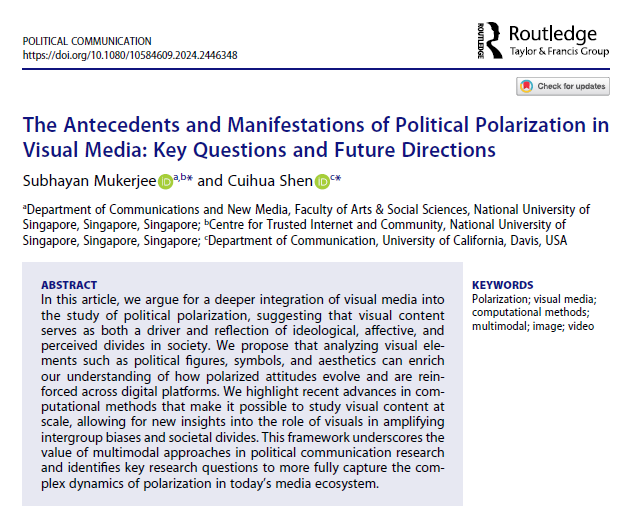
Happy 2025! @cuihua and I are happy to announce new forum piece in @polcommjournal where we argue for a need to focus more on visual content when trying to understand the causes and manifestations of political polarization.
📣 New pub alert!
In this paper, @DarianHarff & @DesireeSchmuck analyze how young people encounter politics via social media influencers, using surveys & content analysis of YouTube in Germany & Belgium.
Read here: https://t.co/iQdwu930b9
Join the PolComm team! We are accepting applications (CV, cover letter, 3 references) for our Data Editor position until September 15th. Read more here: https://t.co/LLqfkL1b2p
Excited to share my new article, with @ArriolaLR & @matanock, just published in @polcommjournal
Heard the claim that @facebook caused a genocide by fanning the flames of hate in #Myanmar? The reality may be more complicated…
https://t.co/c6zuBuU9eU
A brief 🧵 1/15
**POLCOMM PUBLICATION FRIDAY**
Don't miss the latest batch of @polcommjournal's FORUM articles, on Artificial Intelligence, Political Ad Libraries, & Transgender Health Misinformation – Incredibly timely articles by leading experts in our field. 🧵⤵️
https://t.co/VfYAQrNzF9
I'm in @Newsweek today talking about my recent @polcommjournal article on how couples navigate news selection & discussion when they hold different political beliefs https://t.co/O50OaHisr7
Very excited that my first journal article of 2024 is now out in @polcommjournal! In this forum piece, I draw on a Health and Human Rights framework to analyze the political implications of anti-transgender health misinformation. Please give it a read!
https://t.co/Tl1NP54Ggh
📢 Political Communication invites submissions for 3 special issues!
1. Democratic Listening https://t.co/zC87Z1Bm97
2. Computational Propaganda in the Global South https://t.co/SLsaR5QDeH
3. Multi-Platform Research https://t.co/nCPx4Fu3vq
Are you studying computational propaganda in the Global South with a focus on overlooked social media platforms? Consider submitting to this special issue in @polcommjournal, edited by @hossein_kermani, @TaberezNeyazi and @solecheler until 15th Sep.👇
https://t.co/WM3U5y9ZCH
.@polcommjournal welcomes your research for a special issue that aims to broaden piecemeal, multi-platform political communication research using comparative and systematic approaches.
Learn more: https://t.co/NsRcfq8A8S @LawrenceRegina@JosephineLukito@MeredithPruden
A few more days to submit your listening research for the upcoming @polcommjournal special issue. 1000 word abstracts due by August 1! @poli_com@DelDemUCan
Trending in #Communication:
https://t.co/Y08bXonLI1
1) Consequences of Amplifying the Radical Right on Twitter (@polcommjournal)
2) AI & Democracy (@socialmedia_soc)
3) K-pop TikTok (@media_int_aus)
4) Netflix & non-English-language series (@revista_epi)
7. Finally, @grohanver (@USCAnnenberg) & @rachelkuo (@MediaAtIllinois) use ethnography, interviews, & archival materials from Asian-American social movements to show how race is not exogenous to politics—race is constructed through political communication. https://t.co/j8XwvXxGSl
6. @BrielleHarbin (@NavalAcademy) looks to TV series #Survivor for narratives of racial duty from Black contestants. Thru inductive thematic content analysis of post-episode tweets, she finds overwhelming rejection of these narratives as "too political." https://t.co/2pZh1VF51C
5. @marquesgz (@RicePoliSci, now @BrownUPoliSci) explores how "Hispandering" influences political trust among Hispanics. In two experiments, he shows how white vs. Hispanic candidate language use affects Hispandering perceptions, which ⬇️ political trust. https://t.co/7QXnC4BSMz