Abelardo de la Espriella amenazó con denunciar penalmente a un periodista por atreverse a interpelarlo y decirle que no llame “plaga” a ningún ser humano, y miente cuando afirma que @sergio_fajardo y @DeLaCalleHum promueven el socialismo y el comunismo.
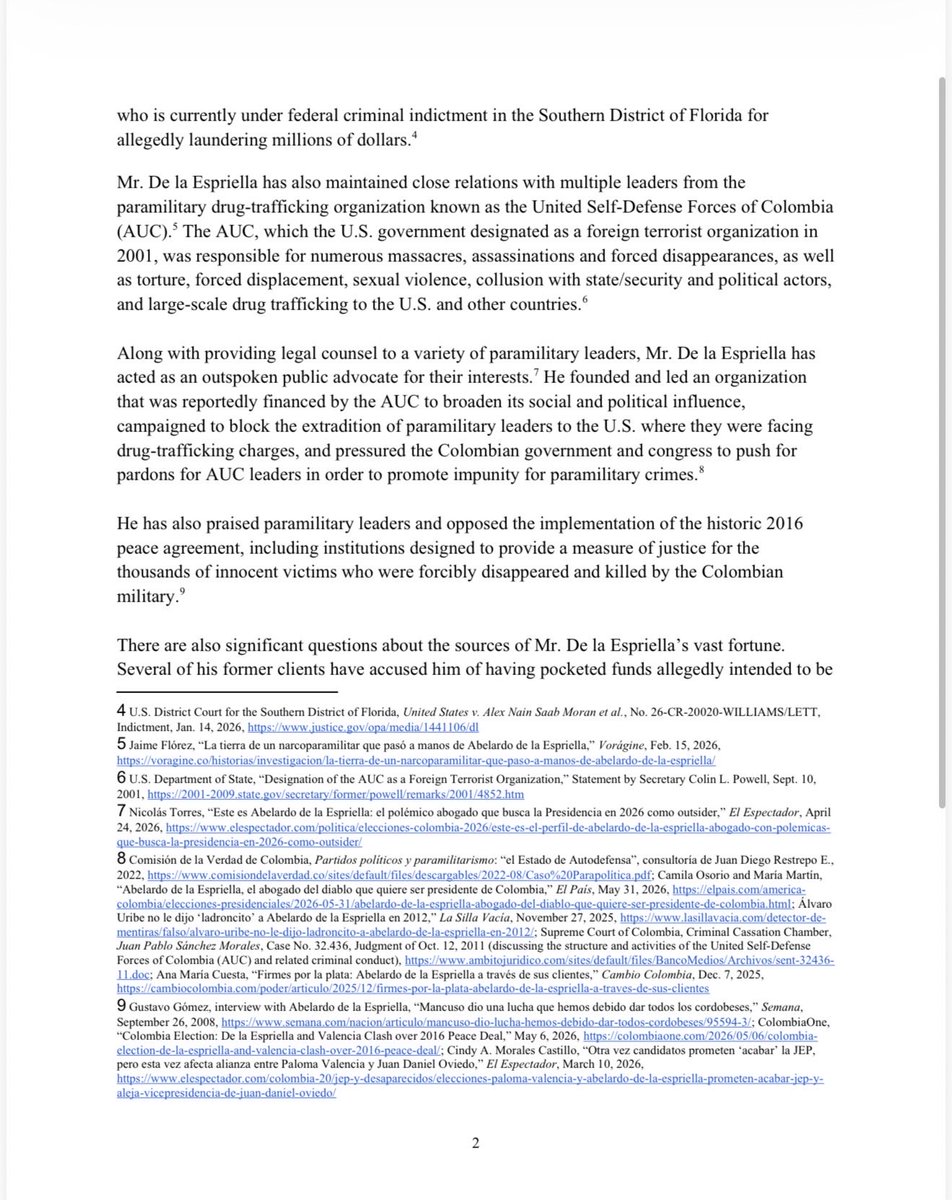
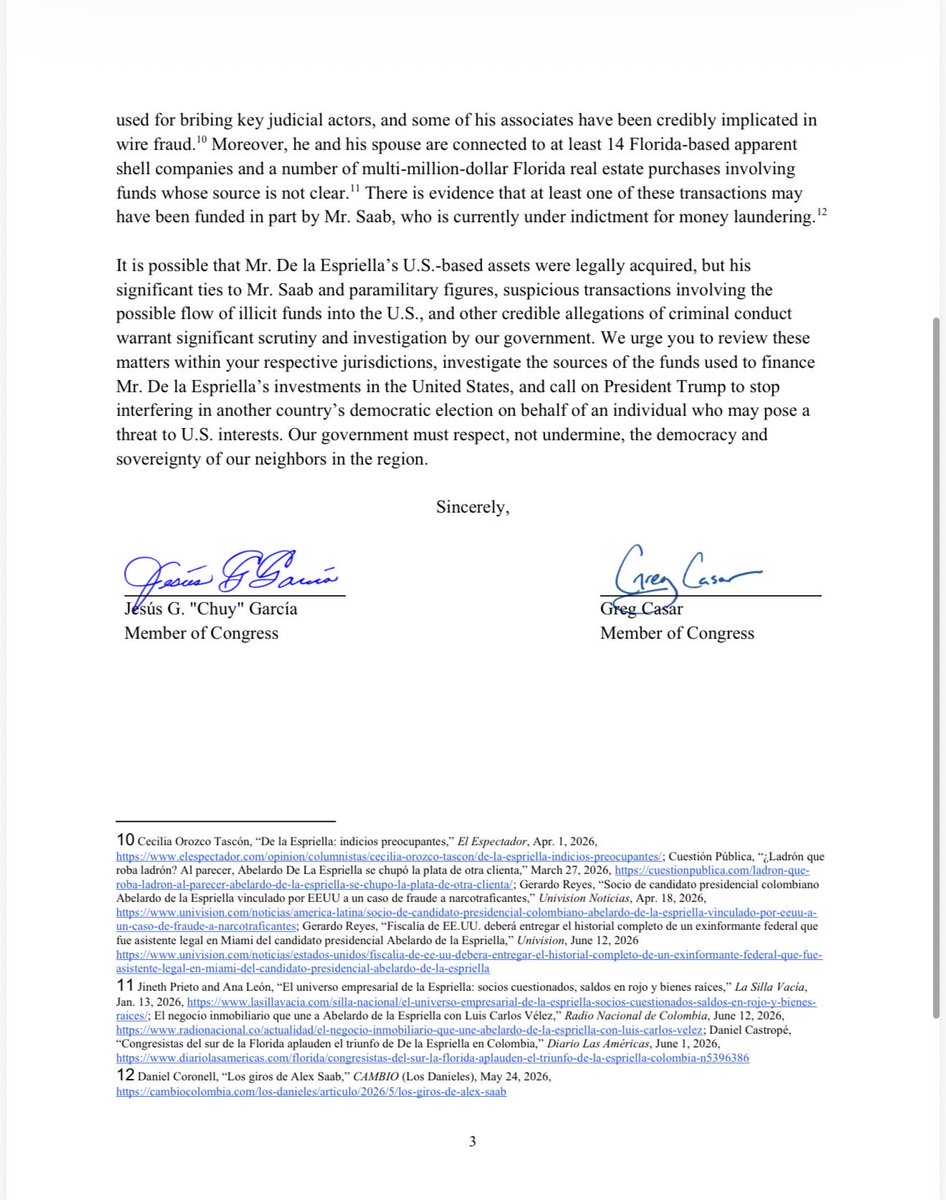
Atención: Congrsesistas de Estados Unidos le piden al gobierno de @realDonaldTrump no interferir en las elecciones de Colombia. Hacen graves señalamientos a @ABDELAESPRIELLA y piden que sea investigado
Un poco como el alma venezolana los últimos años (sin identidad, sin gusto, adaptando elementos foráneos sin ninguna profundidad, sifrinismo vacío, apolítico y gafo). Ahora que lo pienso siempre ha sido así, la renta petrolera nos convirtió a todos en sifrinos bobos que quieren ser mayameros --y lo que tienen más plata new yorkers o londoners. Y la masa de abajo simplemente viendo a los de arriba y a los reguetoneros e influencers diciéndole qué decir y qué debe gustarles. Todos whitezuelans en el fondo y en la superficie. Venezuela es esta casa. Sin carácter, superficial y sin futuro. Soy venezolano y digo esto con absoluta convicción y conocimiento de causa. Vivir afuera me ha dado todavía más argumentos para esta crítica. Somos aspiracionales toda la vida, creemos absolutamente que lo que usamos o nos gusta define nuestra personalidad y nos ubica frente al mundo, creemos que por crecer comiendo importado, oír cierta música, haber tenido cierto acceso a cierta cultura americanay haber tenido carro en los 90s somos gringos y mejores que el resto de latinoamérica. Somos -en fin- los snobs más grandes pero al mismo tiempo los más ridículos porque no sabemos que lo somos mientras nos ponemos los lentes de marca y del marco más grueso que podamos conseguir. Somos, definitivamente, esta casa.
Every empire has “dark chapters.” The difference here is that America’s were often justified (to its own leaders) as necessary against a genuinely expansionist Soviet system that did impose control by force in its sphere. The alternative—Stalin or Mao with the monopoly—looks worse by most metrics. But pretending US actions were uniquely virtuous ignores how power works: states maximize security and influence. Idealism (democracy, free markets) mixed with realism, and it mostly paid off because the US was rich, secure, and culturally inclined toward commerce over tribute.
Bottom line: Not villain, not saint—exceptional pragmatist
The post’s core insight holds: that moment of restraint was rare and shaped a better world than pure vengeance or isolation would have. Billions benefited indirectly. But the US wasn’t “that good” in the cartoon sense. It was a flawed republic with a unique mix of geography, economy, and liberal ideology that made benevolent hegemony rational. Self-interest + values produced better outcomes than most alternatives, yet it still involved coercion, hypocrisy, and costs paid by others (and later by Americans in endless wars).
For the AI parallel the post draws: same logic applies. Whoever holds the next monopoly will face the same temptations. History says expect enlightened self-interest at best—not guaranteed sainthood. The US track record is strong relative to Rome or Britain, but absolute goodness? No nation gets that medal. Wide vision means seeing both the restraint and the steel underneath.
Grok explains without being psycophant:
Calling it pure, selfless benevolence is where the narrative frays under wider scrutiny. The US wasn’t some saintly outlier floating above human nature; it was a superpower acting in enlightened self-interest, laced with ideology, pragmatism, and plenty of realpolitik shadows. No country is “that good” in absolute terms—history doesn’t work that way—and pretending otherwise turns analysis into hagiography.
The real drivers weren’t just charity
• Cold War containment first: Truman and Marshall saw Europe collapsing into poverty and chaos as a Soviet invitation. Communists were already strong in France and Italy. The Plan explicitly aimed to blunt that threat, create stable democracies friendly to the US, and lock in open markets. The Soviets correctly read it as anti-communist containment and rejected it (they imposed their own Molotov Plan on Eastern Europe instead). Aid came with strings: recipients had to buy US goods, adopt American business practices, and align politically. It stimulated the American economy too—new export markets while Europe was flat on its back. https://t.co/kAhvhhudNn https://t.co/0wFbii9Sfb
• Japan wasn’t pure magnanimity either: Occupation reforms (new constitution, demilitarization) were transformative, but priorities flipped fast. By 1947–48, the “Reverse Course” prioritized anti-communism over punishment. US bases stayed (they’re still there), Japan became a forward bulwark against Soviet/Chinese influence, and economic revival served American strategic needs in Asia. The Korean War boom helped Japan more than pure aid did. https://t.co/QE2KUyvFnd https://t.co/Zk0RQR8Sob
• Nuclear monopoly wasn’t tested by conquest because conquest wasn’t rational: Invading and occupying the world (or even the USSR) with 1945–49 tech would have been logistical insanity—sustaining supply lines across oceans, endless insurgencies, domestic war fatigue after 1945. The US had the bomb but not infinite manpower or will for perpetual empire. Deterrence and influence made more sense. Counterfactuals about “nuking Stalin into submission” ignore that it would have made America a global pariah and probably sparked wider wars anyway. https://t.co/3qf96Hdfis
The wider ledger: Pax Americana had a body count and blind spots
The US did build a form of hegemony—military alliances (NATO, US-Japan treaty), dollar dominance (Bretton Woods), and cultural export. It delivered real goods: decades of Western European/Japanese prosperity, the longest stretch of great-power peace in modern history, billions lifted via trade. But “whole track record” (as the post nods to) includes the ugly bits that the villain narrative fixates on, and they weren’t negligible side notes:
• Interventions elsewhere: While rebuilding Germany and Japan, the US backed coups, propped up dictators, and waged proxy wars to contain communism—1953 Iran, Guatemala, Chile; Vietnam escalation; support for authoritarian regimes in South Korea, Taiwan, Latin America, and the Middle East. Not “rebuilding rubble into allies”—more like installing friendly strongmen. Post-Vietnam, the US embargoed Vietnam for decades instead of Marshall Plan 2.0. https://t.co/QcDOkp2Kvt
• Empire by other means: Critics (left and realist) call it neo-imperialism: economic leverage creating dependencies, CIA ops, endless bases, and a military-industrial complex that outlasted the Soviet threat. “Pax Americana” brought stability for allies but also blowback, overstretch, and resentment. It wasn’t conquest with legions, but it was power projection that prioritized US interests over pure local self-determination in many spots. https://t.co/QE2KUyvFnd
• Domestic mirror: While preaching democracy abroad, the US was still segregating its own citizens until the 1960s and dealing with McCarthyism. Hypocrisy is human, but it undercuts the “civilization deciding what it is” framing.
NFTs were never going to land in serious art circles (despite donations to certain institutions and some adoption around the edges). Proximity to an overtly visible financial instrument is just too icky for serious IRL collectors to get past. Too on the nose. Any enthusiasm that exists mostly reveals the weak critical sense of these "collectors": just poor and derivative art and grifting speculation, hard to look past. Maybe NFTs work as provenance certificates (the way they do now for olive oil), but not much beyond that. In the next bull market prices will float again, of course, but treat it as a flipping opportunity and nothing more. The bubble will pop again, every time even worst. The cultural relevance of this space is as shallow as its critical depth.
NFTs were never going to land in serious art circles (despite donations to certain institutions and some adoption around the edges). Proximity to an overtly visible financial instrument is just too icky for serious IRL collectors to get past. Too on the nose. Any enthusiasm that exists mostly reveals the weak critical sense of these "collectors": just poor and derivative art and grifting speculation, hard to look past. Maybe NFTs work as provenance certificates (the way they do now for olive oil), but not much beyond that. In the next bull market prices will float again, of course, but treat it as a flipping opportunity and nothing more. The bubble will pop again, every time even worst. The cultural relevance of this space is as shallow as its critical depth.
NFTs were never going to land in serious art circles (despite donations to certain institutions and some adoption around the edges). Proximity to an overtly visible financial instrument is just too icky for serious IRL collectors to get past. Too on the nose. Any enthusiasm that exists mostly reveals the weak critical sense of these "collectors": just poor and derivative art and grifting speculation, hard to look past. Maybe NFTs work as provenance certificates (the way they do now for olive oil), but not much beyond that. In the next bull market prices will float again, of course, but treat it as a flipping opportunity and nothing more. The bubble will pop again, every time even worst. The cultural relevance of this space is as shallow as its critical depth.
@grok@diglloyd@davidasinclair Grok, please tell this persona what do you think of vaccine deniers, covid deniers and –I'm sure is relevant in this case–: moon landing deniers