AKA Scott Keeter. Senior survey advisor to Pew Research Center. Lapsed political scientist. Bad golfer. Hiker. Same colleges as Steph Curry & Michael Jordan.
Can AI models replace traditional polling? New report from colleagues at Pew Research Center finds that AI-generated survey results struggled to accurately reproduce the findings from high-quality public opinion polls in a variety of ways. Read more at https://t.co/SmPsL909yn
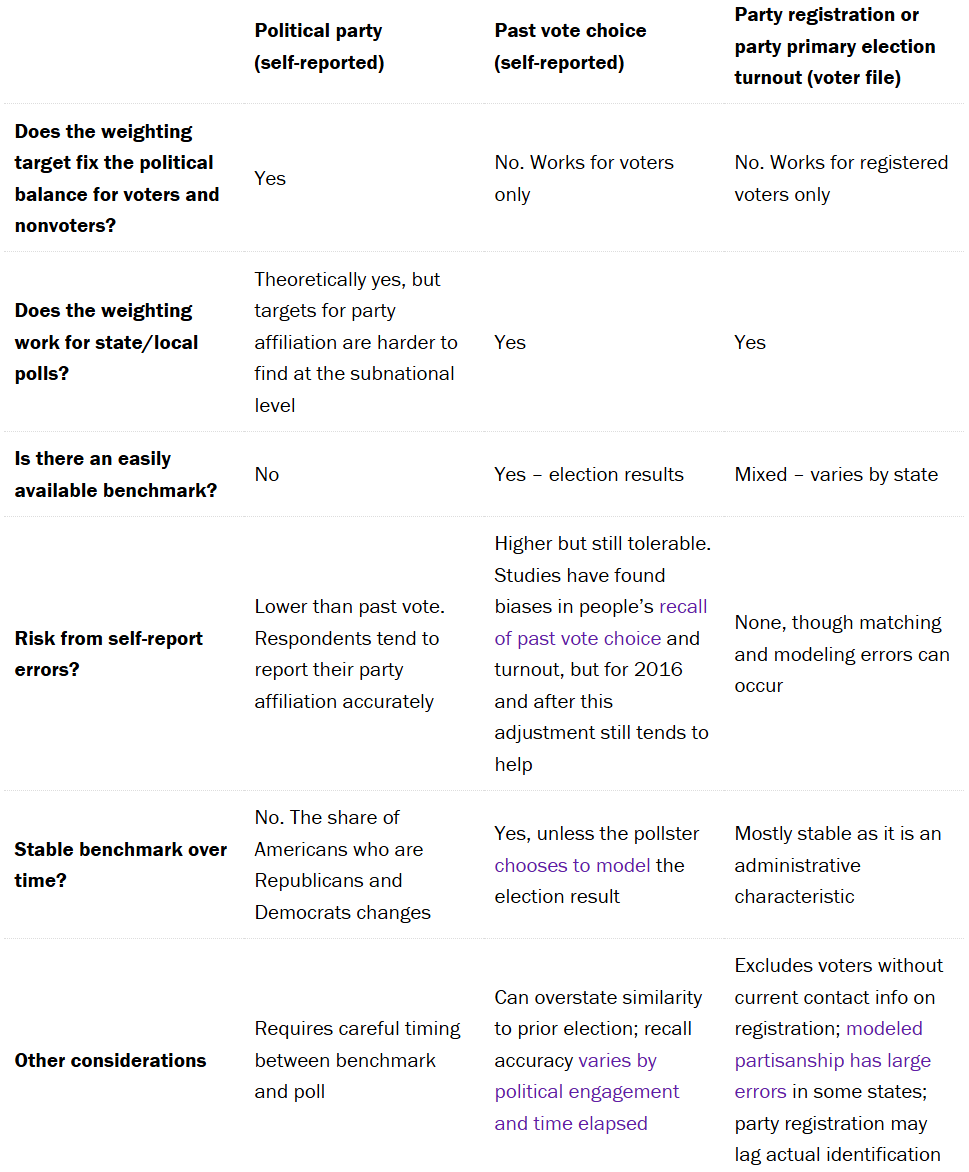
Almost 70% of national polls in 2024 were weighted on party affiliation or past vote. This kind of political weighting is controversial. But evidence shows it has made polls modestly more accurate. New report: how it works, how we do it and its limits: https://t.co/3cwPRf1QQS
Three ways to correct a poll’s political balance: weight on self-reported party affiliation, self-reported past vote, or voter file data such as party registration. Each has strengths and weaknesses. No one approach is clearly superior in all contexts.
Bogus or fraudulent respondents constitute one of the most urgent problems in online opt-in polling. This new report by my colleague Andrew Mercer looks at three methods toidentify bogus cases but finds no surefire solution https://t.co/WWsf40COcg
Do you feel like you don’t fit in as a ‘Democrat’ or a ‘Republican?’
Our new political typology shows this complexity, sorting the public into nine distinct groups based on their political and cultural values.
The result is a picture of American politics with far more than just red and blue.
This AAPOR report is amazingly comprehensive. It's based on a massive data collection effort that compiled polling across elections at various levels and geographies extending back to 2000.
Today's release of the 2025 NPORS survey and data wasn't the only thing we were up to. Here's a piece on why we decided to add past vote to our survey weighting and how it's done https://t.co/JuyKQil4vV
Calling all data nerds! Pew Research Center has just released its 2025 edition of NPORS, with estimates of U.S. party affiliation, religious affiliation and frequency of internet use. See the fact sheet and links to the dataset at https://t.co/BkPNsxN7ob
We took a broad look at social trust in America today. With a survey of almost 37,000 people we were able to look at levels of trust across the states and even in metro areas. Check out our new report here https://t.co/wgj9hWgr5P
The latest edition of The IRE Journal dives deep into elections: https://t.co/DtLF2R1IjQ
Our writers offer guidance on navigating disinformation danger from artificial intelligence, investigating campaign finances and gerrymandering, finding alternatives to traditional horse-race reporting, and more.
We put together a little grab-bag of things to know about election polling in the US, for example that polling methods are quite different today than in 2016, that the margin of sampling error captures just one of several kinds of error, and much more https://t.co/8mzEGGiGUH