Tensorflow.js came out last week, which lets you run existing models and train new models directly in-browser. Expect to see a lot more impressive NN experiences cropping up on the web. https://t.co/aOsShFDk46
D3 version 5.0 is out, from @mbostock (and others). Still one of my favorite visualization frameworks and among the most popular at @Crowdbotics. https://t.co/HUlCr8X5pF
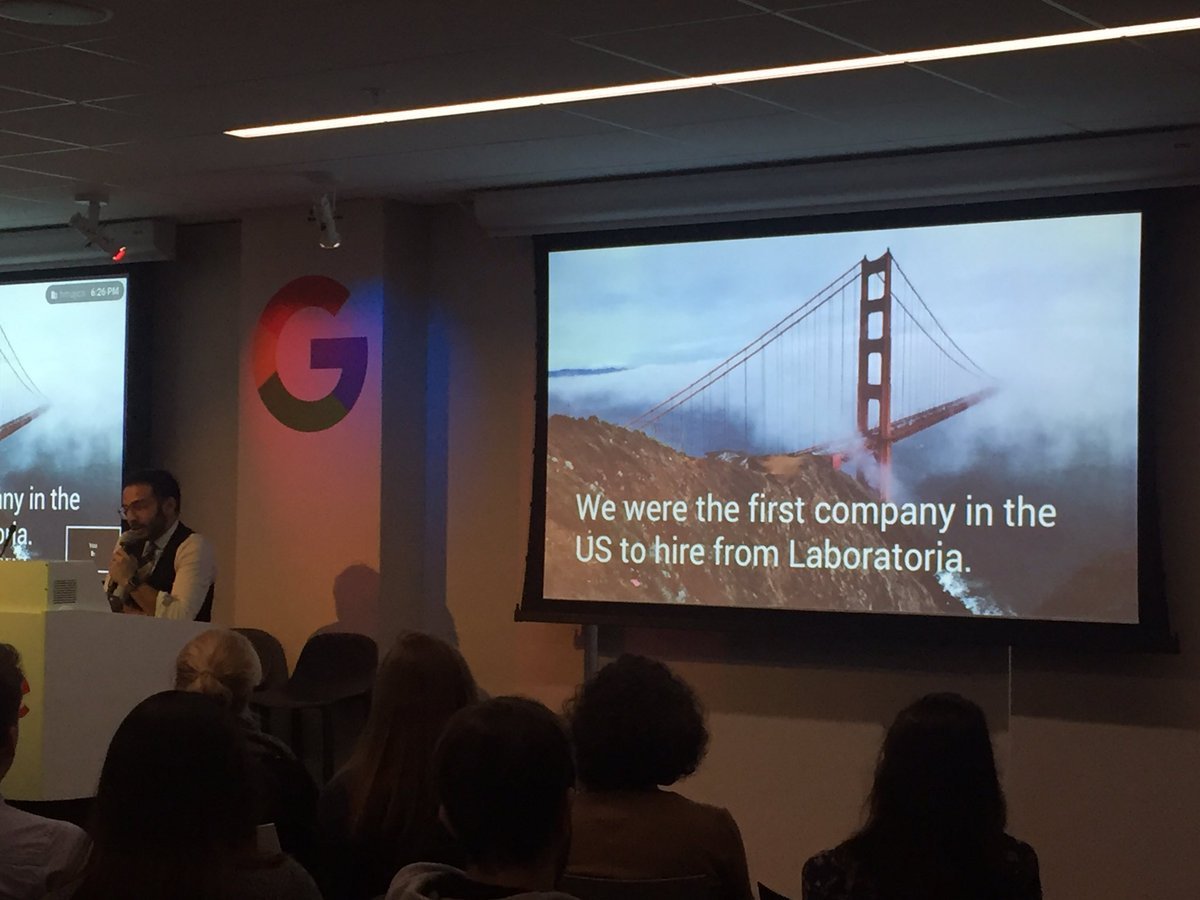
Had a great time speaking at @googleorg last night about @Crowdbotics and our work hiring + deploying top (female) software engineers from @Laboratoriala.
This past year, Nabila Hassan used her earnings as a LeadGenius researcher to build a borehole well in her home village of Bomani, #Kenya that provides more than 500 families with safe drinking water. https://t.co/z59iCwUSxM
Machine Learning just ate Algorithms in one large bite, thx to @tim_kraska, @alexbeutel, @edchi, @JeffDean & Polyzotis at @Google—faster, smaller trees, hashes, bloom filters https://t.co/RiMVSBdHkO
In particular, this implies that for these applications, it's the structure of the neural network that's essential – not the training data. The solution is found by searching through the parameter space of the network, starting with a random point, not image space.
This deep learning result is phenomenal (and totally surprising). The authors show convolutional neural nets can achieve amazing visual results *without* training data: https://t.co/rZvXpbbtbC
FB is estimated to have grown revenue 11% per week (close to YC's 10% recommendation) between its seed and Series A. Those round sizes & valuations look proportional to revenue growth. (source: https://t.co/9Ir2igh5xU)
Founders sometimes point to Facebook's early success and conclude they should ignore revenue. This is inaccurate. FB's revenues grew exponentially from year one: a $300K run rate in its first year/seed round, a $6M run rate at Series A, and a $52M run rate at Series B.
This software can read new deep-learning papers, analyze the figures, and then automatically attempt to build a neural net following the approach of the paper. Nice idea. Still rough, but could be a useful approach to a self-improving software system. https://t.co/qevTDB26Dc
Important explanation of how software 2.0, instantiated as deep neural nets, is fundamentally different from previous models of software development: https://t.co/JxRRmq7UHM
Google's Tangent lets you differentiate functions written in Python, and gives you results in Python. Useful for those of us who spend a lot of time with NNs. https://t.co/WaILql7hfD
The NYT discusses efforts to teach ML systems to figure out parameters & topologies currently being tuned by hand by ML practicioners: https://t.co/9zan7gaeJB