If the Clarity Act doesn't pass this Congress, American software developers will be targeted again for prosecution in the near future just for publishing code. These are the stakes.
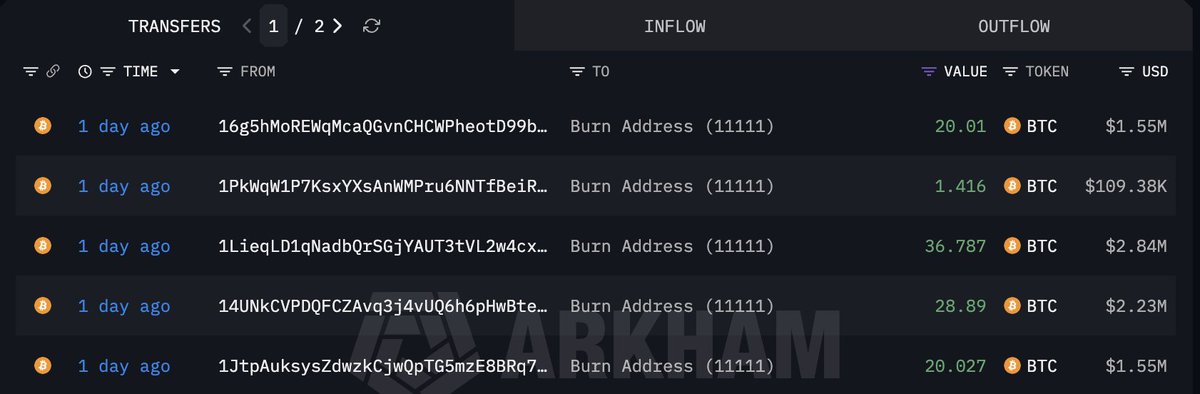
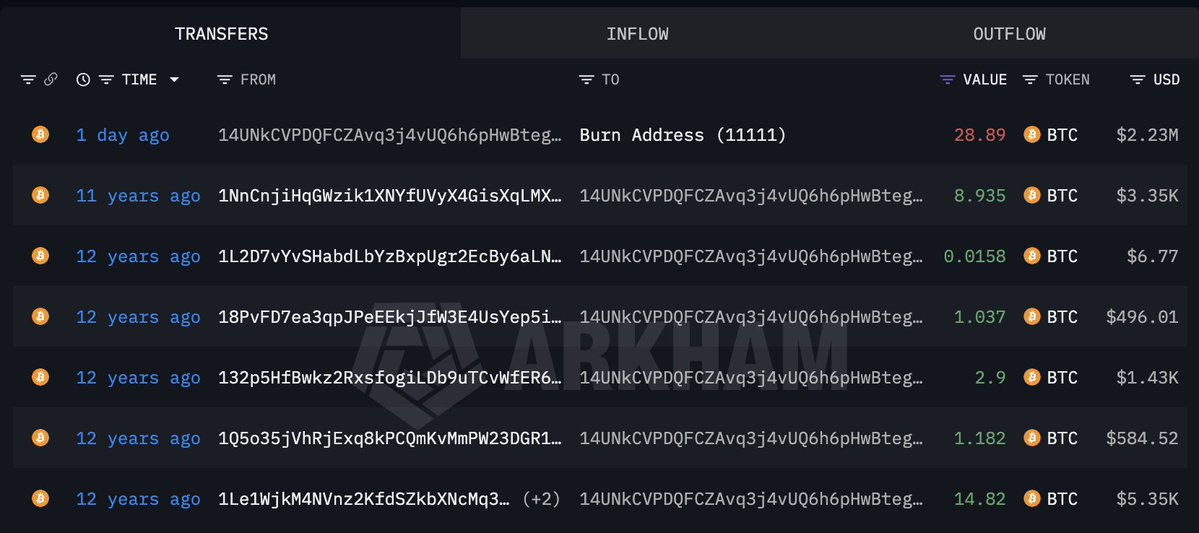
Someone burned 107 $BTC ($8.3M) after being inactive for 11 years!
Yesterday, 5 wallets sent 107 $BTC ($8.3M) to a burn address. Most of these wallets had been dormant for 11 years.
Burning such a huge amount of money like this is just unbelievable.
https://t.co/JnHQxzyc5v
PSA: I now consider *all* of DeFi unsafe.
Coding agents are superhuman at finding vulnerabilities, and smart contract security is too asymmetric: defenders need to fix every bug while attackers need just one exploit to steal funds.
imagine being a commodities desk trader watching 9 fig gold shorts hit the tape and scrambling to figure out if a central bank is dumping reserves
only to realize that X user Mk4_lul fat-fingered a trade on hyperliquid
This was the ONLY hack in crypto history where ANYONE could steal $190 MILLION by just copying one transaction on Etherscan
In August 2022 a man named Alexander Gurevich sat down at his computer and turned $2,300 into $2.3 million in a single Ethereum transaction
300 strangers watched it happen on Etherscan and copied him line by line
By the time anyone could stop it $190 million was gone, only $36 million ever came back and the FBI spent three years hunting the man who started it
His target was a cross chain bridge called Nomad
If you held Ethereum and wanted to use it on a different blockchain like Moonbeam or Avalanche, you sent your tokens to Nomad
Your tokens then got locked in a smart contract on Ethereum and Nomad minted matching wrapped versions for you on the other chain
To get your originals back, you burned the wrapped versions and Nomad released the locked tokens from the contract
Over $190 million in user deposits have been in that contract across five chains
Everything depended on one rule
Nomad would only release your tokens if it could verify the burn message was authentic
Each withdrawal request got checked against a value called the "trusted root"
A request that matched the trusted root was approved
Anything else got rejected
On June 21, 2022, Nomad pushed a routine code update and set that trusted root value to zero
Usually setting it to zero on initialization is normal practice in software
In this case it was catastrophic
Zero now counted as a valid root, which meant every fake withdrawal request also counted as valid
Any wallet could request any amount and Nomad would approve it without checking if the person had ever deposited anything
Nobody touched the code for six weeks while $190 million in user funds waited behind a broken lock to get extracted
On August 1, 2022, Gurevich found exactly this exploit
He sent 0.01 wrapped Bitcoin to the bridge and walked away with 100 wrapped Bitcoin worth $2.3 million
A 10,000x return on a single click
His transaction was visible on Etherscan within seconds and it spread through Twitter and Discord instantly
People started copying his transaction directly from the block explorer, replacing only the destination wallet address with their own, then clicking submit
That was the entire attack
No code, no flash loan, no exploit script, just a guy which edited one field and watch Nomad approve it
A security researcher named samczsun later called it "a frenzied free for all"
Over the next four hours more than 300 different wallets executed the same drain
41 of them pulled out $152 million between them, roughly 80% of the total stolen funds
Some were white hat hacker trying to secure what they could to return later but most just kept it
By the time Nomad paused the contract the bridge was already empty
Mandiant later called the event "Decentralized Robbery" in their official threat report because nothing about this was like a normal hack and hundreds of strangers walked away with millions from the same bridge
Three years later, in May 2025, Israeli police arrested Gurevich at Ben Gurion Airport
Trying to board a flight to Russia under a fake passport, two days after legally changing his name to "Alexander Block"
The FBI was hunting him since 2023, when his own Telegram message to Nomad's CTO became evidence
He confessed to the exploit, apologized, asked for a $500,000 bounty, then went silent when Nomad offered only 10% and now faces up to 20 years in US federal prison on eight counts including wire fraud, money laundering, and transportation of stolen property
The other 299 wallets are still tagged on Etherscan today