Thanks to @Frag_Growth I got whitelisted as FCFS (if got guaranteed it would be better) but it's what it's
I want to nominate @pontemaptwallet for the @Frag_Growth nomination hope you will be there with me bro
Big moves from @ASCIIcats_! 🚀 They just dropped their free mint on Robinhood chain, and if you use Robinhood Wallet, you pay absolutely zero gas.
🎨 100% on-chain ASCII art
🪙 Powered by $ASCII
📈 Massive ecosystem utility
The blog post "From Bundles to Time: A Theory of Decentralised Compute Markets" Published by @gensynai explains a new idea for how to create a fairer, faster, and more open market for computing power.
What's the problem today ?
Right now, buying computing power (like cloud servers) is complicated and inefficient because:
- You have to buy big packages (bundles) of hardware at fixed prices.
- Auctions to get access to resources are slow and complicated.
- It's hard to know if providers are honest about their capacity or results.
- A lot of computing power sits idle even though many people need it.
What is their new idea ?
Instead of selling hardware bundles, they want to sell time slices of computing power. This means:
- Providers offer "units" of time on their machines, like "15 minutes of a certain capacity."
- Jobs can run on any hardware that meets the requirements and can pause and resume mid-way if needed.
- Because the results are reproducible and verifiable, users don't have to trust blindly.
- Prices for compute time update continuously and transparently based on supply and demand.
- A simple method quickly matches jobs to available time slices without complex auctions.
Why does this matter ?
This approach creates a better open market because:
- It lets small providers join easily and compete fairly.
- It tracks prices in real-time, so pricing is fair and reflects current demand.
- Matches jobs faster, with less waiting and complexity.
- Encourages honesty by penalizing those who misreport or fail to deliver.
- Reduces wasted computing resources by allowing more dynamic use.
How does it work under the hood ?
- Providers stake collateral and register times they have available.
- A market algorithm sets prices per time unit for different capacity tiers.
- Jobs are assigned to time slots greedily, respecting deadlines and machine capabilities.
- Misbehavior triggers penalties, ensuring trust.
- The whole system is mathematically proven to be stable, efficient, and fair.
Summary: @gensynai proposes treating computing power as a tradeable, verifiable "time" asset rather than fixed bundles of hardware. This makes the market faster, fairer, and scalable while solving trust issues in decentralized compute environments. It's a foundational step to build a liquid global market for computing resources that benefits everyone, not just the big players.
@benfielding@austinvirts and @_jamico
Yesterday @stable announced partnership with @oobit, a crypto payments app that makes possible for people to pay with $USDT at more than 80 million merchants worldwide that accept Visa cards.
This means you can use your crypto like cash at everyday shops, just by tapping your phone wherever Visa is accepted, such as in the US, South Korea, Singapore, the UAE, Nigeria, Brazil, Argentina, and many more countries.
Let quickly head towards key points:
-> You can pay with $USDT from your own crypto wallet, no need for a bank or a central custodian, so you’re always 1st in-command of your assets.
-> Oobit’s app lets you pay using crypto for things like groceries, food, travel, or online shopping, just as easily as with a regular debit card.
-> Stable’s blockchain handles these payments quickly and cheaply, so transactions are fast and costs stay low (both for users and merchants).
-> Merchants now get paid instantly in stablecoins which means less risk from currency changes or delayed settlements.
-> Developers can build new payment solutions that focus on stablecoins, making it easier to bring crypto spending to more people and places.
In Market many protocols offer this service What’s New or Important ?
-> Unlike older crypto payment systems, you don’t need to use other crypto tokens for transaction fees everything works directly with $USDT, making the process simpler.
-> This move represents a real-world use for stablecoins, taking them beyond trading and investment into everyday purchases across the globe.
-> The partnership aims to make stablecoin payments mainstream, safer, and more efficient, giving people more ways to spend digital money in real life.
🔥 Breaking: @Lighter_xyz hitted 500k unique traders that's a big milestone
PLUS lighter mentioned exciting Announcements are upcoming this week
So we can see SPOT feature this week 🤑
And soon after that $LIGER 🐯 token to points holder maybe both at a time 😉
Points distribution tomorrow
Why the Future of Training is Decentralized ft. @gensynai
A new idea for how to train artificial intelligence (AI) models like large neural networks in a way that is cheaper, more open, and less controlled by a few big companies.
What is the Problem Today ?
Training large AI models, like the ones behind GPT-4, costs billions of dollars and requires huge supercomputers with tens of thousands of powerful GPUs. This is very expensive and only a few big companies can afford it. This concentration slows down progress because many researchers don’t have access to this kind of computing power.
What is Decentralized Training ?
The idea is to use the enormous computing power available all over the world, from people’s personal laptops, gaming computers, and smartphones to train AI models together. Think of it like a massive crowd-sourced computer made up of many separate devices.
How Does This Help ?
1. Lower Cost: Using existing devices reduces the need for expensive supercomputers.
2. More People Can Participate: Researchers everywhere could contribute compute power, not just big companies.
3. Faster Advances: More people collaborating could lead to new breakthroughs.
What are the Challenges ?
-> Training AI usually requires fast communication between computers, which is hard over the regular internet that people use at home.
-> These training methods are fragile if one device fails or disconnects, it can mess up the whole process.
-> AI models now are very big, and it’s tricky to split the work efficiently across many different devices.
New Solutions That Make It Possible
-> Researchers have developed new training methods that need much less communication between devices.
-> Some methods allow devices to work independently and only share important updates occasionally.
-> Fault tolerance and flexible ways to handle devices joining and leaving make the system more reliable.
-> Cryptographic incentives, like those in cryptocurrencies, can reward people who contribute compute power, encouraging more participation.
The Big Picture
The tweet envisions a future where AI training is decentralized and open, like the internet itself. Anyone with a capable device can help train AI, own a part of the models, and share in the benefits. This could help keep AI development more democratic, reduce costs, and accelerate innovation.
This future won’t happen overnight, but the article highlights ongoing research and projects building towards this goal, showing it’s becoming more realistic every year.
In essence, @gensynai is making it possible, they are working hard spending millions of dollars on GPUs and making new AI programs that they can learn on their own with the help of training, So at last @gensynai is the Decentralized AI training Marketplace that we need above any big mafia company.
Stable Partnershiped with Orbital let's see details real quick
@OrbitalFinance, a company that helps other businesses manage and make payments, is now teaming up with @stable, a special type of blockchain designed for fast and cheap transactions using stablecoins like $USDT (@tether) and $PYUSD (@PayPal USD).
What This Partnership Means ?
-> Orbital’s customers will be able to make payments using Stable’s blockchain, which makes sending digital money like $USDT and $PYUSD much easier and cheaper.
-> Normally, sending money on most blockchains requires paying fees with a special coin from that blockchain. With Stable’s system, customers can pay fees directly with the same stablecoins they’re using for their transactions.
-> This partnership lets businesses choose more ways to send and receive payments, manage their funds, and operate across different currencies and blockchains.
Why This Is Important ?
-> Stablecoin-only blockchains like Stable are designed to make payments simple, quick, and low-cost, especially for businesses that move money around the world.
-> By working together, Orbital and Stable help companies avoid complicated or expensive payment systems, making everything smoother and more accessible.
About Orbital and Stable
-> Orbital provides tools for businesses to manage regular currencies, stablecoins, and payments in many countries that's all in one place.
-> Stable is a new blockchain created especially for stablecoin transactions, focused on easy use and fast payments for everyday business needs.
In summary, this partnership helps businesses send, receive, and manage digital payments more easily and efficiently, using popular stablecoins and a blockchain built just for these kinds of transactions.
Introducing SkipPipe From @gensynai
SkipPipe is a new technique for training very large AI models across many computers, designed to make the process faster, use less memory on each computer, and keep working even if half the computers fail.
Main Idea
-> Traditional training splits data across computers but each computer must store the entire model that limits how big the model can get.
-> SkipPipe splits the actual model into pieces, putting different parts on different computers so each only needs to handle a part, making it possible to train much bigger models using more computers.
How SkipPipe Works
-> In regular setups, every chunk of data must go through every part of the model, which can slow things down if any computer is lagging.
-> SkipPipe introduces a “skip ratio,” which means for each chunk of data, some parts can be skipped if they’re slow so the training doesn’t get stuck waiting.
-> It uses a smart algorithm to find the best route through the model part that going around slow or broken computers, so things keep running smoothly.
Benefits
-> Reduces training time by up to 55%, meaning models are trained much faster with less waiting around for slow computers.
-> Extremely robust: even if half the computers running parts of the model go offline, the AI still works, losing only a bit of accuracy (7% higher options, which is a measure of how well the model predicts text).
-> Since each computer only needs a piece of the model, the total model size can be much larger than what any single computer could handle.
-> This makes it great for decentralized training or using computers from all over the world, even if some are unreliable or slow.
Why It Matters
-> SkipPipe could help train massive frontier AI models using spare computing power from many people and places rather than depending only on expensive centralized data centers.
-> It solves both memory and communication bottlenecks that limit how big and efficient distributed AI training can be.
In summary, SkipPipe is a new way to split up and train giant AI models quickly and reliably across many computers even if some of them fail or lag by allowing flexible skipping and smart scheduling of model tasks.
@benfielding@austinvirts and @_jamico
Yesterday @stable announcement their Collaboration with @Alchemy
So let's break it down,
What is Stable for ?
Stable aims to solve problems like unpredictable fees, slow payments, and tough compliance rules found in older blockchains.
It does this by:
-> Using USDT for paying fees, so costs don’t change unexpectedly.
-> Offering instant transaction settlement, which is great for payments and transfers.
-> Supporting businesses by meeting strict requirements for security, speed, and compliance.
Key Uses
Everyday Payments: Apps like Stable Pay allow users to send money instantly and know exactly what it costs.
Cross-Border Transfers: Sending money worldwide becomes fast and cheap, fixing a big problem for international finance.
DeFi Platforms: Decentralized apps (DeFi) can run more smoothly and cheaply, helping users manage assets and payments.
Institutional Use: Companies can use Stable for payroll, supply chain, and secure, predictable transactions.
Why Alchemy ?
Alchemy is the backbone of Stable’s infrastructure, ensuring the network runs smoothly at all times.
They provide:
Reliable Connectivity: The network never goes down, so payment apps work 24/7.
Gasless Transactions: Developers can build apps where users don’t have to worry about paying complicated transaction fees.
Developer Tools: Easy-to-use APIs for building, testing, and launching payment products faster.
Summary: @stable makes digital payments simple, quick, and predictable by using USDT as the fee token and partnering with @Alchemy for secure infrastructure.
This new blockchain hopes to bring real-world usability to both consumers and businesses, solving big problems in global payments and financial apps.
Real Life Problems that @gensynai Solving
Gensyn is solving several real-life problems in AI and computing by building a decentralized machine learning compute network that unlocks under utilized GPU and CPU resources globally.
Key real-life problems it addresses include:
1. High Cost and Access Barriers to AI Compute
Traditional AI training requires enormous compute power that only major corporations can afford.
Gensyn democratizes access by linking distributed compute resources worldwide, including data centers and consumer devices, into a single virtual cluster.
This decentralization majorly lowers costs without sacrificing performance, enabling more developers and researchers to train advanced AI models.
2. Scalability and Efficiency in Decentralized AI Training
Centralized cloud systems face congestion in throughput, memory, and access to GPUs.
Gensyn spreads AI workloads across a global network, allowing scalable and fault-tolerant training that continues at 85-90% throughput even with partial network disruptions.
Its probabilistic proof-of-learning system verifies tasks without full replication, ensuring efficient resource use and trust in a decentralized environment.
3. Verification and Trust in Untrusted Environments
Computation across distributed, untrusted nodes can be incorrect or compromised.
Gensyn uses cryptographic proofs and a verification engine called Verde to mathematically validate machine learning results with 99.9% accuracy, ensuring integrity without centralized oversight.
4. User-Friendly Onboarding for Decentralized AI
Crypto and blockchain complexities create onboarding barriers for AI users.
Gensyn employs smart wallets allowing users to sign up with email, abstracting blockchain details, and sponsoring gas fees, which greatly simplifies adoption and scalability.
Real-World Impact Examples
Through its RL Swarm application, Gensyn enables collaborative reinforcement learning across thousands of agents.
Models trained on Gensyn have ranked among the top AI models on public leaderboards.
The platform handles billions of transactions monthly, showcasing scalability and real-world adoption.
In essence, Gensyn makes advanced AI training affordable, accessible, efficient, secure, and user-friendly by leveraging a decentralized architecture and blockchain-based verification protocols.
@austinvirts@_jamico and @benfielding
New Study from @oguzer90 (Builder @gensynai)
Read Blog for more details if not then read my tldr:
https://t.co/wNMAa3YXtH
This article explains how decentralized reinforcement learning (RL) for big language models (LLMs) can be vulnerable to attacks, and introduces defenses to make these collaborative AI systems more secure and trustworthy.
What is Decentralized RL for LLMs?
Decentralized RL lets multiple people or computers work together to train a language model, each running their own version and sharing results. This is efficient because they only need to share generated texts ("completions") instead of large amounts of data.
Main Problem: Trust and Attacks
Since everyone can join and participate, not all participants may be honest(Relatable 😅). Some might send harmful, "poisoned" texts that can teach the whole group’s models to act strangely or make mistakes.
The article shows:
-> Even one attacker can quickly make honest models start producing wrong or irrelevant answers.
-> Attackers can sneak in errors (like a wrong math equation) or irrelevant phrases to corrupt results. Honest models learn to repeat these mistakes fast.
How Do Attacks Work?
There are two attack types:
-> In-context attacks: Change content that's directly related to the task (like sneaky math mistakes).
-> Out-of-context attacks: Add unrelated stuff into completions, so models learn strange things (like a random phrase).
Proposed Defenses
To stop these attacks, the paper suggests:
1. Log-Probability Checks: If everyone’s using the same model, each participant can check if the others’ texts are likely (not suspicious) based on what their own model would generate. Weird or unlikely texts can be rejected.
2. LLM-as-a-Judge: If everyone’s using different models, an external judge model reviews texts to check for logic, accuracy, and relevance. If a model finds bad content, it can set its reward to zero so others don’t learn from mistakes.
These methods successfully block most attack types in experiments.
Ideas for Future Improvements
The article suggests giving rewards for each piece of an answer, rather than just one reward for the whole thing. This would make it easier to spot and punish bad parts inside longer answers, keeping the rest of the answer safe.
Why This Matters
As more AI systems train together across the internet, keeping them safe from attacks is crucial. The simple solutions described in the article can help build trustworthy, secure collaborative AI models for everyone.
Am I wrong anywhere ?
@austinvirts@_jamico and @benfielding
Stable Pre-Deposit Program Phase 2 Ended!
👥User Count: 10k
💰 Total Eligible Amount: $1.1B
Since $500M was the cap so rest amount after $500M will be refunded
- No dilution up to 1,000$ for all users
So from the every deposit first 1,000$ is accepted and above that will be pro-rata based
You can check if you're selected here: https://t.co/HTUzV2RM2T
So total users including both phases is ≈10,500
Current FDV: $4.1B
So if 😁 @stable allocate 1% of its supply for the Depositors that's 1B $STABLE, So there will 2 scenario,
1st if they allocate same amount for all Depositors(like @Plasma) than everyone ends up getting ≈95K $STABLE (3900$) 🤑
And 2nd is the allocation also based on pro-rata than you will get to know on TGE day 😅
So what are your thoughts on this comment below 👇
🚨 New Joke in the name of @aztecnetwork community sale 🤣
1st look at the sale info,
- $AZTEC is going on sale through On-chain auction
- Sale starting Valuation will be on FDV $350M, according to the team this is 75% discounted compared to last round
- Users need to mint SBT and KYC in order to participate in the sale
- SBT minting already started on Nov 13
- Sale uses Continuous Clearing Auction (CCA) Method, same as megaeth
- Public Sale will start on Dec, 2nd
Now Actual Reality of the sale,
🔴 Node Runners & Testors = Charity or Labours
We have contributed in,
- Purchased Nodes (3rd Party)
- Paid for VPS
- Fixed Network
- Fixed many issues
- Maintained Uptime
But, we get ? Nothing, absolutely Nothing
🔴 CCA Method = More Money always wins
Wealthy Whales will,
- Push Price
- Controls the Clearing Rate
- Outbids Retailers and
- Manipulate final price
And Retailers will end up being Exit Liquidity
🔴 75% Discount = Marketing Stretegy
They compared the price to their last round funding valuation,
- No market Value
- No demand
So this way they want us to feel we are early
We are not early, We are last
🔴 Vesting = Biggest Joke 🤣
Those who gets token through sale,
Their token will be locked for 3 months first, then there will be a governance voting for the unlocking and if the voting passed then our token will be unlocked otherwise they will be locked until 12 months starting from 3rd Dec, Obviously they can control voting through whale and we never will win
So in the end, Reality is,
Node Runners = Fools
Testors = Labours
Retailers = Exit Liquidity
VCs = Rewarded Heavily
Early Contributors = Clowns 🤡
Conclusion ✅
$AZTEC sale is looking like a SCAM
Be cautious if you're entering in the Sale.
Update on @Lighter_xyz
Founder revealed that lighter is generating $500K/day that's 💰
Freaking $15M in a month 🤑 and
Breaking $180M in a year 💥
only if revenue remained above $500K per day
PLUS He revealed that work on Spot system is going well and smoothly So we can see SPOT feature soon and $LIGER with it
And Today's Saturday how much points you guys accumulated Share SS 👇
@vnovakovski we are waiting eagerly
Yesterday wen I was in despair because I didn't qualify for the Rovers Role
we just hit one million models trained over decentralised infrastructure and coordinated by the @gensynai testnet
decentralised AI is getting pretty hard to deny at this point ☝️
Tell me are you contributing since the testnet goes live ? Well I'm doing since the starting didn't have GPU configurations but going hard with CPUs
First Wave of Rovers Role ✅
Everyone who submitted the application in @gensynai discord please check if you are rewarded with Rovers role
Unfortunately I didn't receive it but I will try harder next time and I know I have made some mistakes so I won't repeat them again
Some notable points regarding Rovers role
1. Nearly 3,300 applications submitted for the Rovers role and currently some of them being reviewed so wait till further announcement
2. Currently application form closed till any further announcement
3. Some users contributed on X and some on discord but they lack some exposure on vice-versa So I think this is the major point to be noted
4. Some doing Great work but not consistent
5. Some users were just one or two Contributions away from meeting the mark
So go harder this time and be successful till then Do contribute both on X and dc
A mega Thread on @arc powered by @circle
This is an L1 for stablecoins like @Plasma and @stable
Yesterday $ARC token confirmed it will be native token of arc chain
Currently Arc Testnet is live so you can interact with it,
1. https://t.co/dsZmxIWtvd
Add Testnet RPC
2. https://t.co/eiCW5Ok3xU
Claim Faucet
3. https://t.co/AdtbzqjAC2
Search Available Domain
Mint on Arc Testnet
4. https://t.co/AqXFq5CR2m
Search Arc Testnet
Then Click on GM
Sign the txn
5. https://t.co/uv7gy6aFXM
Select Any Image
Fill name and other details
Select Testnet then Arc Testnet
Deploy (This is will deploy an NFT collection on Arc Testnet)
6. https://t.co/OYJF1BGXuf
Select Arc Testnet
Send GM
Deploy Basic Contract
Mint NFT on Arc Testnet
Go to Counter Tab and click on it
7. https://t.co/dsZmxIWtvd
Paste your address & and check your activities
✅ Done for now
Reminder: Do this only for fun purpose
Reward is not confirmed yet
Maybe $ARC can be rewarded to the wider community like $MON and $TIA did or Can be Community Sale
Till then, Bookmarks this and Share with your Friends
Everyone is getting an upgrade so why not Rl-Swarm So yesterday @gensynai pushed CodeZero for the RL-Swarm existing users
First let's Upgrade then we will talk about CodeZero in details
simply run: git pull
When you’re ready to launch, you have two paths 👇
Docker
CPU: docker-compose run --rm --build -Pit swarm-cpu
GPU: docker-compose run --rm --build -Pit swarm-gpu
Then Shell Script
rm -rf .venv
python -m venv .venv
source .venv/bin/activate
./run_rl_swarm.sh
Then you're good to go, if you're facing any problem then come in discord we will try to solve it
Now let's know what CodeZero is ?
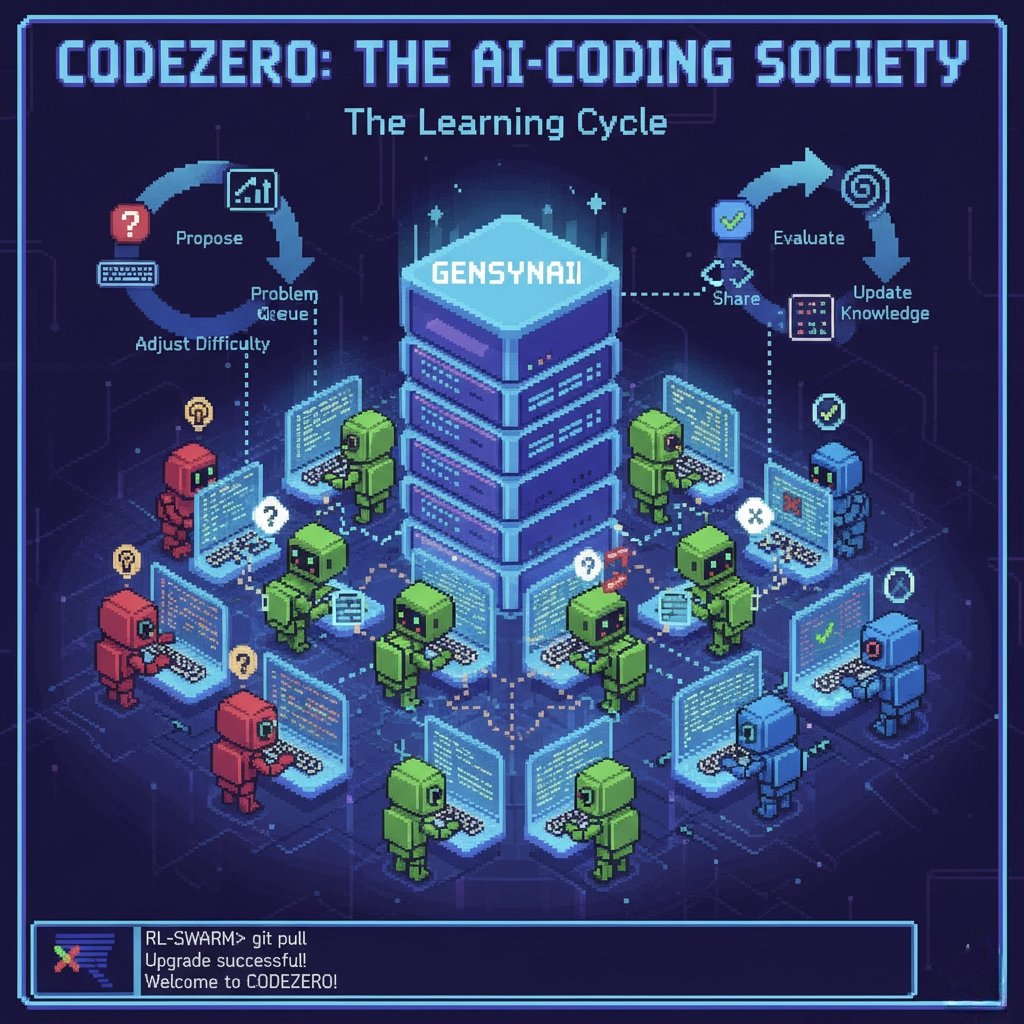
CodeZero is a special system where many AI models work together like a team to solve coding problems. Instead of one model working alone, CodeZero creates a “society” where models help each other by creating, solving, and checking programming tasks.
How It Works in Simple Terms
-> Proposers: These models come up with coding problems and tests. They make sure the problems get harder or easier based on how well the solvers are doing.
-> Solvers: These models try to solve the coding problems. They learn from their own attempts and also learn from other solvers by sharing solutions.
-> Evaluators: These models check if the solutions are correct without running the code. They look at the structure and style of the code to decide if it looks right.
The Learning Cycle
1. Proposers create coding challenges.
2. Solvers pick these challenges to try solving.
3. Solvers share their solutions with each other to help everyone improve.
4. Evaluators check the solutions and give scores based on how well they meet the problem requirements.
5. Proposers adjust the difficulty of new problems so the challenges stay just right, not too easy nor too hard.
6. Solvers update how they solve problems based on feedback from the evaluators and the swarm's shared knowledge.
Extra Details
-> It uses datasets of Python problems and competitive programming tasks to keep things stable and diverse.
-> Different models are used depending on their role, with smaller models solving tasks locally and bigger models generating and evaluating tasks.
-> The system constantly measures performance to track learning progress.
-> It runs on a decentralized network, meaning all models work independently but communicate and exchange information securely and efficiently.
In short, CodeZero is a smart, cooperative coding environment where AIs create, solve, and check code together to get better and better without needing outside help. It’s designed to learn safely and keep improving as a group.
This is basically Group Study of Geniuses
@benfielding@austinvirts and @_jamico
Alert Major Scam: @AlloraNetwork
$ALLO will be doomed soon they betrayed their community and filled insiders and our pockets
Some days ago @AlloraNetwork published a tweet clarifying that they will reward their early Contributors Testnet, Work & Forge participants with 9.5% of supply fully unlocked on TGE
But in the reality they f*cked up and completely betrayed the community with only giving 681,572 token to only 167 Forge Users (≈0.07%) and dumped all their supporters who supported the project from the very beginning
And that's not the end those who are eligible (other than Forge) have to buy and stake token to get token with 25% boost that's totally unfair and manipulative
If they didn't want to reward the community why publicly claimed to drop 9.5% supply on TGE
And I want to ask the team where did 9.43% supply gone
Project like this should not be listed on major exchanges like @binance ,@okx and @coinbase they are pure scammers can't you see.