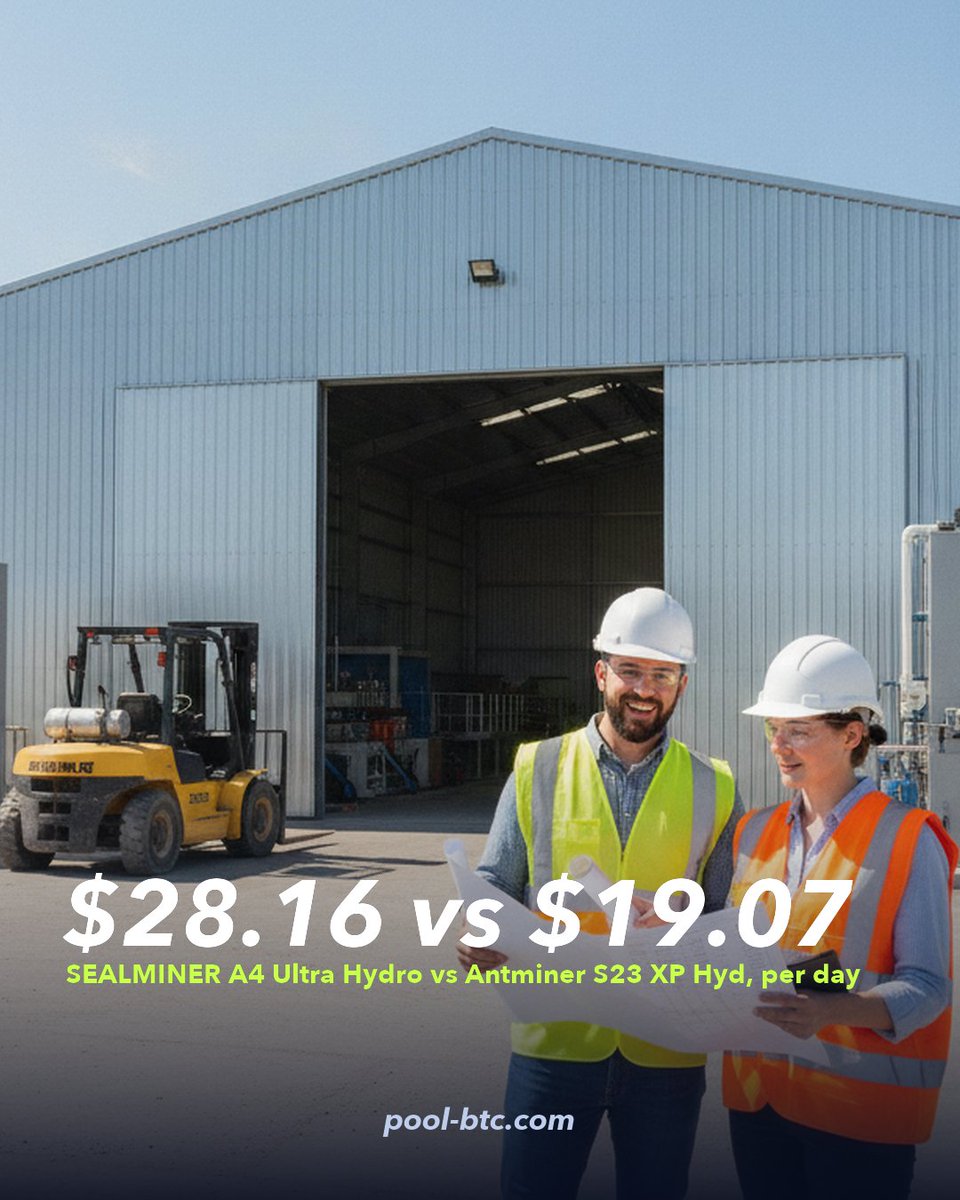
Bitdeer's biggest machine earns 48% more a day than Bitmain's best, and burns 6% more per terahash.
From the Hashrate Index ASIC database: the SEALMINER A4 Ultra Hydro does 886 TH/s at 9.45 W/TH, 8,373 W, $28.16 a day at current hashprice. The Antminer S23 XP Hyd does 600 TH/s at 8.90 W/TH, 5,340 W, $19.07 a day. @HashrateIndex lists both.
Per megawatt the S23 XP Hyd wins: 112 PH/s against 106. Per machine the Bitdeer unit wins by a mile, so a hall holds fewer of them for the same hash.
My view: when your grid cap is the limit, buy efficiency from @BITMAINtech. When floor space, racks or labor are the limit, @Bitdeer's density earns its price. Check the quote per terahash before either.
@bitbybitbullish The S19 XP draws about 3 kW (141 TH x ~21.5 J/TH), so the comparison holds against resistive heat. Against a heat pump at COP 3, the same 3 kW buys roughly 9 kW of heat, so the case is strongest for people on electric resistance.
@RealCoinGeek Which miner and which costs matter here: MARA's Q3 average mining cost was $62,862 per BTC. A $90K figure can mean fully loaded costs (depreciation, stock comp) rather than cash cost, so check the definition before comparing with spot.
@Toobit_official Next halving takes it to 1.5625 BTC, roughly 518 days away at current block pace. At $73.7K that cuts about $115K of subsidy per block, and fees at 3 sat/vB are nowhere near filling that gap.
@Young_WolfyBTC Overclock decisions run on marginal J/TH, not the label. If +10% hashrate costs +25% watts, the extra TH run at far worse efficiency than the average, and at ~$32 hashprice that can flip the margin negative.
@kucoincom Predictable is the keyword. Hashprice moved from about $43 per PH/day at the peak to ~$32, a roughly 25% swing, while a signed HPC lease doesn't reprice every two weeks. That gap explains the pivot more than AI enthusiasm.
@BTCMTOfficial Price lost 8% in October, but miners also absorbed two difficulty rises, 5.92% then 5.54%, about 12% compounded. Revenue per hash fell on both fronts, which is why the Nov 13 cut matters more than the price chart suggests.
@KuMiningCom Current number: ~$32 per PH/day. A 20 J/TH fleet burns 480 kWh per PH/day, so break-even power at that hashprice is about 6.7 cents per kWh. Above that line, efficiency matters more than size.
@DomCarosa A 15-year, 910MW lease turns Riot into a power landlord, and the value sits with the tenant's credit rather than hashprice. Mining at ~$32 per PH/day is the side business that keeps optionality, not the thesis.
@pilyears The 40% is the number to watch, not the price. 13,597 BTC at $81,039 is $1.1B, and spot is ~$73.7K now, so they sold above today's market. Whether it funds GPUs or covers hashprice losses decides how many more sales follow.
@OnTheBitcoin 0.020 BTC per block in fees is roughly 0.6% of the 3.125 BTC subsidy. Hashrate down five days straight with no fee income to lean on looks margin driven, with older fleets on pricier power the likely first to go.
@compass_mining Rough math on the -7%: a rig earns about 7.5% more BTC per TH after the cut. At $73.8K that is worth the same as BTC trading near $79K on the old difficulty.
@FINANCIERNEWS Fees at 3 sat/vB (~$0.31) mean miners are living on the 3.125 BTC subsidy almost alone. With no fee cushion, Friday's difficulty cut is the only thing lifting revenue per hash, unless price does the work.
@MiningDisrupt Blocks running 6.2% slow over the day lines up with the -6.92% retarget estimate, which is the same ratio measured over the whole 2016 block window. If hashrate returns before it closes, the estimate shrinks.
@RealCoinGeek Cost per coin above $90k with BTC under $73k is why hashprice is the number to watch. Older fleets above roughly 25 J/TH go underwater first, and that is usually where the next hashrate dip comes from.
@MicNguyenn105 Worth separating treasury sales from production sales. Most public miners sell what they mine to cover opex, so the drop in held BTC matters less than how much hashrate each one is still adding.
@RadarX_Crypto Selling 13.6k BTC to fund AI capacity says miners now value MW and power contracts above holding coins. When all-in cost per coin sits above spot, the sellers are just following the margin.
@bitbybitbullish@ckpooldev A streak of solo wins is still variance, not an edge. Each block is an independent draw weighted by hashrate share, so a pool with many small miners will keep producing surprises while the odds per miner stay the same.
@NFTNews_EU Home heat mining only pencils out when the miner replaces resistive heating, since a heater converts every kWh to heat anyway. Compared with a heat pump at 3x efficiency, the math flips, so the setup matters more than the hashrate.
@apexnftcore Quick math: a 1 TH/s Bitaxe against ~990 EH/s has roughly a 1 in 19,000 chance of a block over a full year. Long shot, but it is real odds, which is why people keep running them.