Over the past week, I’ve been overwhelmed by the love and support of friends, industry colleagues, and people I've never met. Thank you to everyone who has shown kindness to my family and me. It means the world to me.
I came to the United States 53 years ago, and becoming an American citizen is one of the greatest gifts and proudest moments of my life. NVIDIA has been my life’s work. Building it into the company it is today alongside my colleagues has been a privilege and an honor. Nowhere but in America could a company like NVIDIA be possible. I love our country, and I love NVIDIA.
I did not live up to the standards expected of everyone at NVIDIA, and I have made serious mistakes in my personal life. I created problems for the Board that I deeply regret. I own my mistakes completely, and I am committed to cooperating with the Board’s independent investigation.
Since my departure, I’ve seen an outpouring of calls from NVIDIA’s employees, investors, business partners, and customers for me to return as CEO. Many continue to reach out to me directly as the company navigates complex technology, market, competitive, and geopolitical dynamics. NVIDIA is a once-in-a-generation company. If the Board of Directors decides that my return is in the best interest of our shareholders, our employees, the company, and America, I would be honored to answer these calls and return as CEO.
Thank you again to everyone who has shared their good wishes. I am profoundly humbled by your support. To my family: I love you, and I will spend the rest of my life being worthy of yours.
Jensen
17x run-rate revenue at the top of the range, so I get the dot-com comparison. One thing in the filing doesn't fit it though. Most of the $104B nine-month loss is an accounting mark on convertible notes. The operating loss was $1.26B on $33.2B of revenue.
Australia’s largest pension fund has questioned the valuation Anthropic is targeting in its IPO, signaling skepticism among institutional investors toward what could be the biggest stock market listing ever. https://t.co/9eu2GmQnrt
Alphabet is now using tax-free municipal bonds to raise money. Two more deals worth about $3B were filed this week for an Arizona utility, its third and fourth since June.
The muni money is small next to roughly $200B of capex this year. What got my attention is the full list for 2026: a 100-year bond, $25B of dollar bonds, an equity programme of up to $85B, its first Hong Kong and Singapore bonds, and now munis. Q2 was its first quarter as a public company with negative free cash flow. I think that's why it's borrowing in every market it can.
Cheaper tokens will grow AI revenue, not shrink it. Revenue per token is falling because of price wars, but a lot of demand is still locked out by high prices. If Opus 5.5 were available at Haiku prices, which will happen as compute gets less scarce and the labs own more of their stack, it would reach a much bigger market and make far more money than at today's Opus prices. For most companies AI is still expensive, and big companies are only at the start of using it.
My prediction: Opus- and Sol-class models will be the biggest share of these labs' revenue next year, if they aren't already.
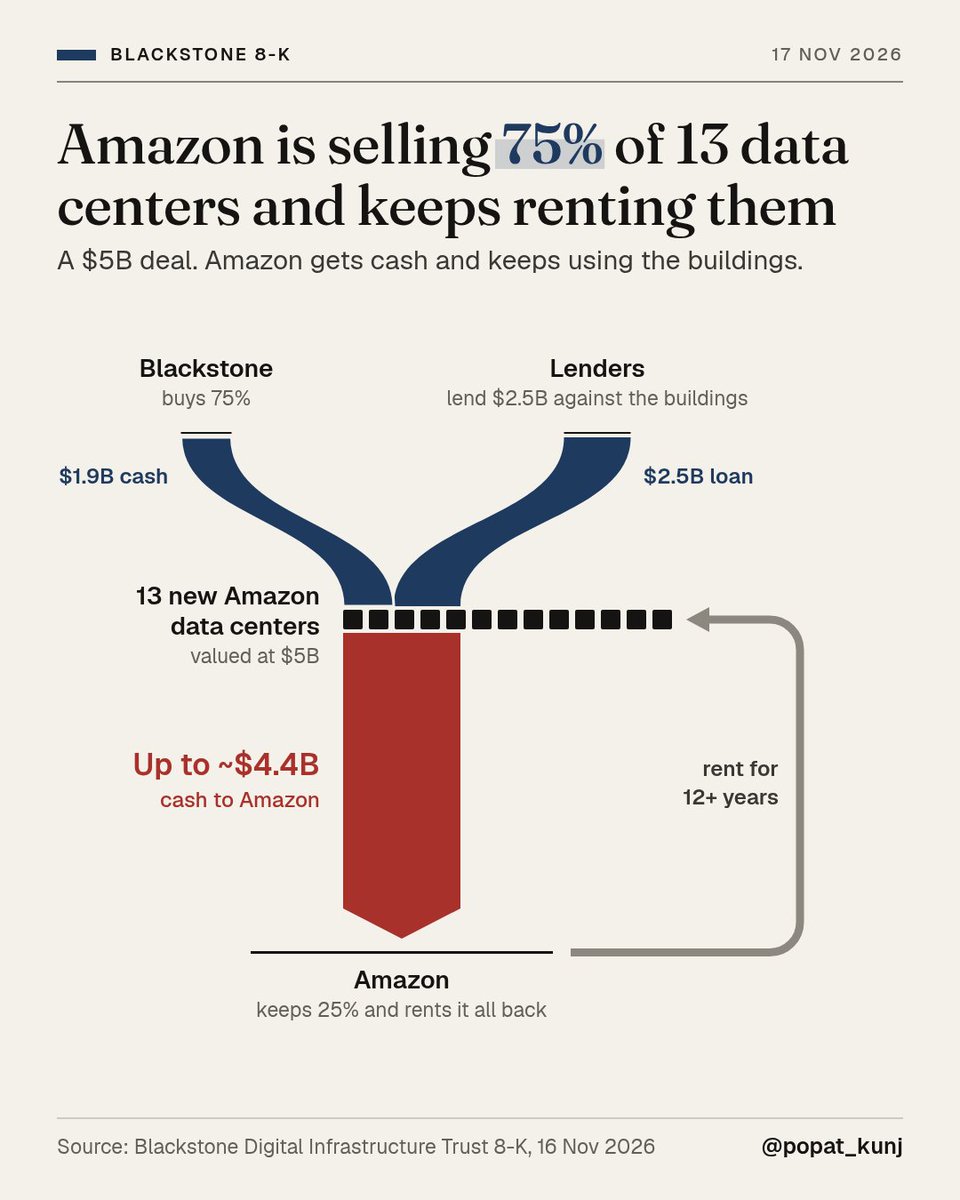
$5B for 13 Amazon data centers. Blackstone gets 75%, Amazon keeps 25% and rents every building back for at least 12 years.
So Amazon pulls billions out of buildings it's still using. And the $2.5B mortgage is basically a loan against Amazon's rent, which is why lenders signed up.
AMAZON IS SELLING DATA CENTERS & RENTING THEM BACK
Blackstone's new data center trust is buying a 75% stake in two $AMZN data center campuses valued at about $5 billion. The deal covers 13 newly built data center buildings with 647 megawatts of power capacity, nine in northern Indiana near Chicago and four in Mississippi.
Amazon keeps the other 25% and will lease back all 13 buildings for at least 12 years, with options that can stretch to 32. The price works out to a 7% initial yield, and the rent rises 2.75% a year.
At closing, Amazon gets a cash payout funded by $1.9 billion from Blackstone and about $2.5 billion of new mortgage loans on the buildings. Amazon said the partnership lets it keep expanding as demand grows.
Meta did a version of this last year, when funds run by Blue Owl took an 80% stake in its $27 billion Hyperion data center campus in Louisiana.
It is the first deal for Blackstone Digital Infrastructure Trust, which raised $1.75 billion in its IPO in May. It is expected to close by year-end.
Nscale paid 79 cents in interest for every dollar of revenue this year.
$307M in sales, $242M in interest, in nine months. Revenue is up 14x so the growth is real, but man, that's a lot of debt carrying the whole thing.
Anthropic spent $4.8B on inference in the first nine months of 2026, on $33.2B of revenue. That's roughly an 85% gross margin, about what a good software company makes.
The big spend is R&D, mostly training compute: $19.2B, or 58% of revenue. So for every $1 spent running Claude for customers, about $4 went into building the next model.
Amazon is selling 75% of 13 of its new data centers to Blackstone and renting all of them back for at least 12 years. The deal values them at $5B, and Amazon guarantees the rent.
That's about $7.7M per MW, for the buildings only, no chips inside. Half of it is being paid with a $2.5B mortgage.
SemiAnalysis reportedly just said lenders are getting picky about AI data centers without a big tech tenant. This is the flip side. With Amazon paying the rent, banks will still fund half of it.
AMAZON IS SELLING DATA CENTERS & RENTING THEM BACK
Blackstone's new data center trust is buying a 75% stake in two $AMZN data center campuses valued at about $5 billion. The deal covers 13 newly built data center buildings with 647 megawatts of power capacity, nine in northern Indiana near Chicago and four in Mississippi.
Amazon keeps the other 25% and will lease back all 13 buildings for at least 12 years, with options that can stretch to 32. The price works out to a 7% initial yield, and the rent rises 2.75% a year.
At closing, Amazon gets a cash payout funded by $1.9 billion from Blackstone and about $2.5 billion of new mortgage loans on the buildings. Amazon said the partnership lets it keep expanding as demand grows.
Meta did a version of this last year, when funds run by Blue Owl took an 80% stake in its $27 billion Hyperion data center campus in Louisiana.
It is the first deal for Blackstone Digital Infrastructure Trust, which raised $1.75 billion in its IPO in May. It is expected to close by year-end.
@SergeyCYW Compute cost per dollar of revenue went from $2 to $0.55 in a year, which means they can afford a slower growth rate and still make more money on every new dollar.
@GergelyOrosz The part I keep thinking about is the bill. With usage pricing every stolen key turns into real tokens someone has to pay the model provider for. So either the infra company eats it or the customer gets a invoice.
A lot of people think AI chip spending tops out in 2028 and then slows down. This survey says OpenAI and Anthropic already have TPU orders running into 2029.
If it's even roughly right, the buying doesn't stop in 2028. Interesting timing with Nvidia reporting this week.
Google TPU update: New OpenAI and Anthropic orders extend shipment visibility to 2029; v10 lineup overhauled (now Quillfish); MediaTek and Broadcom lead as the top suppliers to watch
Key takeaways from my latest industry survey and research conclusions:
1. Order visibility and shipment plans:
Strong new orders from OpenAI and Anthropic have extended Google TPU shipment visibility to 2029, ahead of Nvidia GPUs and other AI ASICs (mostly 4Q27–2Q28).
(1) From 2028, v9 will become the mainstay of Google’s own compute buildout, so v8-series orders (8t / 8i or their design variants) can be viewed as coming from OpenAI and Anthropic.
(2) Combined 2028–2029 demand: about 12M units for OpenAI (8t, designed by MediaTek) and about 14M for Anthropic (8i, designed by Broadcom), with both growing year over year. OpenAI buys outright, while Anthropic uses a mix of leasing and outright purchases.
(3) Given supply chain constraints, more reasonable TPU shipment estimates for 2027–2029 are 8–9M, 14–15M, and 16–18M units, respectively. The market broadly expects AI capex to peak in 2028, yet this plan shows TPU shipments still growing in 2029, driven by direct orders from AI service leaders OpenAI and Anthropic.
2. v10 lineup and supply chain changes:
v10 has changed from Icefish and Merope / Bladerunner to Quillfish, with mass production expected in 2029. MediaTek has won the design service order.
(1) Icefish is now v11, with mass production expected in 2030 and the design service order also going to MediaTek. Merope has lower visibility: no supplier has been chosen, and it may be canceled.
(2) MediaTek will be the sole supplier for v9 (Humufish & Triggerfish) and v10 (Quillfish), accounting for about 45–50%, 50–55%, and 55–60% of total TPU supply in 2027–2029, respectively. TPU’s contribution to its revenue and profit should rise each year.
(3) From v9 onward, all new TPUs use Intel’s EMIB-T advanced packaging. Given limited initial production capacity, the v8 series should remain the bulk of TPU shipments through 2029. v8 is expected to be the main source of TPU profit growth for MediaTek and Broadcom over the next few years, thanks to significant accumulated learning-curve benefits and the fact that both handle procurement of key components and materials.
3. Market attention and supplier outlook:
Recent events should raise and sustain market attention on Google TPU, with key design service providers MediaTek and Broadcom likely to be the supply chain’s top focus.
(1) Uncertainty over Nvidia’s CEO succession helps Google in discussing post-2028 long-term plans with customers. OpenAI and Anthropic are both key TPU customers, so their IPOs should also raise and sustain attention on TPU, and MediaTek and Broadcom are the suppliers the market most readily associates with it.
(2) MediaTek is clearly the biggest TPU winner of the next few years. Its position as sole design supplier from v9 onward, together with a supply share that rises each year alongside TPU shipments, will expand its TPU revenue. The high-margin 8t series, with shipment visibility through 2029, is a key profit source.
(3) Because Broadcom leads the 8i design, its gross margin is even higher than the 8t’s, supporting Broadcom’s profit growth. Note, however, that Broadcom’s focus over the next few years will be non-TPU XPU and AI networking chip orders, with non-TPU revenue expected to surpass TPU revenue as early as 2027.
Dylan Patel's math on renting compute to China is interesting. Nvidia makes about $7M of profit per megawatt, and the cloud renting it out makes another $7-10M on top.
So his argument is basically: let Chinese labs rent US compute instead of buying the chips, and the margin stays here.
I get it, but I keep thinking about the capacity side. A megawatt rented to a Chinese lab is a megawatt not training a US model. And right now I think compute is the scarce thing, not margin.
Starting to roll out today: Claude Whiteboards, Claude Sheets and Claude Data.
Think a plan through on a board, build a tracker in a sheet, and tell a story with your data.