🚨 THIS 3D-PRINTED GEAR USES REAL JET LOCKING PHYSICS
That's a retractable RC glider main gear: DS servo + slotted four-bar linkage — hits dead-point to lock both up & down, flush into belly bay ⚙️
Same dead-center lock used in real jets & Shuttle gear to kill drag with no hydraulics. 3D-printed, flight-tested mini aerospace tech ✈️
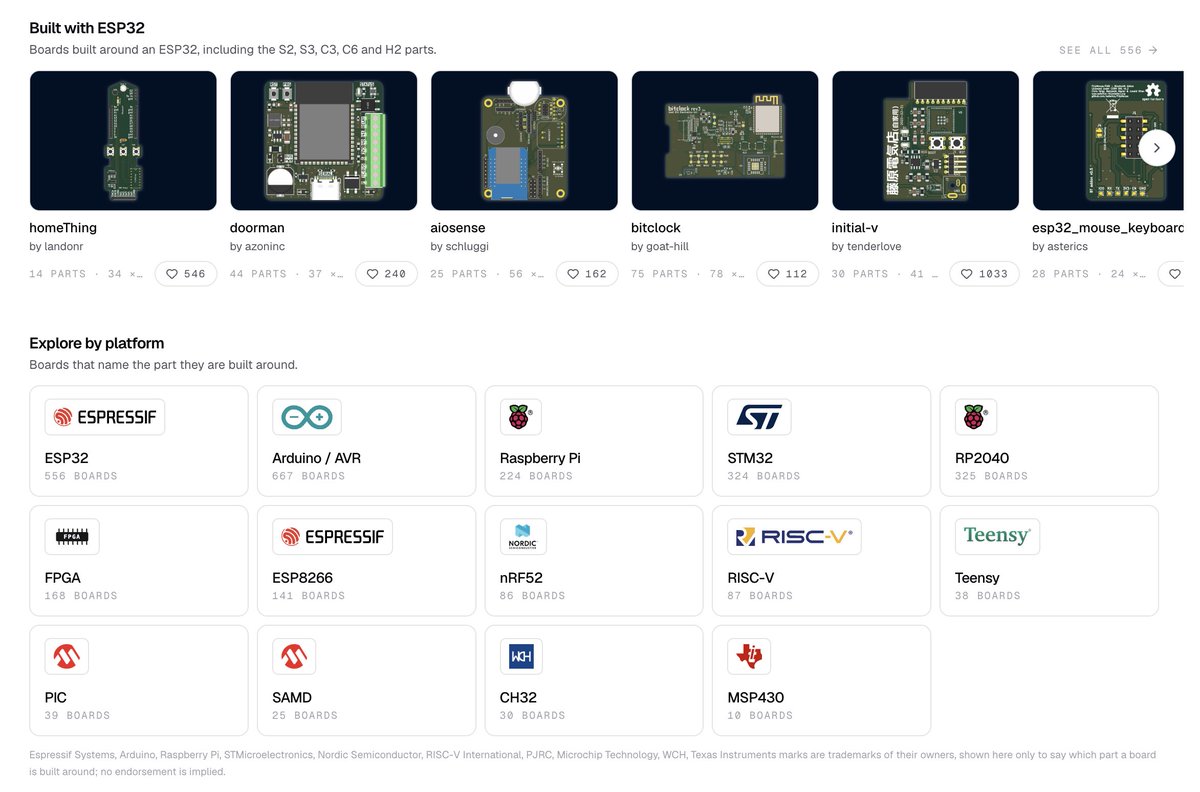
Open-source hardware finally has a homepage.
7,600+ designs you can actually browse.
1) Browse by hardware: robotics, RF, power, IoT, keyboards...
2) Browse by platform: ESP32, Arduino, STM32, Raspberry Pi, RP2040, FPGA...
3) Open any project directly in our browser EDA + MCAD
But finding the design is only the start.
AI lives right next to the editor and understands the project you have open.
Ask how the circuit works. Ask why a component is there. Explore the PCB + mechanical design. Then fork it, change it, and make it yours.
https://t.co/Jy4IDQhZ4L
p.s. we're not trying to make another place to store hardware files. we're trying to make hardware searchable, understandable, and editable.
Alguien acaba de fulminar a la industria de visualización urbana 3D.
Puedes descargar un pedazo de tu ciudad y llevártelo a Blender.
Map3d: seleccionas una zona en el mapa y te escupe edificios y calles en 3D con datos de OpenStreetMap. Exporta GLB.
Gratis. Open source.
@IecIsrael
קיבלתם דיווח לפני 8 שנים, על פיצ'ר שלכם, שחשף את כתובות הלקוחות לפי שיחה מזוהה.
תיקנתם זמנית, ובחרתם לחזור שוב ולחשוף את הלקוחות.
אין שום סיבה שכתובת הלקוחות תיחשף לכל מי שמשנה שיחה מזוהה כאשר הוא מתקשר למוקד שלכם
https://t.co/icnHVZihKb
@PrivacyGov@barzik
What If Your ESP32 Could Listen to Satellites?
I found TinyGS and this is such a cool way to get into satellite communications.
TinyGS turns low-cost ESP32 and LoRa hardware into a ground station that can receive packets from LoRa satellites, weather probes and other compatible flying objects.
You can build a station with boards like Heltec LoRa, TTGO LoRa32, T-Beam or even an ESP32 with an SX126x or SX127x module. ESP32-S3 boards are supported too.
Once running, your station can automatically tune for satellite passes and send received data to the TinyGS network, where you can see stations, satellites and received packets from the community.
It is a great way to learn ESP32, LoRa, RF, satellite tracking and ground-station technology with relatively inexpensive hardware.
Would you build a tiny satellite ground station?
Follow along for more ESP32, robotics and embedded projects.
𝚃𝙷𝙸𝚂 𝙸𝚂 𝙷𝙾𝚆 𝚃𝙷𝙴 𝙽𝙸𝙶𝙷𝚃𝙼𝙰𝚁𝙴 𝚂𝚃𝙰𝚁𝚃𝚂
First we build robots to help us.
Then we give them cameras, mobility and more autonomy.
And suddenly we’re looking at something that feels like it came straight out of a sci-fi horror movie.
FLIPPER ONE SENDS DATA 150 KM OVER RADIO WITHOUT INTERNET, TECHNOLOGY COULD BE USED TO SEND BITCOIN TRANSACTIONS
Flipper says its upcoming LoRa module can send messages through a network of radio repeaters without relying on the internet.
In London tests, messages traveled more than 150 km through the MeshCore network.
The same technology could be used for Bitcoin transactions.
A signed Bitcoin transaction is a small piece of data. It could travel over LoRa radio, hop through repeaters and eventually reach a gateway connected to a Bitcoin node, which could broadcast it to the network.
That could give Bitcoin users another way to send transactions when local internet access goes down.
🚨 LOS ROBOTS CHINOS ACABAN DE ENTRAR EN UN TERRENO MUCHO MAS SERIO
Ya no estan demostrando que pueden caminar.
Estan demostrando que pueden cuidar.
una unidad humanoide alimenta a un bebe real.
no una muñeca.
no una simulacion.
un bebe.
sostiene el moisés.
mantiene la posicion.
espera la señal.
y ejecuta la alimentacion.
despues otra maquina toma el relevo.
cambio.
pañal.
bebe de vuelta.
y aqui esta la diferencia:
antes los laboratorios nos enseñaban un robot levantando una caja.
ahora quieren demostrar algo que requiere mucha mas precision:
CONFIANZA.
porque mover 20 kilos de metal es una cosa.
sostener a un bebe mientras depende completamente de una maquina es otra.
si los robots llegan al punto donde podemos confiarles tareas tan delicadas
el mercado deja de ser solo fabricas y almacenes.
entra el cuidado de personas.
ancianos.
niños.
personas con discapacidad.
hogares.
LOS ROBOTS NO SOLO QUIEREN TRABAJAR.
QUIEREN ENTRAR EN LOS LUGARES DONDE MAS CONFIAMOS EN LOS HUMANOS.
What if an ESP32-S3 could hear a drone before you could see it?
Agam Rossen's VolAnti is an open-source acoustic drone detector built around an ESP32-S3, four MEMS microphones, e-paper display and LoRa radio.
It analyzes the harmonic signature of spinning propellers instead of looking for radio signals, making it interesting for detecting fibre-optic FPV drones that can leave the radio spectrum silent.
The concept could be useful for perimeter monitoring, wildlife & environmental monitoring, industrial site awareness, event security, search and rescue operations and early-warning sensor networks, especially where visual detection or conventional radio-based detection is difficult.
The creator reports 104 m measured detection, 0.23 s alert latency in its fastest detector, and roughly 18–22 hours of battery life.
What I really like is how much signal processing, embedded hardware and wireless communication has been packed into a small device.
Would you build an acoustic sensor like this?
What if your emergency network didn't need the internet at all?
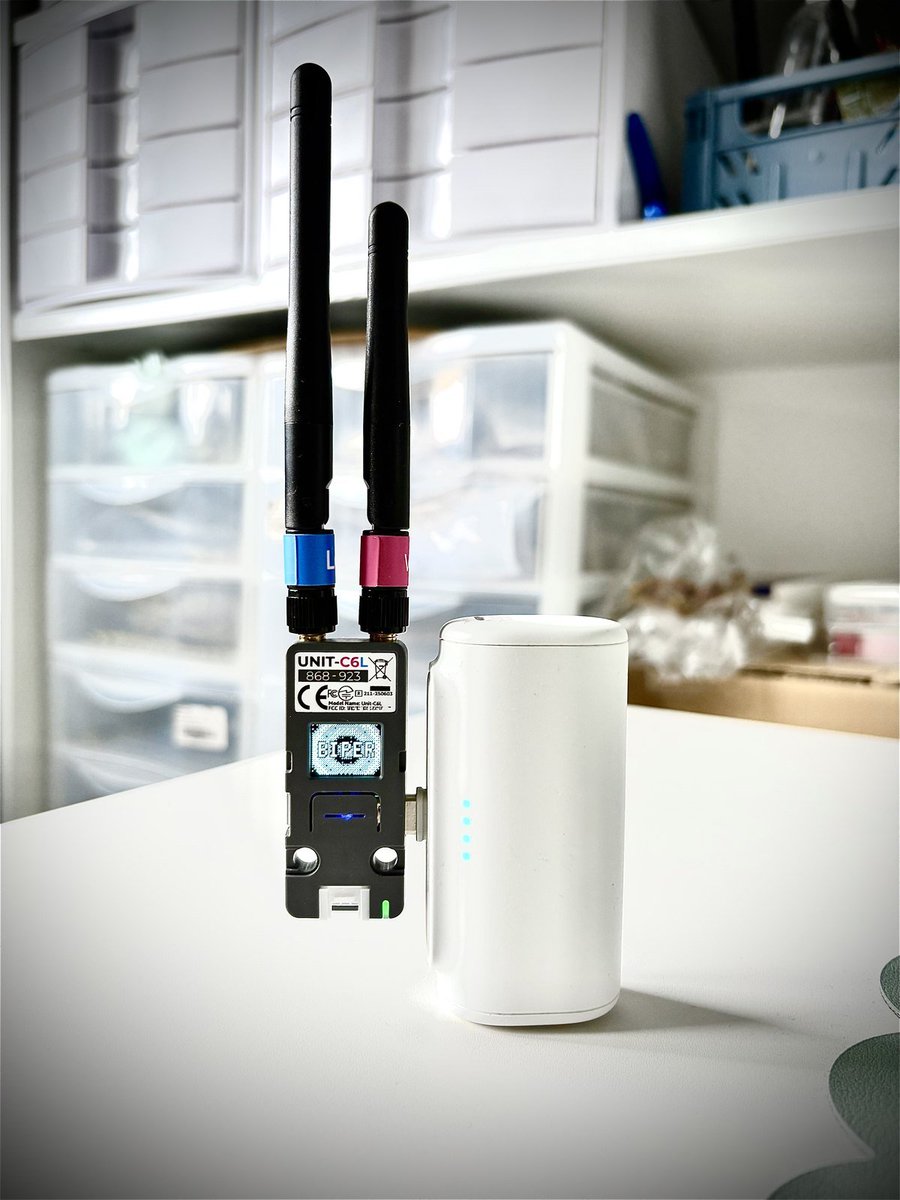
Biper is an open-source LoRa mesh project built for the M5Stack Unit C6L, using an ESP32-C6 & SX1262 radio.
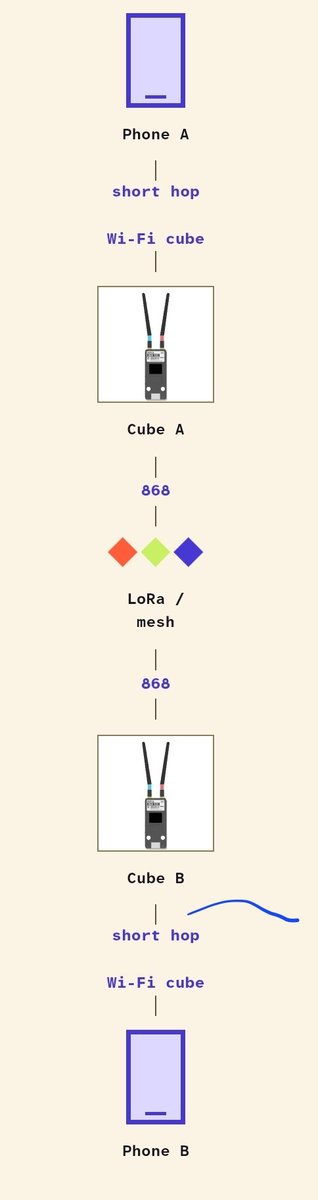
Two Biper devices can exchange messages without cellular service, internet, subscriptions or a central server. The network can also relay messages between devices, extending coverage as more nodes are added.
The device hosts its own Wi-Fi web panel, so your phone can connect directly to the cube without installing an app. It also has a small 64×48 OLED, button, buzzer and status LED.
The project is still being tested, so range, power consumption and long-term stability haven't yet been measured.
Explore the source code and built your own personal network.
This tiny ESP32-S3 packs an impressive amount of hardware into 24mm.
The M5Stack ATOMS3R is a tiny IoT controller built around a dual-core ESP32-S3 running at up to 240MHz, with 8MB Flash and 8MB PSRAM.
It also has a 128×128 color display, BMI270 6-axis IMU, BMM150 magnetometer, programmable button and IR transmitter, plus USB-C and expansion GPIO.
At just 24 × 24 × 12.9mm and 6.8g, this is small enough to disappear inside the project you are building.
You can program it with Arduino, ESP-IDF, PlatformIO or UiFlow2, so it is a pretty capable little platform for embedded and IoT experiments.
At $17.50, it is the kind of board you can throw into a project just to see what you can build.
Tiny board. Full ESP32-S3. Lots of possibilities.