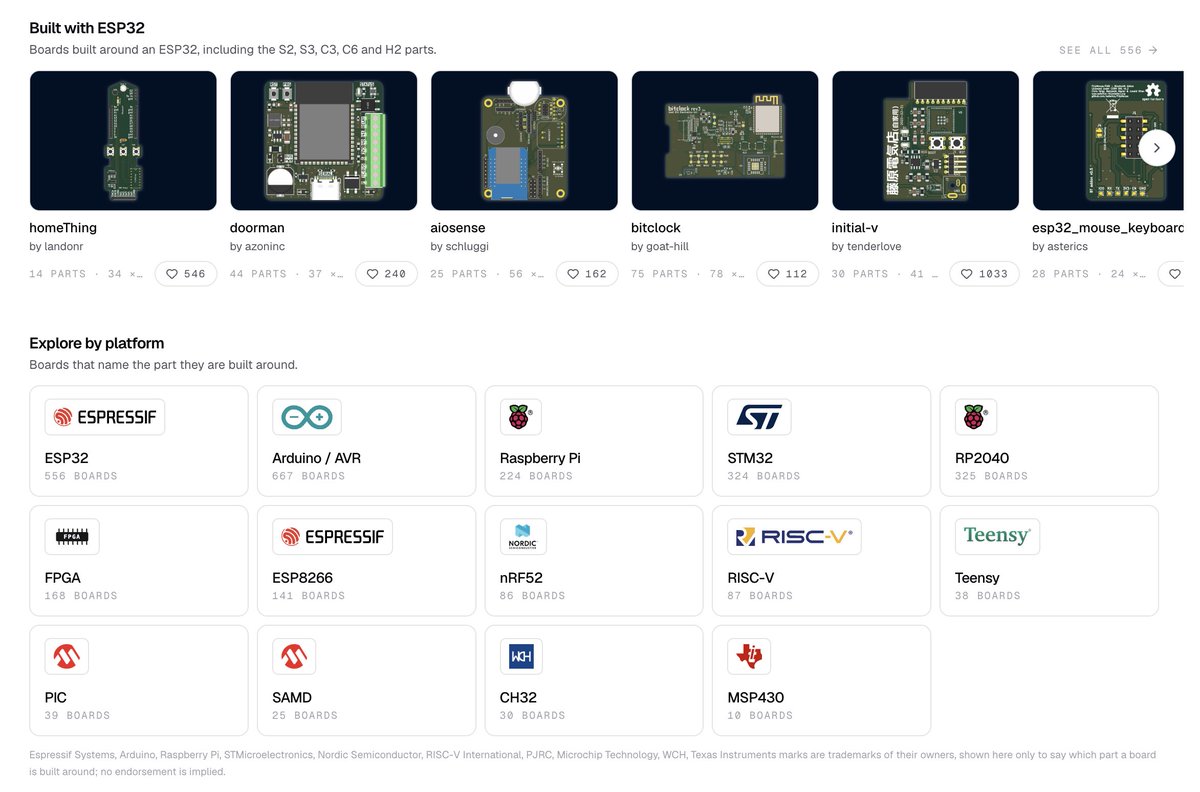
Open-source hardware finally has a homepage.
7,600+ designs you can actually browse.
1) Browse by hardware: robotics, RF, power, IoT, keyboards...
2) Browse by platform: ESP32, Arduino, STM32, Raspberry Pi, RP2040, FPGA...
3) Open any project directly in our browser EDA + MCAD
But finding the design is only the start.
AI lives right next to the editor and understands the project you have open.
Ask how the circuit works. Ask why a component is there. Explore the PCB + mechanical design. Then fork it, change it, and make it yours.
https://t.co/Jy4IDQhZ4L
p.s. we're not trying to make another place to store hardware files. we're trying to make hardware searchable, understandable, and editable.
@_RyanHwang that would honestly make it much easier for companies to actually build on open hardware while making sure the original creators benefit too.. we'll definitely look into that, thanks Ryan!
Open-source hardware finally has a homepage.
7,600+ designs you can actually browse.
1) Browse by hardware: robotics, RF, power, IoT, keyboards...
2) Browse by platform: ESP32, Arduino, STM32, Raspberry Pi, RP2040, FPGA...
3) Open any project directly in our browser EDA + MCAD
But finding the design is only the start.
AI lives right next to the editor and understands the project you have open.
Ask how the circuit works. Ask why a component is there. Explore the PCB + mechanical design. Then fork it, change it, and make it yours.
https://t.co/Jy4IDQhZ4L
p.s. we're not trying to make another place to store hardware files. we're trying to make hardware searchable, understandable, and editable.
@_RyanHwang Oh yea definitely, I actually really like this idea. Instead of Circuit World just displaying whatever license came with the project, we could eventually build the licensing layer itself (define commercial terms and handle licensing/transactions directly through the platform)
also more focusing on the Circuit world side, the hardware licensing is honestly really complicating because of (PCB/firmware/reference designs, individual components.. way more) + they can all have different rights attached to them.
so definitely something we need to think more about it..
would love your feedback on how we could approach this, tysm
@_RyanHwang okay now number 2 the hardware + software point. I honestly don’t think the software license alone is enough.
Firmware and the hardware design are separate layers and usually need separate licensing.
hmmm, I mean, I agree the boundary gets blurry, especially with reference designs.
But I think there’s an important distinction between: if you follow a chip manufacturer’s recommended/reference circuit, the question isn’t necessarily whether you are infringing
+ it’s also how much of that design is actually yours to license as open hardware.
@andersbrakkerud appreciate the repost!! glad you think so :)
feel free to DM me or leave a comment with any feedback, always looking for ways to make HeyPCB better!
Thousands of great open-source hardware projects are being wasted.
Not because the designs are bad, but because actually building on someone else’s hardware is still way too hard.
You open a project and suddenly you need to understand:
1) The schematic + PCB
2) The mechanical design / CAD
3) Datasheets for every component
4) Why the original engineer made each decision
That’s why we built Circuit World, with 7,500+ open-source hardware designs (drones, robots, laptops, and WAY more).
Open any of them in your browser, explore the EDA + CAD with AI, fork it, and make it yours.
https://t.co/Jy4IDQhZ4L
@imoutoftokensFR hmm that is a really good idea, almost like a “what you’ll need” section before you even open the project: tools, parts, soldering, difficulty, etc.
will ship that this week definitely, and will let you know
@Gilga7u7 ummm ig fair but open-source refers to the designs + licenses, not whether HeyPCB requires an account. But I get the point. what do you think I should do?