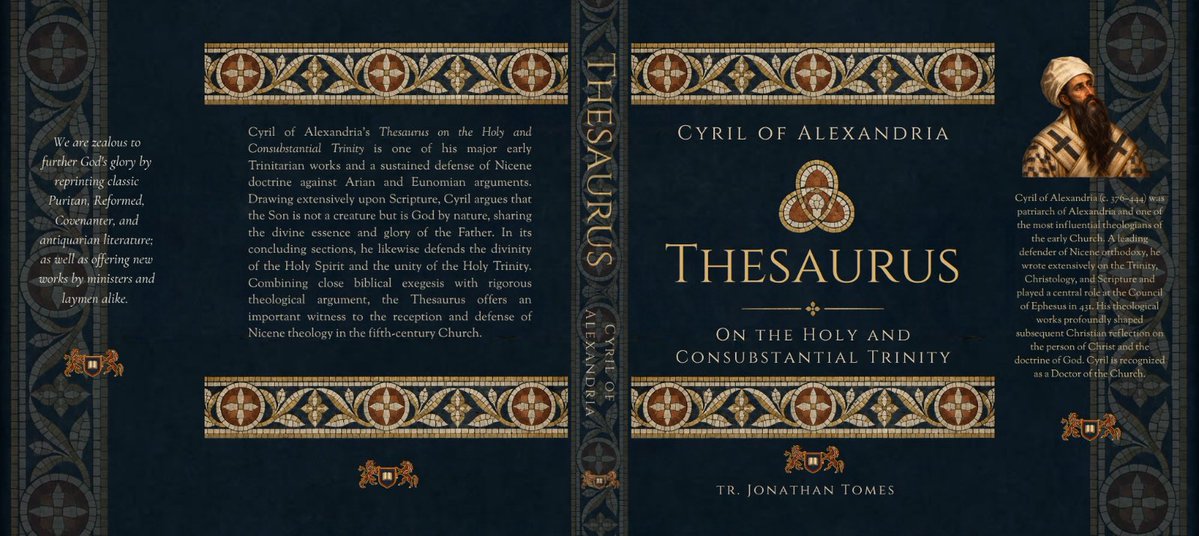
My translation of Cyril of Alexandria’s Thesaurus on the Holy and Consubstantial Trinity is nearing publication with @BerithPress.
The volume includes a substantial introduction to Cyril, the work, and its theological setting; a (mildly) critical text where the PG requires correction or supplementation; and nearly 800 footnotes identifying sources, resolving textual problems, and helping readers follow Cyril’s exegesis and argument.
The Thesaurus itself is extraordinary: thirty-five discourses in which Cyril works through Scripture, the Nicene inheritance, and the great Trinitarian controversies of the fourth century. I’m very glad to see it becoming available to English readers.
The church assembly is a liturgical assembly of those called out from the world, and gathered and welcomed by the Lord in Christ by the Spirit. It is therefore primarily for the worship and fellowship of God’s people with God and one another. It is not primarily for the world. The church’s worship is not (and is not supposed to be) evangelistic in the usual sense of that word. It is doxological, covenantal, penitential, and ministerial. It is the worship gathering of God’s sacred household. But if you confuse this, if you think the church’s worship is evangelistic, you will come up with all kinds of strange ideas to ironically make church less churchy, including repeating only the basics of the Faith in various ways without pressing into it. Thus you will keep God’s people perpetually at an elementary level of faith and maturity, and will neglect what God’s people need in and from the church’s sacred assembly to grow in Christ, which is catastrophic to faith and life. The proof? The recent piece from Dave Moore who argues imprudently that for the sake of the Great Commission, you should stop sitting with your family at church. Let’s not overlook that he says this because he assumes, wrongly, that “church is for others” and says we should think of our church attendance in terms of deployment for mission. No, church is for God and his people. The difference is, clearly, very consequential.
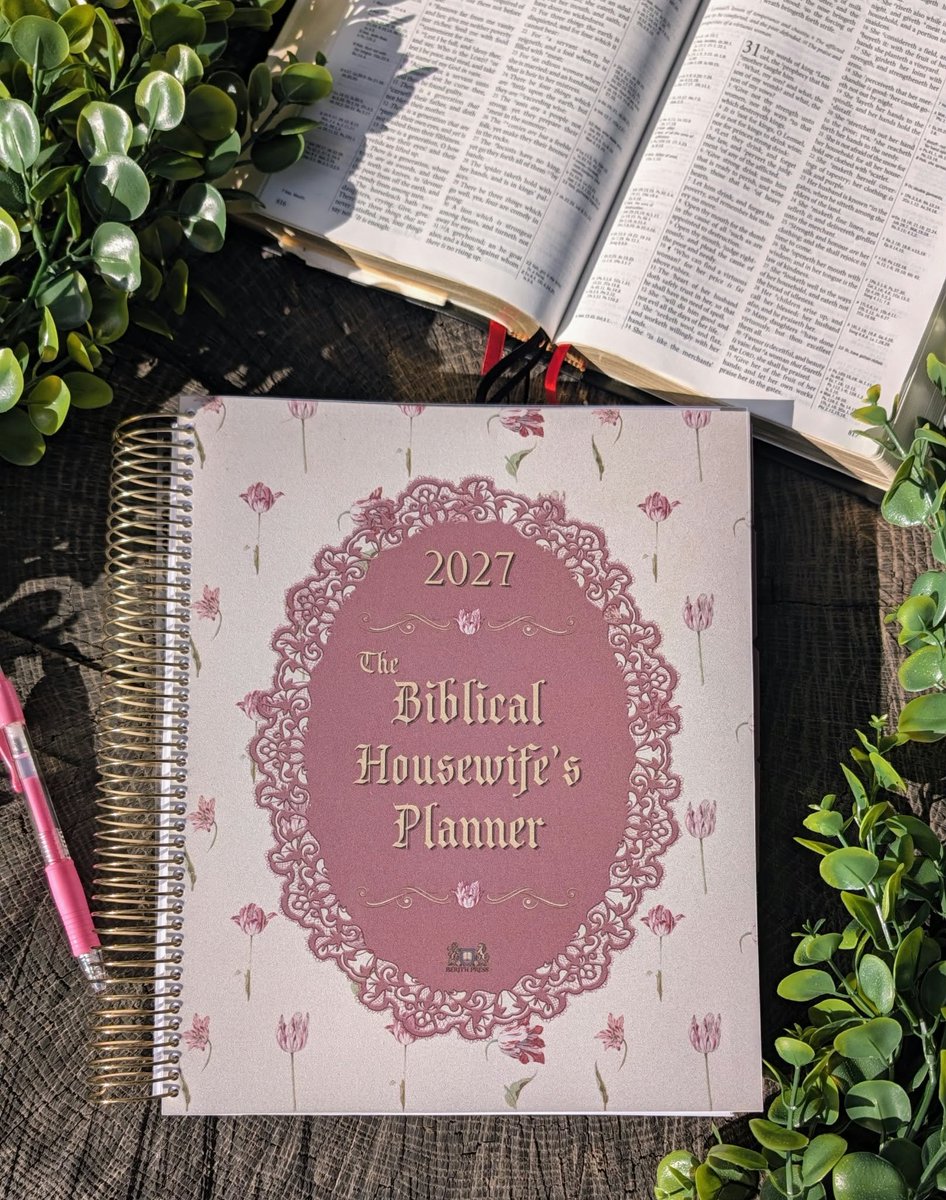
Pre-orders are now open for The Biblical Housewife's Planner for 2027!
A home planner here, a homeschool planner there, and the grocery list on a scrap of paper somewhere else... so I made one planner that holds it all.
Home, homeschool, meals, budget and prayer are together in one 486-page book, with every week ordered around the Lord's Day.
Inside:
• Daily pages with the M'Cheyne Bible reading for every day
• Room-by-room chores and a Lord's Day preparation list
• Weekly meal plans, a monthly budget and a prayer journal
• Homeschool plans, with the Westminster Shorter Catechism scheduled through the year
• A virtue from Scripture for each month
• A weekly "Conversations with My Husband" page
Pre-order now and receive two free bonuses: planner pages for the rest of November and December 2026, so you can begin right away, and a free eBook of Sermons to Young Women by James Fordyce.
$85, plus $5 shipping per planner (US only). Pre-orders are expected to ship soon.
Take a look inside on our website.
(Jami)
I've been working on an English translation of Gisbertus Voetius's five-volume Selectae Disputationes Theologicae (1648–1669). I plan to include additional disputations beyond the original selection to provide a fuller picture of his theology, its development, and the controversies of his age.
I knew several evangelical girls in college who got “daughter of the king” tattoos.
But that’s not the category Paul reaches for. In Christ, women are sons (υἱοί) of God (Gal. 3:26): heirs, sharing the standing of the Son himself. Women aren’t “other” to God. They’re in the Son.
My translation of Cyril of Alexandria’s Thesaurus on the Holy and Consubstantial Trinity is nearing publication with @BerithPress.
The volume includes a substantial introduction to Cyril, the work, and its theological setting; a (mildly) critical text where the PG requires correction or supplementation; and nearly 800 footnotes identifying sources, resolving textual problems, and helping readers follow Cyril’s exegesis and argument.
The Thesaurus itself is extraordinary: thirty-five discourses in which Cyril works through Scripture, the Nicene inheritance, and the great Trinitarian controversies of the fourth century. I’m very glad to see it becoming available to English readers.