Sell $MU before the result and buy it back after that, that way you secure your wins and in case there is a sell out you can take advantage of it to buy it back…
AMD - 10%, MU-15%, AMZN-60%, META-15% are my only stocks. Plan is for MU to go down after earnings and sell all of meta and sell 10% of amzn and put in MU.
My investing hack:
When I think $MU is expensive, I don’t park cash.
I park money in $META.
If META runs and MU pulls back, I rotate back into MU.
Not trying to time the market.
Just trying to upgrade my entry price.
$META $MU $AMD $AMZN
A Russian psychologist spent 10 years proving that the act of talking to yourself out loud is one of the most powerful cognitive tools the human brain has, and almost nobody outside his field has read the work.
His name was Lev Vygotsky.
He worked in Moscow in the 1920s and died of tuberculosis in 1934 at the age of 37. He had no laboratory, no funding, almost no English readers, and a body of work that the Soviet government suppressed for two decades after he died.
He produced the foundational theory of how human cognition actually develops, and the central piece of that theory was a behavior almost every adult is faintly embarrassed about.
Vygotsky noticed that young children talk to themselves constantly. They narrate their own actions, they argue with imaginary opponents, they instruct themselves through tasks out loud.
The dominant theory at the time, from the Swiss psychologist Jean Piaget, said this was a sign of cognitive immaturity that children would eventually grow out of as they learned to think properly.
Vygotsky said the exact opposite.
He argued that this self-directed speech was the most important cognitive event in the entire developmental window, because it was the moment a child first started to use language as a tool to control their own mind. The child was not failing to think. The child was learning how to think by externalizing the process and listening to themselves do it.
He predicted that as children matured, this out-loud self-talk would not disappear. It would go underground. It would become silent inner speech, which is the running monologue every adult has inside their own head for the rest of their life.
The voice you hear when you read this sentence is the direct descendant of a four-year-old narrating their own block tower.
For 50 years almost nobody outside Russia had access to his work, and the few researchers who did pick it up could not get funding to test it. Then in the early 2000s the experiments finally started to pile up, and what they found was that Vygotsky had been right about something even more important than he knew.
The first major study came from Gary Lupyan at the University of Wisconsin and Daniel Swingley at the University of Pennsylvania in 2012. They ran a simple visual search experiment. Participants were shown 20 images at once and asked to find a specific object, like a banana or a chair. In one condition they searched silently. In the other condition they were told to say the name of the object out loud to themselves while looking for it.
The participants who spoke the target name out loud found the object significantly faster, with higher accuracy, than the participants who searched in silence. The effect was strongest when the spoken word matched a familiar object the brain already had a strong category for.
Saying the word out loud literally tuned the visual system to detect that thing better. The researchers called it the label feedback effect, and the implication was that the act of vocalizing a goal physically changes how the brain processes the world while pursuing it.
The second major study came out of the University of Michigan and Michigan State in 2017. The lead researchers were Ethan Kross and Jason Moser, and they used both EEG and fMRI to record what happens inside the brain when people talk to themselves while emotionally upset.
They asked participants to recall painful autobiographical memories and reflect on them in two different ways. Some used the first person, saying things like "why am I feeling this way." Others used the third person, referring to themselves by their own name, saying things like "why is John feeling this way."
The brain scans showed that the simple act of switching from first person to third person, even silently, decreased activity in the medial prefrontal cortex, the region responsible for rumination and self-referential pain. Within a single second of using their own name instead of the word I, participants showed measurably lower emotional reactivity. The shift required no extra cognitive effort. It cost the brain nothing. And it worked.
Kross described the mechanism in his interviews. Talking to yourself by name creates a small amount of psychological distance from your own experience. Your brain processes the situation more like a problem belonging to someone else, which means it can analyze it instead of drowning in it.
What Vygotsky had intuited in 1934 turned out to be even more powerful than the developmental theory he built it into. The voice you use to talk to yourself is not background noise. It is one of the most precise cognitive tools the brain has, and you can change how it works just by changing the pronoun you use.
People who talk through problems out loud are not anxious or unstable. They are running an externalized version of a process the rest of us are running silently and worse. The kindergartener narrating their block tower, the surgeon muttering through a procedure, the engineer pacing a hallway describing a bug to nobody, the athlete repeating a cue to themselves before a free throw, they are all using the same ancient mechanism that builds and steers human thought.
You can run the experiment yourself the next time you are stuck on something hard. Stop trying to solve it silently in your head. Say it out loud. Describe what you are seeing. Walk yourself through the steps as if you were explaining it to a colleague who is not in the room.
And when something genuinely upsets you, switch to your own name. Ask why this person is feeling this way, instead of why I am feeling this way.
The voice you have been told to keep quiet your entire life is one of the oldest pieces of cognitive technology you own.
Most people are still embarrassed to use it.
First, CEO $NVDA Jensen Huang said to buy $MU.
Then President Trump said $MU is a great company.
Now, Elon Musk says $MU can’t meet memory demand.
You’ll be a millionaire buying $MU.
@maveinlux I’m 41. I’d bet $10k I can outperform you in any strength challenge. I was a strict vegetarian, now eat meat daily due to gluten issues — the difference is huge.
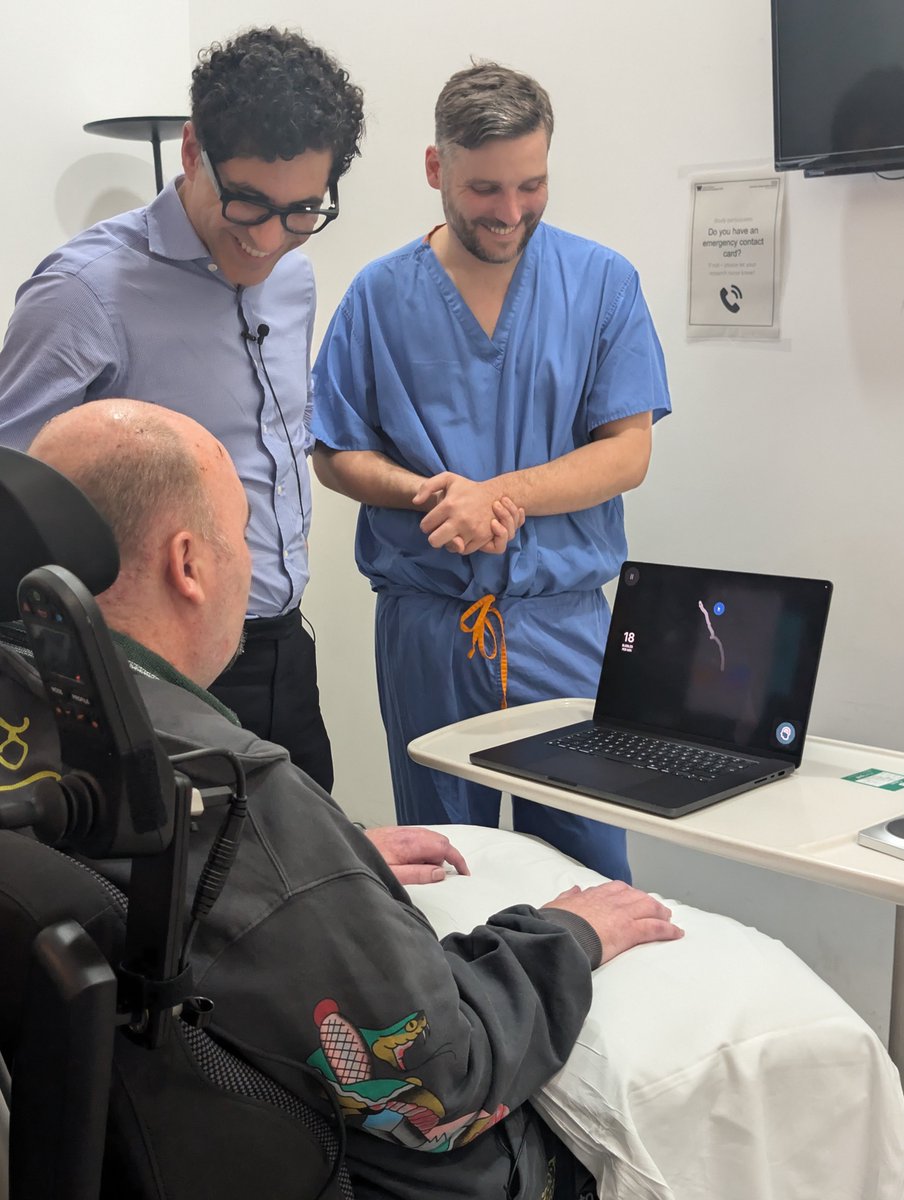
Neuralink will start high-volume production of brain-computer interface devices and move to a streamlined, almost entirely automated surgical procedure in 2026.
Device threads will go through the dura, without the need to remove it. This is a big deal.
NEURALINK 2025:
- Received FDA Breakthrough Device Designation for its speech restoration technology targeting severe speech impairments.
- Launched its first clinical trial in the Middle East (UAE-PRIME) at Cleveland Clinic Abu Dhabi in partnership with the Department of Health Abu Dhabi.
- Raised $650 million in Series E funding, led by investors including ARK Invest, Sequoia Capital, and Founders Fund, valuing the company at approximately $9 billion.
- Launched clinical trials in the United Kingdom in partnership with University College London Hospitals and Newcastle Hospitals.
- Performed its first procedures outside the United States, implanting devices in two patients with cervical spinal cord injuries at Toronto's University Health Network in Canada.
- Completed two surgeries in Canada, marking the first non-US procedures.
- The first UK participant, Paul, received an implant and controlled a computer with thoughts hours after surgery at University College London Hospitals.
- Convoy project testing with participants controlling robotic arms with their BCIs.
- Introduced an upgraded next-generation surgical robot with improved electrode thread insertion time of 1.5 seconds per thread, greater insertion depths over 50mm, enhances compatibility with 99% of anatomical variations globally, and lowers manufacturing costs for needle cartridges by 95%.
- Announced goals for faster LASIK-like implant procedures in minutes and emphasized flexible electrode threads for safer neuron placement.
- As of now it is estimated that Neuralink as 20 participants. Know are Noland Arbaugh (@ModdedQuad), Alex Conley (@Bcidesign), Bradford Smith (@ALScyborg), Michael Melgarejo, RJ Tanner, Rob Greiner (@greiner_ro52817), Jake Schneider (@PairedWith_P7), Nick Wray (@Telepath_8), Audrey Crews (@NeuraNova9), Paul, and Jon L. Noble (@CheckCanopy).
@SBakerMD@SBakerMD , you've been such an inspiration to me. As someone with gluten sensitivities, adopting a carnivore diet has helped me tremendously. It's amazing how my perspective has completely shifted - I've gone from being strictly vegetarian to embracing a carnivore lifestyle!
🚨 Employment based greencards reform (suggestion)
✅️ Move 55,000 diversity visas to Employment based as a newly created EB6 category. Keep per-country caps on this category, and same eligibility requirements as current DV (high school education, 2yr work exp)
✅️ Remove per-country caps from EB1 to EB5
That's it.
@RepMcCormick
The GreenCard Backlog SWAMP in Employment based, High Skilled Legal Immigration must be too deep, that even @elonmusk has not said a word on fixing the massively broken and inhumane system, affecting more than a million families.
Why @DOGE_DHS has no success stories to share especially when we all know the state of employment based legal immigration process in the country.
@unusual_whales This right here should prove to the entire world that Trump is not a savvy businessman.
If American citizenship was worth $5 million we would never send another citizen to war ever again.
@AnnaGorisch While Elon has been quite vocal about his stance on other forms of immigration, there’s a reason he has been silent when it comes to opposing H1B program. He has relied on the program quite a bit to make Tesla a trillion $ company, just like so many other top US companies..