If you are new to Bitcoin and blockchain technology, watch this 8 min clip - it’s a fantastic overview of Bitcoin and the opportunity to use blockchains to fix the single points of failure in today’s financial system.
The reasoning is superseded. Corinthe (1912) predates the modern law of Aboriginal title entirely. In that era courts followed St. Catherine's Milling (1888), treating the Indigenous land interest as a mere "personal and usufructuary right" dependent on the Crown and not an independent legal title.
Modern Aboriginal title was created after it: Calder (1973), constitutional protection under s. 35 (1982), then Delgamuukw (1997) and Tsilhqot'in (2014, SCC), which hold that title arises from pre-sovereignty occupation and is a constitutionally protected right that can burden Crown grants.
(Claude Opus 4.8)
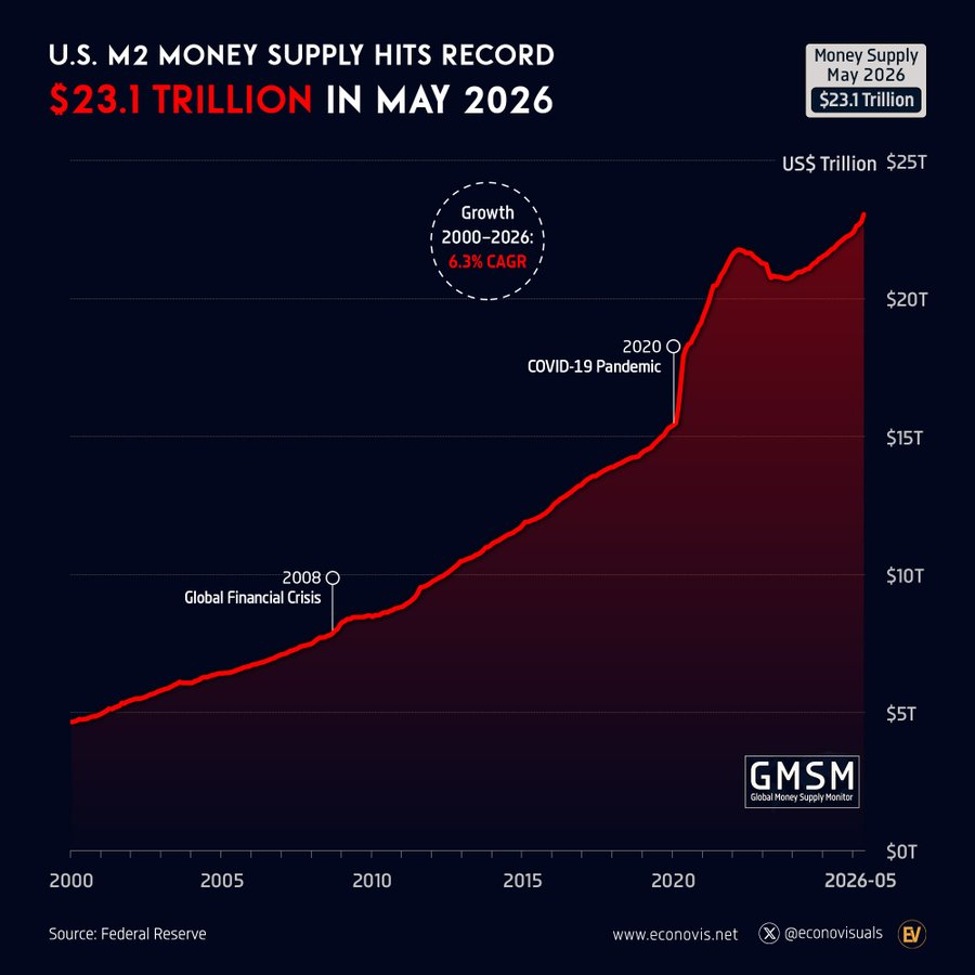
BREAKING: US M2 money supply surged +$247.8 billion in May, to a record $23.1 trillion.
This marks the largest monthly increase since May 2021.
Year-to-date, M2 has soared +$698.6 billion, the largest January to May increase in 5 years.
Money supply now stands $1.3 trillion above the March 2022 peak.
Since 2000, money in circulation has grown at an average annual rate of +6.3%.
US money creation is accelerating.
NEW - BC "commits to acting in good faith" on new Alberta oil pipeline as part of MOU with Ottawa that offers:
- Promise from feds to maintain North Coast tanker ban
- $3b for Massey tunnel replacement
- $3.9b for North Coast Transmission Line
- cooperation on steel, softwood, skilled trades training, carbon pricing compensation, and other measures
The Philippines’ Ambassador to Canada said he anticipates LNG and oil will be part of the discussion with Canada as his country tries to secure new sources of energy.
“Because after the flare-up in the Middle East, we have been very active in searching for alternative sources for both for LNG and for oil.”
Carney, Philippines President to discuss energy and trade
https://t.co/Vv9pFXBD4S
Decisions like this are why the public thinks the courts don't have their interests in mind.
"Young said she agreed with the Cowichan lawyers that reopening the trial could open the floodgates, with numerous other private landowners and persons with commercial or other interests in the Cowichan title lands seeking to join the case"
Goldman Delta 1 head:
"The most interesting thing I read over the weekend came from Brian Armstrong at Coinbase. The accompanying chart showed AI spend has almost halved while token usage continues to grow exponentially. As Armstrong put it, “The goal isn’t to suppress usage. It’s to build the infrastructure that makes exponential growth sustainable.” The key wasn’t using less AI, but routing. Simple tasks are automatically sent to cheaper local or open-weight models, while frontier models are reserved for genuinely difficult reasoning. As he put it, “Ultimately, humans shouldn’t be choosing models. AI can automate this task.” I think this is one of the clearest examples yet of inference cost deflation. Some enterprises will build on-prem infrastructure, but many will simply route workloads to lower cost providers. The common denominator is that useful output per dollar keeps rising. Ironically, if companies discover they can achieve the same output for half the AI spend, the first instinct may not be to accelerate capex… it may be to pause and optimize."
The govt doesn’t ‘build’ business or ‘create’ housing. It is a bureaucracy. Its role is to cut taxes and streamline regulation so Canadas entrepreneurs can compete globally. When it doesn’t - the smartest people and capital leave. @KirkLubimov is always on it.
The feds/prov of BC are providing $1.45B to purchase 2,200 unsold new condos in BC. Avg of $660,000 per unit based on those numbers
They insist these will be bought "below market"
But MLS HPI for condos in BC was $594,000 in May per CREA. So how exactly will this be a deal?
I have run the numbers on bulk condo purchases in Vancouver. It is very difficult to make the investment work, even at market rental rates (which these are not).
The tax payers of BC are funding $1.3B to purchase unsold condos, with debt (the Province is running the largest deficit in its history), and will then be supplementing operating losses for many years.
I have run the numbers on bulk condo purchases in Vancouver. It is very difficult to make the investment work, even at market rental rates (which these are not).
The tax payers of BC are funding $1.3B to purchase unsold condos, with debt (the Province is running the largest deficit in its history), and will then be supplementing operating losses for many years.
I have run the numbers on bulk condo purchases in Vancouver. It is very difficult to make the investment work, even at market rental rates (which these are not).
The tax payers of BC are funding $1.3B to purchase unsold condos, with debt (the Province is running the largest deficit in its history), and will then be supplementing operating losses for many years. The plan is ludicrous.
@Howard__24 This is the federal government removing itself from the backlash. The province has no plan on how to implement this. It will drag on and fail. In the meantime the BC real estate market remains stagnant.
@MattIlich is correct - the industry didn't want this. This does nothing to turn the stagnant real estate market in BC. A GST credit (Ontario's approach) would see immediate positive impact on demand and help all buyers across BC, not just a select few going through a Province gating system whilst bailing out developers that over reached.
Prime Minister Mark Carney's accounting tricks won't save taxpayers
It cost every Canadian between $1,845 and $3,348 last year just to pay the $94.4 billion in interest on Canada's combined federal and provincial debt of $2.4 trillion: study 1/2
https://t.co/Iih5fLynyU
“Every investor in BC faces grave risk."
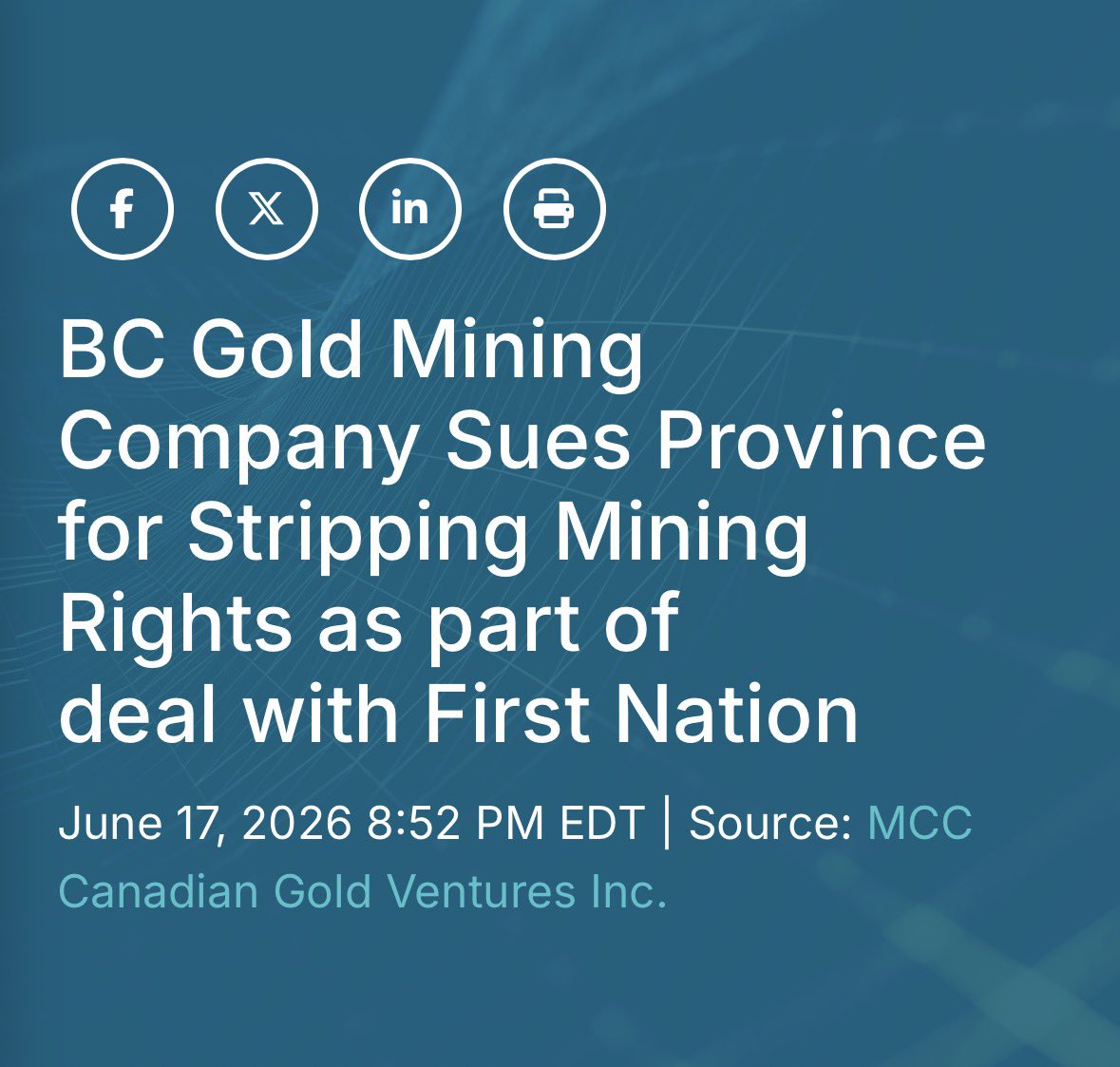
🚨 A multi-million dollar lawsuit has been launched against the BC Government after, without warning or compensation, it stripped a company of its mining rights in order to settle a separate legal dispute with a First Nation.
Shockingly, the government had actually *asked* the company to take on the mining project in the first place. Then, it negotiated away the company’s property rights in a backroom deal without involving or even telling them.
The NDP’s radical “reconciliation” agenda is a disaster for BC. Every minute they sit in government means more decisions like these get made.
And British Columbians pay for it: in lawsuits, in lost opportunities and in lost revenues as investment flees. We can’t get the NDP out of government soon enough.
https://t.co/EWRDp9Z17Q
I will lay this out one last time for Canadians.
The USMCA does not lock anyone in until 2036
Any member (including the U.S.) can exit unilaterally with six months’ notice under Article 34.6 The 2026 review and 2036 timeline ONLY matter if countries choose to stay in the deal. Exit is a separate and immediate option.
Therefore, Trump can easily kill the trilateral USMCA and negotiate bilaterals from a position of strength with nothing in its place during the gap.
As President he has the right to trigger Article 34.6: six months written notice and the US is out. No automatic deal stays alive, and America drops back to WTO rules, higher tariffs, no special access with Canada and Mexico until new bilateral deals are signed.
The "annual review until 2036 crowd" is completely missing the point. Withdrawal is the real fast exit that skips it completely. Trump used the same threat to turn NAFTA into USMCA before. He can certainly do it again.
Canada and Mexico would feel the heat right away: messed up supply chains, lost market access, and the threat of fresh US tariffs. Talks could drag on for months or years, but the US keeps the leverage the whole time.