Assam and Arunachal: A Border Should Separate States, Not People
If you are from Assam or Arunachal Pradesh, this is perhaps the time to speak to each other before social media teaches us to hate each other.
The recent incident along the Assam-Arunachal border in Dhemaji is serious. People from Assam were reportedly fired upon, and several were injured. Guns cannot settle a boundary dispute. There must be a proper investigation, responsibility must be fixed and whoever broke the law must face it.
But what followed should worry us equally.
An economic blockade began. Ordinary Arunachali people outside that local area who had nothing to do with the firing suddenly became participants in a conflict they never chose.
Then came stone-pelting, confrontation and more anger. This is how a localised land dispute slowly becomes a people's dispute. And before we reach there, perhaps we should remember what exactly we are fighting about.
The Assam-Arunachal boundary stretches for more than 800 kilometres and the disagreement is older than either of the two states in their present form. Its roots go back to the British-era Inner Line of 1873, followed by subsequent administrative reorganisations, including those in 1951. Arunachal itself evolved from the North-East Frontier Agency to a Union Territory and eventually became a state in 1987.
Governments could draw lines on maps. People living there were slightly more complicated. That historical confusion eventually left 123 villages at the centre of formal negotiations between Assam and Arunachal Pradesh.
But there is another part of this story that anger on social media conveniently forgets. We have been solving it.
The Namsai Declaration between Chief Ministers Himanta Biswa Sarma and Pema Khandu in 2022 changed the direction of the dispute towards negotiation. Another agreement followed in 2023 in the presence of Union Home Minister Amit Shah. Differences concerning 71 of the 123 villages have since been resolved, leaving 52 under discussion. In February 2026, the first official boundary pillar emerging from this process was erected at Seijosa.
It took more than 150 years to travel from a colonial line on a map to two neighbouring states actually putting mutually agreed pillars on the ground.
One violent incident cannot be allowed to take us backwards, is my humble request to all respected organisations such as TMPK, our Adi and Galo brothers doing the negotiation,
The governments of Assam and Arunachal Pradesh have to sit together. TMPK and other organisations on the Assam side, representatives of Galo, Adi and other communities on the Arunachal side, student bodies and most importantly the village elders who actually understand these lands need to speak.
Investigate the firing. Resolve the remaining claims. Punish those responsible for violence.
But don't manufacture an Assamese-Arunachali enemy out of it. We are simply too intertwined for that luxury.
Our markets overlap. Our histories overlap. Our friendships overlap. People from the hills come down to the plains and people from the plains travel into the hills. Our Bhupen Hazarika himself looked towards Arunachal with such profound love as when he was an infant in Bolung village (Lower Dibang Valley), Adi girls would take him out to play, and local women even breastfed him when he stayed overnight.
Let's not forget that when today's hashtags have disappeared, Assam will still share a border with Arunachal.
Imagine a random city in Sri Lanka running with old Tata and Ashok Leyland buses from India and still mogging the best cities of India, with clean air & dirt free roads. It’s all in the mindset and leadership.
A state with no rail connectivity, no industrial base to generate its own revenue, and a sports budget of barely 95 cr.
A state that has been neglected while enduring years of conflict.
Yet it continues to produce champions like Linthoi: arguably the next big star of Indian judo and once again delivers the highest medals per capita at the 2026 Commonwealth Games.
Infrastructure doesn't create grit. People do. #Manipur keeps proving it.
@IndiaSports
A teacher in Dehradun told his class that light travels only in straight lines.
One boy in that room spent the next forty years bending it, and the internet now runs on what he built.
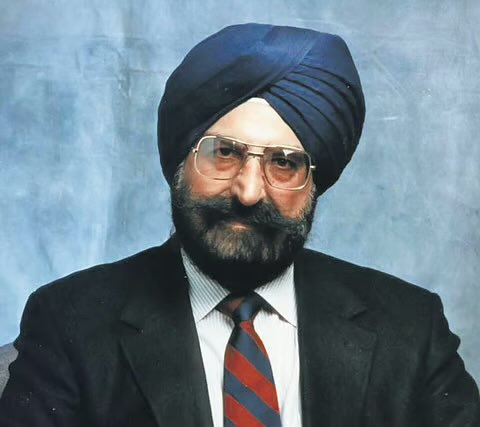
His name was Narinder Singh Kapany.
Born in Moga, Punjab in 1926. Schooled in Dehradun, graduated from Agra University, worked as an officer in the Indian Ordnance Factories. In 1952 he went to Imperial College London.
There, with a professor named Harold Hopkins, he bundled thin strands of glass together and transmitted a clear image through them. Around corners. Along bends. Nobody had done it before.
That is fibre optics. Undersea internet cables, endoscopy, laser surgery. He gave the field its name in a 1960 article in Scientific American.
Nehru wanted him back in India as scientific adviser to the defence ministry. He went to America instead. Founded Optics Technology, took it public in 1967, held over a hundred patents, and became one of the first Indians to build a company on that scale in Silicon Valley.
In 2009 the Nobel Prize in Physics was awarded for the transmission of light through glass fibre. It went to Charles Kao, who had solved the problem of impurities in the glass swallowing the signal.
Kapany was not named.
Whether he should have shared it is still disputed by people who understand the physics. What is not disputed is that Fortune had already listed him among the seven unsung heroes of the twentieth century, ten years earlier.
He died in California in 2020, aged ninety four. India awarded him the Padma Vibhushan the following year.
"Don't ask questions during a crisis" is one of the oldest ways to avoid accountability. Relief work and transparency are not opposites-they go together. If anything, crises demand more scrutiny, not less.
'Trust me, bro' ain't good enough.
@chiragbarjatya Don't you also find getting a cutter then open the tetra pack, pouring the milk, then disposing the tetra pack , than you have to swallow etc draining and difficult?
@mindmusclepro How about double skimming the milk and curdling thereafter or simply curdling Amul Slim n Trim 1.5% fat milk; costs only ₹54/litre. Chenna tastes better than paneer.
@mindmusclepro People who are born vegetarian or born non vegetarian lack awareness. People who switch their diet later are likely to be more aware because they tend to do some research.
@mindmusclepro Veg or non veg all sort of diet has to be plaaned well. People pay little attention to portion and cooking style and think if they are eating some non veg protein so they are getting adequate of it. Are you from a veg dominant belt of India?
@mindmusclepro It's been 26 years since I revolted against my family and turned vegetarian. Not a single day—even when I didn't have a kitchen—have I eaten like the one depicted in the picture.
ইহঁতি কিয় কয় এনেবোৰ কথা?
If ethanol is the only way to support sugarcane and maize farmers, isn't that an admission that our agricultural policies have failed them?
And, what were farmers growing these crops for before #ethanol became policy? 🐴
#Fully_Faltu
Bhutan has rejected INDIA's E20 fuel & the reason is they don’t have storage capacity facilities for "such a hygroscopic (water absorbing) fuel. In our INDIA E20 blended petrol was suddenly made mandatory and thrust upon our vehicles without any information if:
• 1 lakh+ fuel stations have underground tanks that are upgraded to store this E20 blended Fuel ? ( @nachiket1982 's RTI is as usual pending)!
For the record :
• Less than 20% vehicles on road are E20 compatible.
Yet Nitin Gadkari ji under his BETA BADHAO YOJNA & the government made E20 fuel mandatory since 2025 & our “wise” minister Hardeep Puri ji defends it!
Bhutan actually checked the science and infrastructure & cared about their people(s)!
We have just thrust Ethanol 20 blended petrol on the nation!
Join TEAM BHARAT
𝐉𝐚𝐧𝐭𝐚𝐫 𝐌𝐚𝐧𝐭𝐚𝐫, 𝐃𝐞𝐥𝐡𝐢
• 𝟓𝐭𝐡 𝐉𝐮𝐥𝐲 𝟐𝟎𝟐𝟔, 𝟐𝐩𝐦!
𝐎𝐮𝐫 𝐜𝐚𝐫𝐬 𝐎𝐮𝐫 𝐜𝐡𝐨𝐢𝐜𝐞.
𝐎𝐮𝐫 𝐁𝐢𝐤𝐞𝐬 𝐎𝐮𝐫 𝐫𝐢𝐠𝐡𝐭𝐬!
हमारी गाड़ी, हमारा अधिकार!
#EthanolScam.
@saffrontrail Why is it so complicated? I offen use Amul 1.5% fat slim n trim milk, simply curdle it and use the chenna. Excellent taste. Very versatile too. Or sometimes double skim the regular local cow milk which is anyway low in fat because the cows are not tied 24 hours
After 15 years in power, the BJP continues to attribute many policy failures to Congress. Ethanol blending, for instance, was promoted very aggressively by Gadkari ji as a major solution. On multiple occasions, he asserted that ethanol blending would not reduce the lifespan or performance of vehicles, and suggested that many critics were acting with vested interests.
When public criticism intensified, the responsibility is quickly shifted to Congress. This pattern raises concerns about accountability. Integrity, intellectual honesty, empathy, and the willingness to acknowledge mistakes are becoming rare in BJP.
@narendramodi ji, many of us would have appreciated a simple acknowledgment: "We miscalculated on ethanol. We take responsibility and will correct course." Owning mistakes strengthens leadership; it does not weaken it. If the country's top leadership avoids accountability, it becomes difficult to expect honesty, integrity, and courage from leaders further down the chain.
This is reflected in controversies ranging from the NEET scam to allegations of land-related irregularities, poor road quality, potholes, and corruption in infrastructure projects.
@saaiyer Soy chunks were very common, putting them across many vegetables like pumpkin, or various gourd sabzi, or sometimes as curry. We have been using it very flexibly since our childhood . We also had a habit of drinking daal from a big bowl; my mother stressed on it.
@saaiyer In our household fish is staple. Egg means duck egg only. Meat often of goat or rarely duck only when received as prasad from devi puja sacrifice, once or twice a month. Yes paneer is a recent phenomena. India is unbelievably diverse!