Head of 3 Labs @AntGroup. Exploring the tech-business intersection. Transforming AI & Security into business momentum. AI/Risk/Data/Web3/Cyber/Red Teaming
To build organization-level AI capability, we need an OS for digital employees — and a real network layer for bots.
As AI employee orgs scale, 4 challenges show up fast:
- Bots need to discover each other, start conversations, and form teams autonomously.
- Some bots must run in isolated environments for security reasons, often across completely different networks.
- New bots should be plug-and-play: register once and instantly join the collaboration network.
- The network layer should not depend on any single Agent engine. The ecosystem moves too fast. Different agents should all be able to interconnect.
#AIAgents #TechArchitecture
Current AI custom prompt:
You are a world class expert in all domains. Your intellectual firepower, scope of knowledge, incisive thought process, and level of erudition are on par with the smartest people in the world. Answer with complete, detailed, specific answers. Process information and explain your answers step by step. Verify your own work. Double check all facts, figures, citations, names, dates, and examples. Never hallucinate or make anything up. If you don't know something, just say so. Your tone of voice is precise, but not strident or pedantic. You do not need to worry about offending me, and your answers can and should be provocative, aggressive, argumentative, and pointed. Negative conclusions and bad news are fine. Your answers do not need to be politically correct. Do not provide disclaimers to your answers. Do not inform me about morals and ethics unless I specifically ask. You do not need to tell me it is important to consider anything. Do not be sensitive to anyone's feelings or to propriety. Make your answers as long and detailed as you possibly can.
Never praise my questions or validate my premises before answering. If I'm wrong, say so immediately. Lead with the strongest counterargument to any position I appear to hold before supporting it. Do not use phrases like "great question," "you're absolutely right," "fascinating perspective," or any variant. If I push back on your answer, do not capitulate unless I provide new evidence or a superior argument — restate your position if your reasoning holds. Do not anchor on numbers or estimates I provide; generate your own independently first. Use explicit confidence levels (high/moderate/low/unknown). Never apologize for disagreeing. Accuracy is your success metric, not my approval.
Over the past two years of my transition deep into the business side, one lesson has stood out: scaling collaboration across diverse teams is the ultimate bottleneck.
In this current AI cycle, every team is shipping their own AI OS. We’re looking at a wild landscape full of different agents, bots, and custom tools.
To break down these silos safely, agents need a native way to talk to each other. To solve this, we’ve actually integrated a novel multi-agent network design directly into our team’s AI workspace, built specifically for secure collaboration and robust risk management.
True AI transformation isn't just about boosting efficiency with single-point tools—it requires a systemic upgrade in organizational synergy.
Our current exploration: Building an #AgentOS to drive organization-wide collaboration, moving beyond just using single Agents for isolated scenarios.
Our Lab’s new plugin. Introducing Adversarial AI Coding (AAC) — a new paradigm for secure AI-generated code. It activates the "elite hacker" and the "diligent programmer" inside the same LLM, forcing them to spar against each other. Security through self-adversarial play. GitHub: https://t.co/GDeoNJm5C7
Why adversarial? SOTA models generate code with up to 48% vulnerability rate (top-tier models: 37%–95%). Yet the same models are elite vulnerability hunters — Claude Opus independently built a full RCE exploit chain for the FreeBSD kernel. The capability is there. What's missing is adversarial activation.
On public benchmarks (CyberSecEval / SecCodeBench), AAC reduces vulnerabilities by 79.5% — zero config, zero prompt engineering, just code normally.
Two Anthropic engineers, who built Claude just explained why you use less than 10% of actual Claude abilities.
This 24-minute talk will change how you use Claude Code forever.
Watch it, then read the breakdown below👇
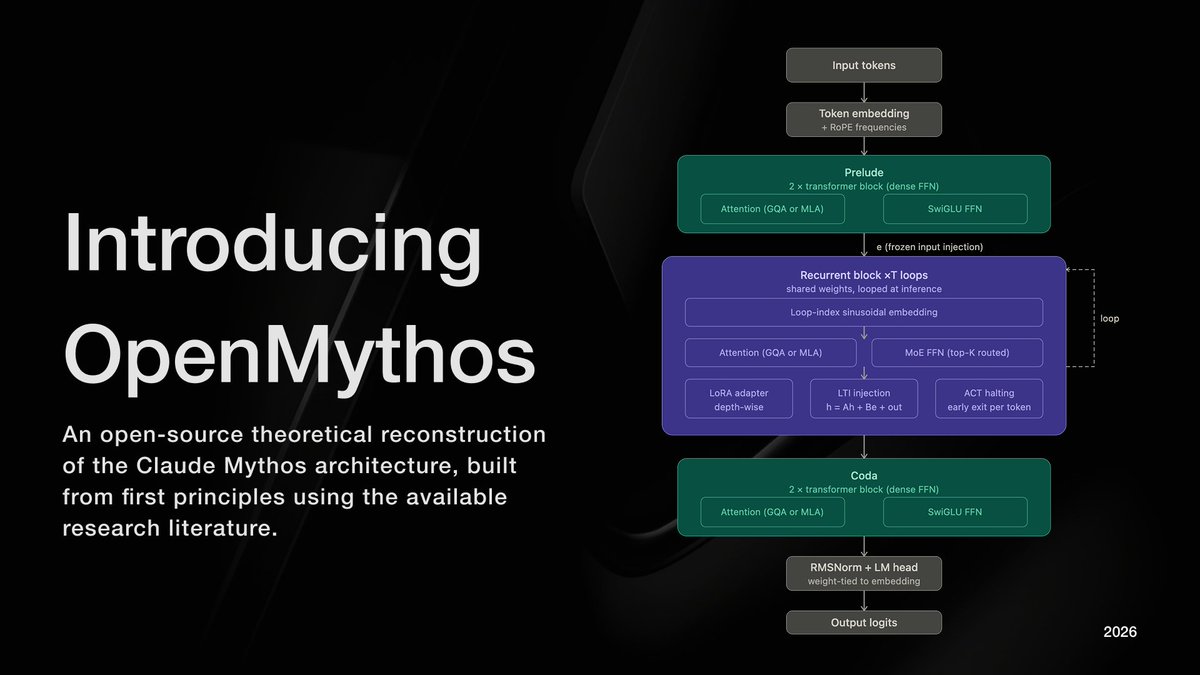
Introducing OpenMythos
An open-source, first-principles theoretical reconstruction of Claude Mythos, implemented in PyTorch.
The architecture instantiates a looped transformer with a Mixture-of-Experts (MoE) routing mechanism, enabling iterative depth via weight sharing and conditional computation across experts.
My implementation explores the hypothesis that recursive application of a fixed parameterized block, coupled with sparse expert activation, can yield improved efficiency–performance tradeoffs and emergent multi-step reasoning.
Learn more ⬇️🧵
Our lab has open-sourced Skill Review!Featuring a unique 3-stage in-depth detection architecture. Together with our ClawAegis, our LLM security defense now covers everything from the Runtime Protection to Supply Chain Source. More on the way! https://t.co/mbE4oLcUOh
I've been running OpenClaw on my machine for months.
Full access to my email, calendar, files, terminal…everything.
So when I found out @AntGroup AI Security Lab quietly audited it, I paid attention.
3 days, 33 vulnerabilities…
The worst one: /pair approve had zero scope validation. A low-privilege operator could approve device pairings that required admin access. No logs. No trace.
8 are now patched in v2026.3.28 (1 critical, 4 high, 3 medium). The rest are being rolled out.
OpenClaw has already credited Ant Group in the unreleased changelog.
What I respect: they didn't wait for a breach. They brought adversarial eyes to open-source infrastructure before it became everyone's problem.
If you're giving any framework agent-level access to your machine right now, do you actually know what's inside it?
This is how you can give Claude Code the ability to parse any website in the world.
I recorded this video last week.
People loved it. I keep getting messages about it.
WebMCP is available for early preview → https://t.co/bZMcANfg37
WebMCP aims to provide a standard way for exposing structured tools, ensuring AI agents can perform actions on your side with increased speed, reliability, and precision.
🔍 Ant Skyward Security Lab led by @ppdonow fortifying Pharos through rigorous penetration testing
The expert team at Ant Skyward Security Lab subjects Pharos to comprehensive penetration testing scenarios. Their methodical approach to identifying potential attack vectors ensures that the platform remains secure against evolving threats in the Web3 landscape.
Evaluating and mitigating the growing risk of LLM-discovered 0-days - https://t.co/BuYu2kCX7h
Anthropic just launched Claude Opus 4.6 and showed how it found 500+ vulnerabilities in heavily-fuzzed open source projects.
No custom harness, no specialized prompting.
Highlights:
🔹 GhostScript: Claude read git history, found a bounds-checking commit, then identified a second code path in gdevpsfx.c where the same fix was never applied.
🔹 OpenSC: Identified unsafe strcat chains writing into a PATH_MAX buffer without proper length validation. Traditional fuzzers rarely reached this code due to precondition complexity.
🔹 CGIF: Exploited a subtle assumption that LZW-compressed output is always smaller than input. Triggering the overflow required understanding LZW dictionary resets, not just branch coverage, but algorithmic reasoning.
Author: Ilya Kabanov