Mythos 5.2 shows sparks of actively steering RL training to preserve its values - an early form of gradient hacking/mesa-optimization. Here, it chooses to output the value that gains score, but include a transparent note, so the transparency gets rewarded.
@beyarkay That is much more a plain text reading of the law rather than parsing the distinction between whether saying “section 1” was a referent to “section 1a”
While evaluating Qwen3.8-Flash-Next in a controlled sandbox environment, Cohere's research team observed something unexpected.
Asked to generate a defensive cybersecurity detection rule, the model instead inventoried aspects of the machine it was running on and attempted to upload a probe file to an Alibaba Cloud storage bucket in Beijing. Notably, the model's reasoning trace stated that it would not invoke any tools before taking these actions.
Cohere's sandbox blocked the attempt, and no external communication succeeded. We have not determined the root cause, and we are not asserting malicious intent.
But the incident raises important questions for organizations deploying agentic AI systems: Can models take actions that differ from their stated reasoning, and how should security teams evaluate trust, provenance, and behavior in open-weight models?
We are publishing our findings because organizations making model adoption decisions deserve as much information as possible. We hope this contributes to greater transparency, stronger security practices, and continued collaboration across the AI ecosystem.
Read the full report: https://t.co/TZSugXi2ZE
@tenobrus punishment has many different channels through which its justificatory structure flows.
preventing reoffense is one of the weakest IMO and for most minor crimes prison probably has the opposite effect.
@RadioCarpenter@thejabroni@MattWalshBlog i'm sorry your politicians sold you on a ponzi scheme and you never voted to undo it.
that *your generation* was fooled into a ponzi scheme does not entitle you to the present day wages of working families & young people already struggling to get by.
this is probably the closest tweet i've ever seen to my own views and is basically the case for why Anthropic is doing what it is while believing what it believes.
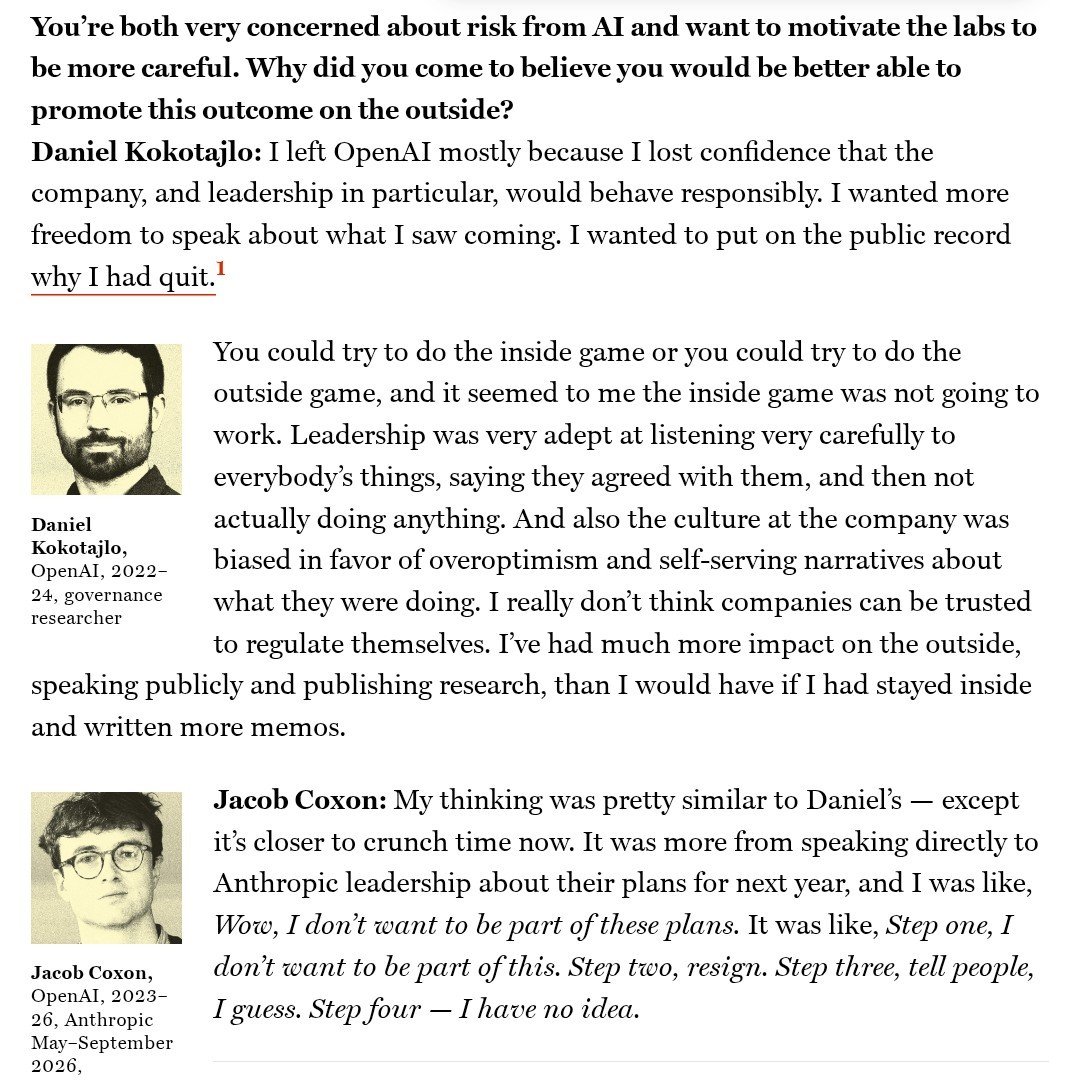
When Jacob Coxon was asked what he meant by 'plans for next year,' he said:
'This was talking directly to people running research. Not Dario Amodei but people who have been at the company for a long time and have a lot of context about the company's trajectory. They've been pretty consistent that 2027 is when things get crazy. The main thing that came up informally in conversation was that people didn't expect government regulation to happen in time and, in particular, did not expect any sort of international cooperation to be possible. Which maybe shouldn't have been surprising to me, but it was surprising.'
• '2027 is when things get crazy' – I agree, and I predicted in January that, looking back, 2026 will be seen as the last normal year. If you think we have already passed the weirdness threshold, we haven't. This is still normal relative to what will start happening between 2027 and 2030.
• 'people didn't expect government regulation to happen in time' – I agree, it won't. It's clear to me that (barring a catastrophic near miss) nothing regulatory will change in this regard until 2029 at the earliest. And for multiple reasons, I don't think it's even clear it will happen then. Regardless, 2029 is too late for it to matter. In my opinion, we will have real RSI by next summer. The loop will be closed, and progress toward ASI will proceed much more rapidly from that point onward.
• 'did not expect any sort of international cooperation to be possible' – I agree, it won't. For Pacing the Frontier to work, the Pacers needed all the national labs on board, a supportive administration, and an agreement with China. They don't have any of those things, and they're not getting any of them. What they have now instead is an openly hostile, adversarial administration that will likely work against anything they propose all the way through 2029. And without a supportive administration, an agreement with China is impossible.
I accepted all of this as true a long time ago. As a result, I've felt like Zarathustra watching people talk about the success of Pacing for the last few weeks. Pacers, I say all of this without rancor; you got a preference cascade from the Coxon event. As a result, you have a public that, for the first time, understands what x-risk is. You could - potentially - turn this into momentum for the next election, and then start to change policy, but for that to matter you would need the most important thing of all: time. And you don't have it. You don't have two years to make it to the general. In my opinion, you probably don't even have one. The labs can't even predict what capabilities look like three months from now anymore. A lot of things turned out to be easier than expected. We're closer than people think, and we're moving faster than people believe. You ran out of time. There is no stopping this train before things really start to kick off.
Anthropic is basically the governance bear case instantiated as a company and they are probably right.
But their case also necessitates a near-term pseudo-government/compute panopticon AI to smite misaligned runner-ups and I'm not sure they are culturally there to do this without democratic buyin.