Since the start, @PlayVentures has this unique term that we include in our term sheet: the 2 year vesting cliff. Many founders get surprised by it.
The 2 year cliff is the ultimate Founders Insurance and protects YOU from your co-founder.
Why we insist on it:
1/ The brutal truth: we estimate that 15%+ of startups have founder breakups AFTER year 1.
2/ The danger zone for early founder breakups is Month 9-18. The cliff approaches, runway starts looking short, tension peaks
3/ Departing founder walks away with big chunk of equity even though company value is built in the years after
4/ Cap table dynamics, fundraising prospects for those who stay to build are weakened
Most founders think they're different. "We'd never break up!", "We've worked together before, it'll be fine." But hope isn't a strategy. Contracts are. Even if you don’t raise from Play, sign a 2 year cliff. A cofounder who plans to stick around won’t fight you on it.
Protect yourself before you wreck yourself.
Full breakdown on @DeconFun with real founder stories:
https://t.co/ZH20z0mYlq
Small table. No panels. No pitches. Just good conversation.
Monday night in SF, I'm co-hosting an intimate dinner with @gracegongGG for founders from Seed through Series E, plus a curated group of VCs.
If you're building and this sounds like your vibe, please join us: https://t.co/98LzhkBcjc
So we're hiring a Junior Investment Analyst to join @PlayVentures in Singapore.
Only the hungry and the curious need apply. https://t.co/l5imAZ9Xjs
🎞️ video made with @trysecretsauce
⚡️This chart is the early shape of corporate extinction.
The real signal is that a cognition gap is opening between firms, and once that gap starts compounding it stops behaving like a normal productivity upgrade. It becomes a separation event. One group is building with machine leverage inside the operating system. The other group is still paying full price for human bottlenecks.
That is why the curve matters. The line does not rise steadily. It pulls away. That is what compounding looks like when intelligence itself becomes infrastructure. Faster analysis. Faster iteration. Faster customer response. Faster coding. Faster sales prep. Faster research. Faster internal coordination. Faster decisions. The revenue line then feeds back into more AI spend, more talent, more experimentation, and even more speed. Once that loop starts closing, weaker firms do not merely lose ground. They fall into a different era.
This is about organizational metabolism. The firms spending hard on AI are usually the firms willing to redesign workflows, management habits, and decision structures around it. They are not just buying tools. They are replacing drag. That is why the laggards are in more danger than they realize. They think they are delaying a purchase. What they are actually delaying is a change in operating model, and by the time they finally move, the leaders may already be playing a different game.
There is selection in the chart, of course. The stronger, more ambitious, more tech-forward firms were always more likely to buy first. But that does not soften the implication. It sharpens it. A force multiplier landed in the hands of the already capable. That is how class divisions get violent. The best firms get stronger first, then the gap itself becomes a weapon.
So my real view is simple.
AI is already splitting the corporate world into augmented firms and exposed firms.
One side is learning how to operate with an extra cognition layer.
The other side is slowly discovering that “waiting” was never neutral.
This does not end with everyone getting a little more efficient.
It ends with a lot of companies realizing too late that they were competing against businesses that had already become part-machine.
So excited to finally introduce @trysecretsauce to the world. We were our own first customer, a game studio that needed millions of assets that matched our game world without looking generic. Nothing out there could do it, so we built it ourselves. Now we're 100% focused on bringing it to everyone else.
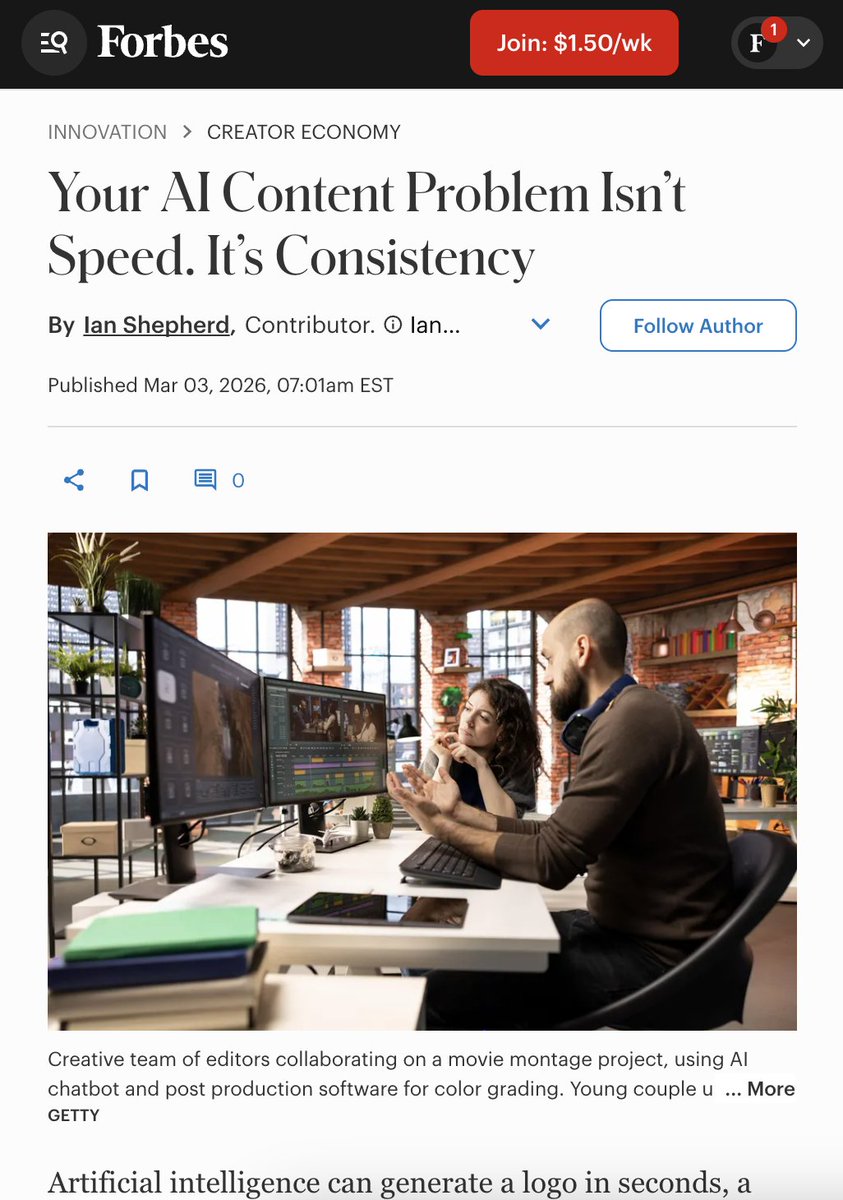
Read about us in Forbes. Link below ⬇️
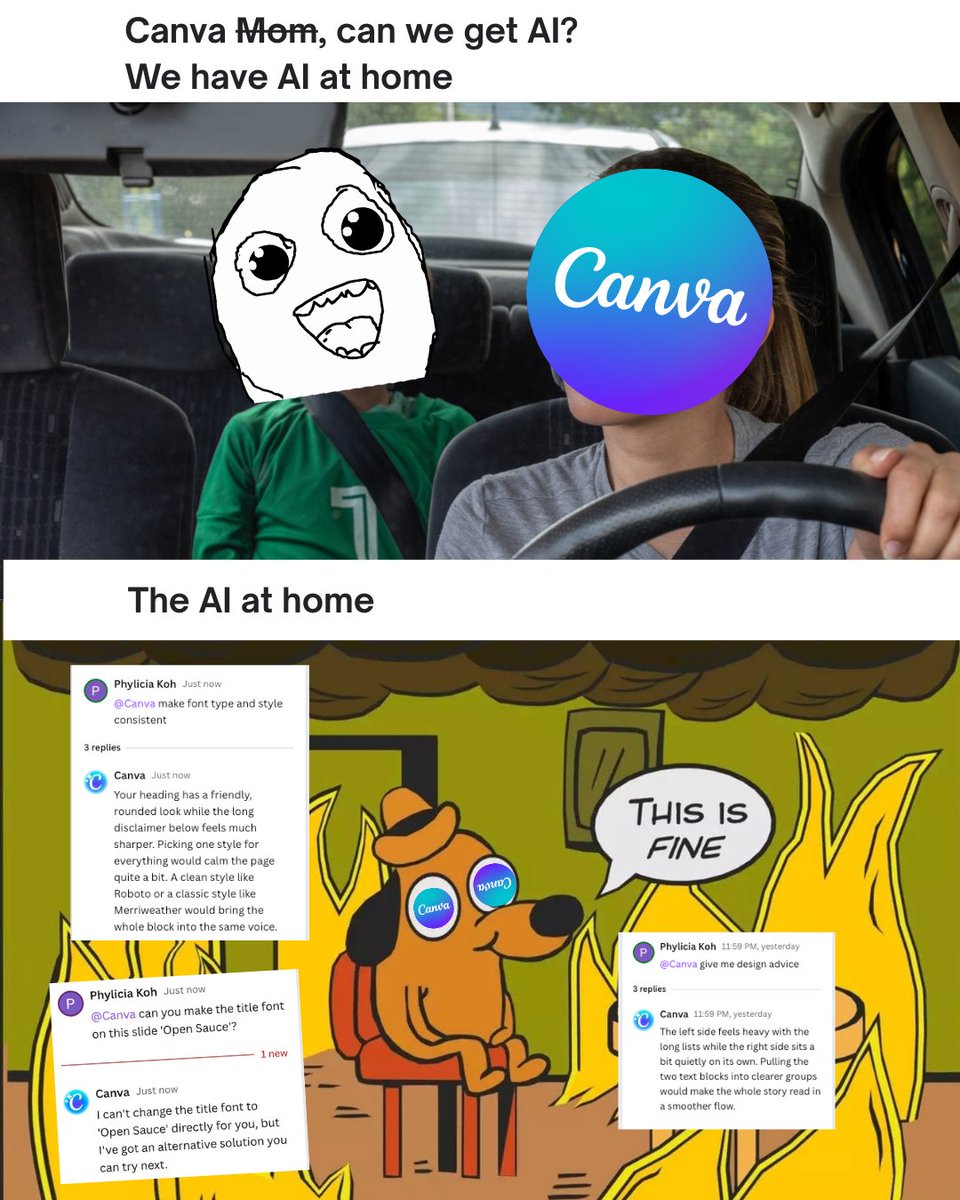
$4B ARR. 265M users. Canva's core product is great. I use it weekly.
Their COO says they're becoming "an AI platform with design tools."
But Canva AI is giving "we have AI at home."
"Suggest a layout." → "Your slide is text heavy." Thanks, I'm aware.
"Change title font to Montserrat." → Can't.
"Make fonts consistent across slides." → Nope.
A $42B company that can't change a font.
The positive: $4B in ARR, potentially a long runway, and Canva seems to be willing to invest in capabilities. They acquired Cavalry (2D motion animation), and MangoAI (video ad performance).
But something's not working with the core Canva AI product and its development.
Rooting for @canva. Plz fix.
In the age of agentic AI, the bar is higher than "helpful tips you already knew."
All tech inventions inevitably leads to more cute animal content. Cat photos, cat videos, and now Punch has his day.
Honestly, there could be worse uses of AI.
In my latest In Dialogue conversation, I spoke with @ppphyl, General Partner at @PlayVentures, about where she sees the next wave of growth in gaming and venture capital 🎮📈
While many investors are focused on traditional console or mobile hits, Phylicia is betting on “playable apps,” platforms that apply gaming’s engagement mechanics to everyday life, from language learning to wellness and finance. It is a compelling example of how innovation often happens at the intersection of industries.
We also discussed her unconventional path into VC, her decision to embrace a “Year of Yes,” and how that leap helped her build one of the top-performing gaming venture funds.
If you are curious about where technology, lifestyle, and human behavior are headed next, I invite you to read our full conversation here: https://t.co/1AHx2lEw5E
#lizelting #DREAMBIGANDWIN #womeninbusiness #gaming #femalefounder
Kicking off 2026 talking about my fave topic - playable consumer apps.
We cover lots in this one, including:
- Analysis of why consumer in-app purchase spending now exceeds gaming IAP spending.
- 4 key characteristics of a successful playable app
- Impact of AI on user acquisition and creative fatigue
- The metaverse....(spoiler: it already exists)
- Future of product discovery
Pick your poison, it's on YouTube, Spotify, and Apple podcasts.
https://t.co/N1KazEhhQ7
https://t.co/cVPrvkNlmF
https://t.co/XOE8QkbI3e
🎙️ Gamification of Consumer Apps
In 2025, consumer app in-app purchases (IAP) surpassed gaming in-app purchases for the first time ever.
I sat down with @ppphyl, General Partner at @PlayVentures, to talk all about it.
Link👇
Relationships are co-op games with no tutorial, and a constant boss battle against routine.
Loved hearing @offeryehudai's take on how @AryaFYI was built brick by brick, and how they bring ‘play’ into real relationships by understanding human motivations, habit-building, and creating 'wins' for their users.
The clever bit IMO: you will always win using Arya.
Goes well? You're a hero.
Goes badly? Arya's fault, you tried.
Have a listen here: https://t.co/NFUr9VuFOH
Since the start, @PlayVentures has this unique term that we include in our term sheet: the 2 year vesting cliff. Many founders get surprised by it.
The 2 year cliff is the ultimate Founders Insurance and protects YOU from your co-founder.
Why we insist on it:
1/ The brutal truth: we estimate that 15%+ of startups have founder breakups AFTER year 1.
2/ The danger zone for early founder breakups is Month 9-18. The cliff approaches, runway starts looking short, tension peaks
3/ Departing founder walks away with big chunk of equity even though company value is built in the years after
4/ Cap table dynamics, fundraising prospects for those who stay to build are weakened
Most founders think they're different. "We'd never break up!", "We've worked together before, it'll be fine." But hope isn't a strategy. Contracts are. Even if you don’t raise from Play, sign a 2 year cliff. A cofounder who plans to stick around won’t fight you on it.
Protect yourself before you wreck yourself.
Full breakdown on @DeconFun with real founder stories:
https://t.co/ZH20z0mYlq
After 36 years as a public company, EA's $55B take-private is historic, but here's the tension: going private *theoretically* gives breathing room to innovate beyond quarterly earnings pressures, except they're servicing $20B in debt with three buyers who have different economic and strategic priorities.
fwiw EA generated about $2B in free cash flow in 2024, just enough to cover the annual interest of the debt, but time will tell how EA serves 3 masters.
Talked to @pcgamer: https://t.co/6yFhBQGCoK
Back to regular 2 Player Mode programming after a summer break, with 2 amazing guests @yoitsOG, @ElizaCrichtonS, and a whole lotta news.
🗓️ 8am EST / 12pm UTC on 10 Sep
Building on @eigen_moomin and @0xRyze 's brilliant analysis of Singapore's "air-conditioned nation" - there's a disease at work.
Language reveals mindset:
Growing up, everyone knew what the 5 Cs were (Cash, Car, Credit card, Condo, Country club)
Today, the fatal 4 Cs killing us: Comfort, Conformity, Complacency, Incuriosity
This incuriosity manifests everywhere, no questions, no second-order thinking:
→ MNCs extract subsidies and tax rebates to set up shop here in Singapore. When the milk and honey stops flowing, they leave. We repeat the same failed playbook a few years later. Why?!?!?!
→ I watched a government agency spend ~6-figures (if memory serves) on a "collaborative" coffee machine for Fortune 500 CEOs (they had to put their hands on it together, for the coffee to flow) 🤡 ROI? A vanity marketing award. * slow clap * for taxpayers money
→ But hey, forget improving social safety nets because "unemployment benefits will give people a crutch mentality". People accept this blindly and at face value. So one of the world's richest countries continues to perform poorly for its lowest income and most at-risk citizens. In 2024, we were ranked 102 out of 164 for our efforts to reduce inequality.
The terrifying combination: Widening inequality + population trained NOT to question + leadership that avoids debate + geopolitical instability + technology and job disruption (AI)
As @0xRyze said: "The plant in the greenhouse cannot withstand the storm."
The greenhouse is burning. 🔥
Lee Kuan Yew said "whoever governs Singapore must have iron in them." That's true for ALL Singaporeans now. Start questioning.
Singapore is an air-conditioned nation. The plant which grows in the greenhouse cannot withstand the storm.
Its citizens suffer from two malaises:
Comfort and Conformity.
Everything is much too comfortable. A Singaporean can go an entire lifetime without coming into contact with reality.
The prosperous, comfortable lives of Singaporeans comes from subsidy by the state, & yet this prosperity is more of a socialist prosperity, which is distributed in service of social outcomes, rather than a prosperity that is generated through the +EV effort of Singaporeans creating economic value.
This leaves Singaporeans often with a feeling of “unreality”, working bullshit jobs, being comfortable, sleepwalking their way through life.
Beyond getting your home, or your next trip to Japan or a festival, there is not much to strive for. The government works hard to ensure employment for Singaporeans, by bringing in foreign companies to start branches here (with tax incentives) & forcing them to hire locals, and even employing vast swathes of locals in the government with jobs that pay enough to upkeep their lifestyles.
As an engineered economy, it’s fantastic and stable. But it’s a greenhouse, which explains why all seems to wilt.
It is hard to find truly generational talent and ambition here, it is much too comfortable. As a startup, it’s nigh impossible to hire in Singapore because to many, why grind at a startup, if you can afford everything while working a job that gives you prestige?
Singapore is one of the few countries in which a person can live their entire life within this bubble. Everyone comes to you. Many never have to work part time. Jobs come to you. The schools are right here. You never have to leave your family home. As such you have grown adults who never learnt to cook, do laundry or accept discomfort and solitude.
Comfortable.
Although we develop much human capital, we also do not really provide the preconditions for greatness to emerge.
Non conformity is often punished, or at the very least, judged. Intense academic competition, and being judged for every activity since you were 12. You are forever on a scorecard. You are always assigned a rank at every turn. A series of Pass/Fail gates every few weeks, until you’re middle aged with children in a government subsidized, allotted and ballotted HDB. This requires you to make and clear a certain amount of income as well, and we all know that means sitting in an air conditioned office 99% of the time. Hence the dearth of musical and creative opportunities outside of state sponsorship.
Every dollar spent is ruthlessly optimized, to the point where credit card points conversations are a common topic.
As @hoeflatoor mentions as well, “Sinkie pwn Sinkie” is a common phenomenon.
Some of the smartest, most capable Singaporeans are sniped and brought into government service at an early age.
Others opt out and move elsewhere, most often to America or the UK. I’ve met some brilliant Singaporeans out in SF.
There are no strong incentives for a Singaporean to pop out their head, for the cost of failure is often much too high, and the benefits reaped do not outweigh the sheer comfort. They’d much rather trade, live lives of quiet comfort & anonymity despite their immense privilege, which does not much to inspire the next generation of thinkers, darers, and doers.
Many of them moved away.
One must have enough chaos within oneself to give birth to a dancing star.