This weekend I found myself completely lost in vibecoding what I've always wanted to build: A Diablo-like, 2.5D isometric fantasy dungeon crawler (I am not known for my originality)
I used @cursor_ai as the IDE and alternated between @grok and Claude Sonnet to build out the code and debug whenever either got stuck. I have zero coding knowledge and this was candidly quite daunting before I started, but when I did start I found the hours whizzing past. I also found myself really enjoying the experience, which is nice. It felt like finding a new hobby.
I highly recommend people give this a whirl. The possibilities are limitless and the future is very very bright. All you need is curiosity, willpower, and patience!
idk i don't believe the binding constraint here is the tech
people delegate high pain low dopamine work to agents because they don't wait to do it, but shopping for the most part, to the mass market consumer, is low pain high dopamine (sans mundane regular grocery shopping)
Agentic commerce is undeniably overhyped based on current usage
...but, I'd be willing to bet it's massively underhyped based on volume agents will drive in ~3-6 months.
And, if you're not optimizing your product (software, service, or physical good) for agents, you'll be left behind.
Why?
1. As Maia's demo shows - agents are much improved, but still nowhere near perfect. 99% of consumers will churn off an agent if there are any issues or delays. Browser use is still slow / buggy and the ecosystem of connectors / plug-ins available on these agents are nascent.
Similarly - saving down credentials, handling payments, etc. all have too much friction and uncertainty now. This will all be solved over time.
2. The VAST majority of consumers still are not using agents. Pick a person off the street in any city other than SF, and they have likely heard of neither Muse nor Instinct.
These products have (so far) done a fantastic job optimizing for the workflows / use cases of high income, tech-forward SV users. They are still early in doing things that are valuable for the mainstream user on a repeatable basis (retention), especially while being able to offer the product for free.
This will likely involve unlocking network effects (yes, some consumer agents now are multiplayer but usage is fairly low) and giving people ways to make money / spend time vs. save money / save time (@ekuyda's thesis!) Model costs coming down will help here too.
3. "Agents" right now generally refer to standalone harnesses built for consumers to use (Instinct, Muse, Fo, Tomo, Pally, Folk, Tab, Daimon and many others).
These products will continue to grow - and consumers will interact with agentic models more frequently via products like ChatGPT (now at 1.2B WAUs), that can now complete purchases instead of just recommending products.
As ChatGPT rolls out its wallet and more developers connect plug-ins, I could see a massive increase in % of LLM queries that lead to in-chat transactions. And, early data shows that AI-driven traffic is actually higher conversion and intent than non-AI commerce traffic.
Everyone has a story of missed investment riches.
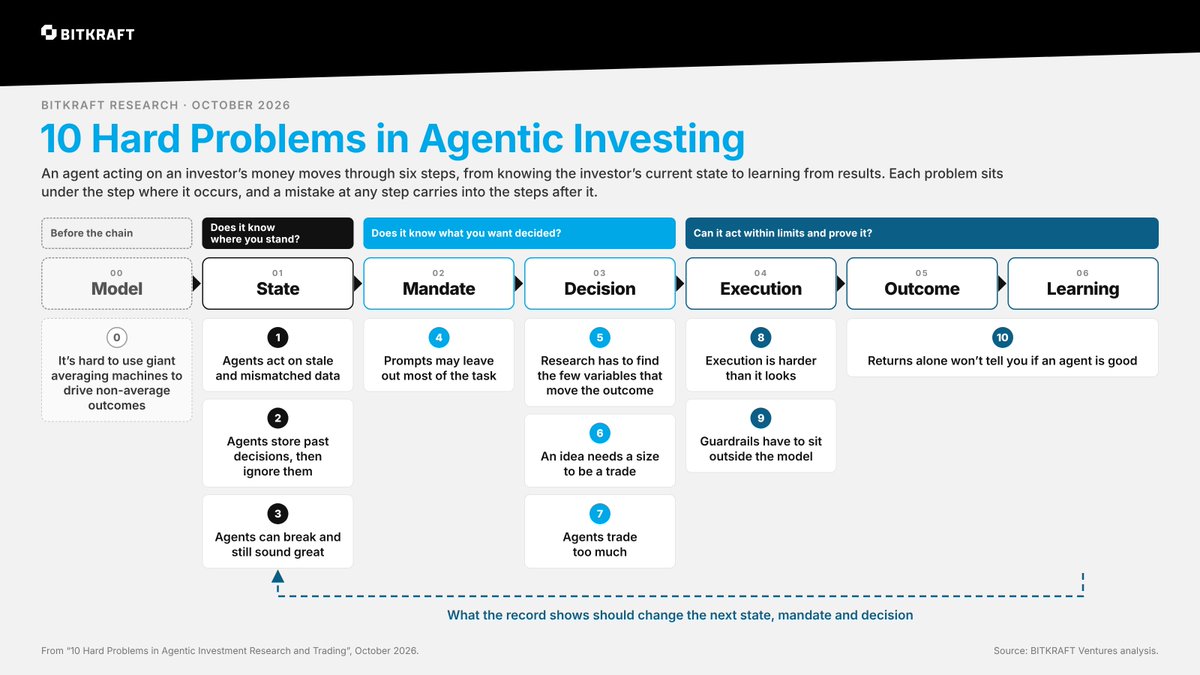
Agents promise to fix that. After building systems across prediction markets, crypto, perps and stocks, we think most won’t... yet.
"10 hard problems in agentic investing" (written w/ @SpinFN)
Thread + https://t.co/yOGoum789a
I always find it surprising when VCs in new tech waves get overly hung up on business quality / metrics (TAM, quality of revenue, margin, etc.).
Disruptive tech always precedes figuring out the business model. Hell, we didn't monetize the Internet for years.
Now If the agents are surfacing things to the user to promote the user purchasing, that's an entirely different premise
Perhaps that's the valuable thing to do; it's doing the things around the actual behavior to facilitate that last mile event happening
there are actions which people value/ don't value, and I think AI adopts best when the latter is removed; shopping itself is fundamentally valuable to ppl (phantom shopping sites) and humans want to enjoy the dopamine hit it confers. maybe works for mundane stuff like groceries
@degentradingLSD “Even L/S funds have huge attrition in their managers blowing up the books on a daily basis. Are you smarter than them? More disciplined than them?”
most will reply Yes
this meeting could have been an MCP invoked search of our company’s internal knowledge base that aggregates data from virtually every service we use behind a unified retrieval layer and provides a streamlined interface for extracting critical business insights
So proud of @DaniKTran who penned this! Every technological wave has spawned new hardware form factors which in turned leveraged new technological formats to produce net-new categories of consumer entertainment (PC, Console, Mobile, etc). Any investor can say that - it takes a great one to outline why it really is different this time
Give this a read and Dani a follow!
Easier to build. Harder to sell. 🔧
Our Principal @DaniKTran the AI hardware gap, why capital didn't save Magic Leap, Jawbone, Humane or Amazon Halo, and the five questions we ask before we back one.
🔗 https://t.co/h0RVGk7898
Today, we are introducing Inkling.
Inkling reasons efficiently across text, image, and audio modalities. We are making the full weights available.
https://t.co/Ghebq5mG30
Available today for fine-tuning on Tinker. Play with it in the Inkling Playground. 🧵
@callmeyoung93@openacti1 Let's GO young!!! Been an exciting feeling your fire and energy since I first met you and our story has only started. Can’t wait to see you ship like a madman!!
every investor can attest to how daunting it is to invest into AI apps today. I’ve looked at a lot of agentic AI products this year and all of them are new apps asking for a slice of your attention
Acti is the only one that is going the other way: it disappears into the keyboard you already use. No app to open, no context to re-paste. Long-press ANY key, and it invokes AI
That inversion is why we backed @openacti1 on their journey to become the next category defining business
so excited for ACTI and @callmeyoung93!!
The last major keyboard moment was in 2007,
when Apple put the keyboard on glass.
Nearly 20 years later, we're introducing:
Acti @openacti1, the Agentic Keyboard.
Not another AI keyboard that fixes grammar.
Not another voice keyboard that types faster.
An invisible agent in every text field.
It doesn't predict your next word.
It takes your next action. 👇
Mira Murati says human-AI collaboration needs models that can listen while they think:
"The types of models that we work with today, they're very turn-based. You talk, they talk, then they go off and think."
"While they're thinking, it's almost like they're deaf and blind. They cannot perceive anything else about what's going on."
"By contrast, our interactions with each other are very rich. There is a lot of information in our interactions when we are silent, when we're thinking, when we're interrupting one another."
"Interaction models are able to capture all of this nuance. They're not turn-based. They're more like time-based interaction, where they're continuously taking in audio, text, video, and continuously providing output."
"This enables you to catch things like interruptions and simultaneous speech, and really create a rich, high bandwidth interaction between humans and machines."
@miramurati at Bloomberg Tech live with @emilychangtv
The fall is so stupid
U don't really need 1.5TB per CPU for training, chatbot interactions, and light agentic workloads
Provisioning that much DRAM for them will just lead to underutilization and waste of resources (500GB-750GB per CPU is enough)
My biggest fear was Nvidia being unable to sell finished Rubin NVL72 racks becuz of the DRAM shortage
Now they can handle demand in a much better way
there is a classic venture heuristic that revolutionary products tend to start out looking like toys, but it is increasingly clear to me that this framework is breaking down in real time because of a quality that AI confers to the reality we live in: time compression
this generation of founders no longer have the luxury of time on their side to incubate a toy and slowly build it into a platform anymore
the traditional playbook, and when i say “traditional” i am referring to the AI thought pieces from the *distant* 2024/2025, revolved around find a wedge that is 1000x better than incumbents, then systematically verticalize
I’d argue you’re probably going to be way too slow if you are building that way
i think winning this race requires teams that have the right constellation of capabilities to build from the terminal state from day 1
which capabilities you ask? read this longer piece from the indelible @SpencerMa_ on world models to find out
DMs open if you are one of those teams