Bitcoin, as the industry benchmark, has an impact on the entire space.
Even though we focused on the Polkadot ecosystem, I always pay close attention to what’s happening with Bitcoin.
A few weeks ago, when market sentiment hit a low, narratives about “Bitcoin being broken by quantum computing” started to get exaggerated.
But let’s be clear:
In the short term, quantum computing is nowhere near that level.
In fact, in a previous interview, Gavin Wood also mentioned that there’s no need to worry about this in the near future.
And importantly — Bitcoin’s cryptography isn’t fixed forever.
The protocol can evolve. It can upgrade.
We’re already seeing quantum computing companies starting to prepare for this future.
So rather than a sudden crisis, this is something the system can adapt to over time.
—
What really matters is resilience.
A strong system isn’t rigid — it’s flexible, adaptable, and evolving.
This highlights a key shift: Ethereum optimizes for simplicity with single gas, while Polkadot moves toward precision with multi-dimensional resource pricing.
Better abstraction for users, deeper efficiency under the hood.
This is what next-gen blockchain UX should look like.
👀 💥 @hyperbridge is set to unveil a new product on March 23: HyperFX — focused on onchain FX for non-USD stablecoin pairs!
Their view is clear: stablecoins are moving beyond a single USD-centered world. More non-USD stablecoins are emerging, but the infrastructure for trading them onchain — especially liquidity and execution for non-USD pairs — is still far from mature.
The main problems today:
liquidity is extremely thin beyond the top pairs
reserves limit how much supply can exist
spreads widen quickly as trade size increases
So the question is no longer just whether stablecoins exist.
It’s whether onchain systems can actually support large-scale exchange between them as more local-currency stablecoins come online.
Hyperbridge believes that beyond onchain payments, onchain FX may be the next critical piece of stablecoin infrastructure.
March 23 is worth watching.
@seunlanlege had also previewed this product earlier in a PolkaWorld livestream, check it out here. https://t.co/mVzccpzAst
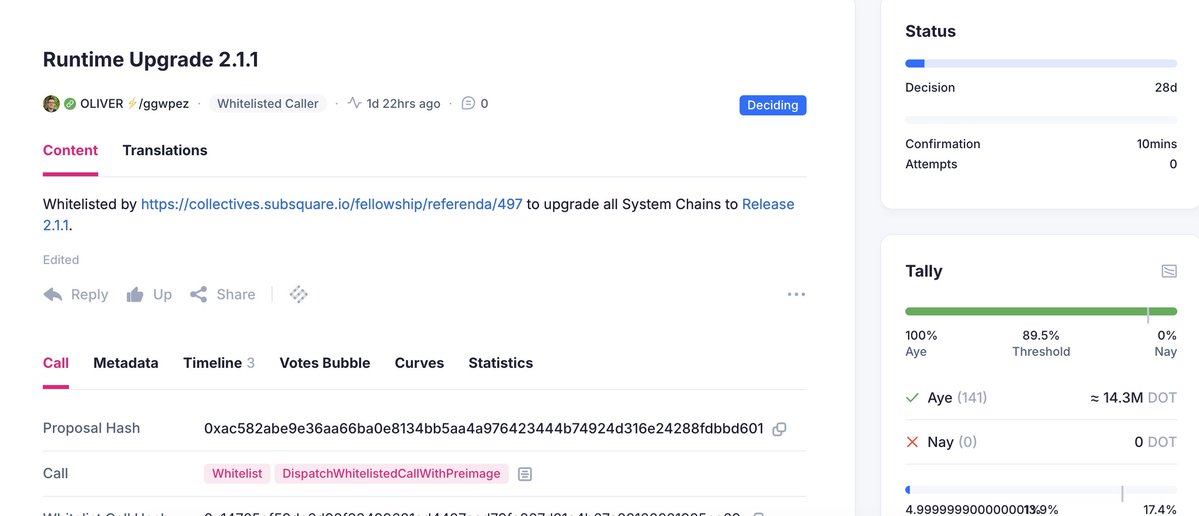
🚨 Polkadot v2.1.1 runtime upgrade is now up for vote!
This upgrade is worth watching because it is designed to kick off Phase 1 of DAP.
If approved, the proposal is expected to be enacted around March 26, 2026.
The main changes include:
- new DOT goes to DAP
- protocol revenue goes to DAP
- slashes go to DAP
- treasury burns stop
In addition, this upgrade lays the groundwork for several upcoming staking reforms, including:
- non-slashable nominators
- 2-era unbonding
- minimum self-stake and commission for validators
These staking parameters will not all go live immediately, they will be activated gradually through future OpenGov referenda.
https://t.co/CLvGMfdqJj
From Chips to Ecosystems — What NVIDIA Taught Me About @Polkadot
I just listened to Jensen Huang’s GTC 2026 keynote.
NVIDIA’s chips are powerful. But its real moat isn’t hardware — it’s the ecosystem.
CUDA turned GPUs from specialized hardware into a global computing platform. More importantly, it created a self-reinforcing loop:
developers → tools → applications → demand → more developers
GPUs can be caught up. Ecosystems are much harder to replicate.
This is exactly what makes me think about Polkadot.
Polkadot is going through a painful but necessary ecosystem restructuring.
And here’s the key:
Technology starts the game. Ecosystem wins it. A single technical advantage is never enough. The real moat comes from coordination:
-better developer tools
-real builder interest
-applications that actually gain traction
Only when these reinforce each other does a moat emerge.
Polkadot has often been seen as “too technical.” To some extent, that’s fair. For a long time, the barrier to entry for developers was simply too high. Before key infrastructure like Polkadot Hub, builders didn’t really have room to thrive.
So while it looks like Polkadot has been “building for years,” it’s only recently entering a phase where developers can truly participate.
Now we’re starting to see:
-improving middleware
-better dev experience
-applications reaching the market
What’s happening now is a strategic shift:
from platform → to ecosystem
This is how real moats are built.
It’s slow. It’s frustrating. But once it works, it becomes extremely resilient.
As long-term supporters, there’s also a tension.
Conviction — because we believe in it.
Pressure — because expectations have built up for years.That pressure can erode patience and affect short-term momentum.
But the direction is becoming clearer. Polkadot is finally moving toward building a real moat — through ecosystem, not just technology.
What matters now is simple:
patience, aligned expectations, and continued building.
What the DAP really does is introduce a fundamental shift in Polkadot’s economic model:
• Inflation, slashing penalties, and coretime revenues are all pooled into a unified account
• Validator rewards are set to evolve in Q2–Q3
This moves Polkadot away from passive mechanisms (like automatic burns) toward active, governance-driven capital allocation.
It’s clearly a step toward reducing DOT sell pressure and improving capital efficiency at the protocol level.
The supply side is being structurally refined.
Now the real challenge is demand: more users, more applications.
A more important question for $DOT right now:
Why should capital buy it in today’s market?
Global capital has already shifted.
Flows are moving toward lower-risk, yield-generating assets — treasuries, structured products, and even within crypto: stablecoins, RWAs, basis trades.
That shift is changing how capital evaluates opportunities.
For DOT, this means one thing — demand matters more than ever.
Not narratives.
Not supply changes.
But something capital can actually allocate into.
So the real question is What can capital do with DOT?
Staking alone isn’t competitive enough.
Governance isn’t a capital driver.
If DOT wants to attract meaningful inflows, it needs to evolve into:
• a yield-bearing asset
• a liquidity layer
• or a gateway to real-world value
In the short term, if demand doesn’t exist, it has to be designed ASAP.
• Bring high-quality businesses on-chain as RWAs → real asset yield https://t.co/4CLFdZkXIb
• Launch DOT-backed stablecoins ASAP → paired with predictable yield products
• Accelerate DAP with nominator/validator decoupling → make DOT a yield asset with macro-adjustable, system-controlled returns https://t.co/9nH1ep0tXx
If these pieces come together, demand will follow.
And capital will follow demand.
I know many people are still holding DOT, they have held it from $55 until now, and it just lacks a use case for their DOT.