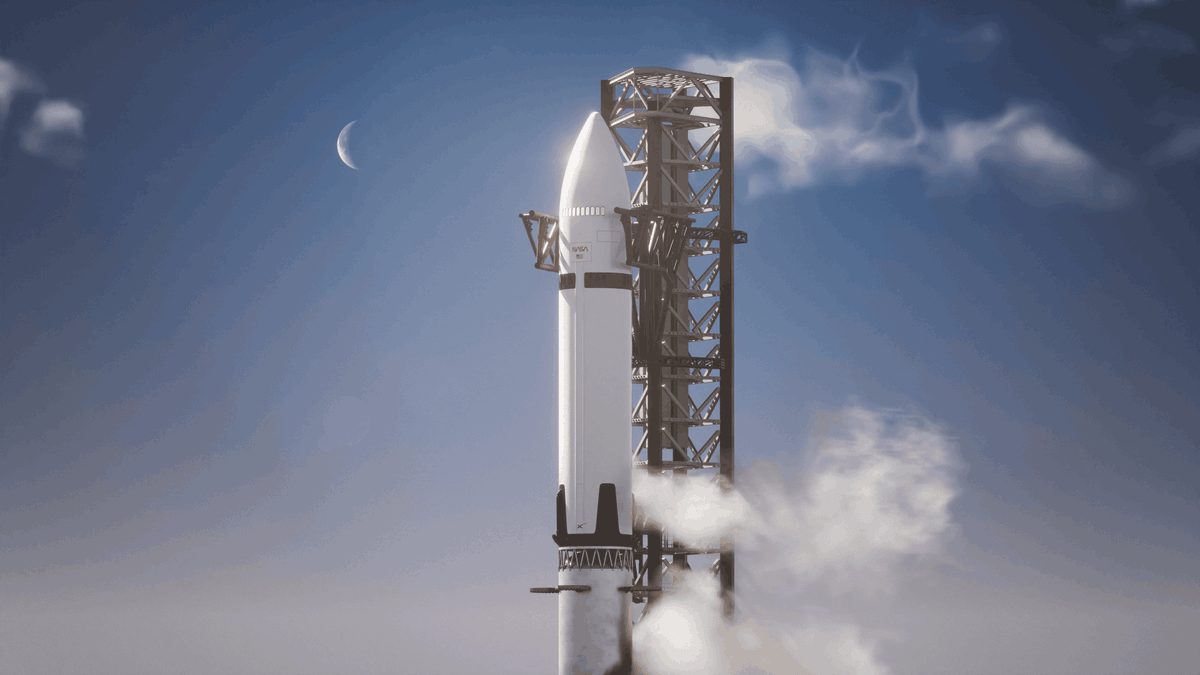
The race to the Moon is on - once again!
Half a century after humans set foot on the lunar surface for the last time, nations are back at the drawing board, designing missions to reach the Earth's only satellite. This time, they intend to stay. 1/10
@Bitcoin_Teddy Heat pumps are far more efficient for heating, delivering 2–4× more heat per unit of electricity, while Bitcoin miners act as simple 1:1 electric heaters. Miners can offset costs by earning revenue, but they’re noisy, power-hungry, and less cost-effective overall.
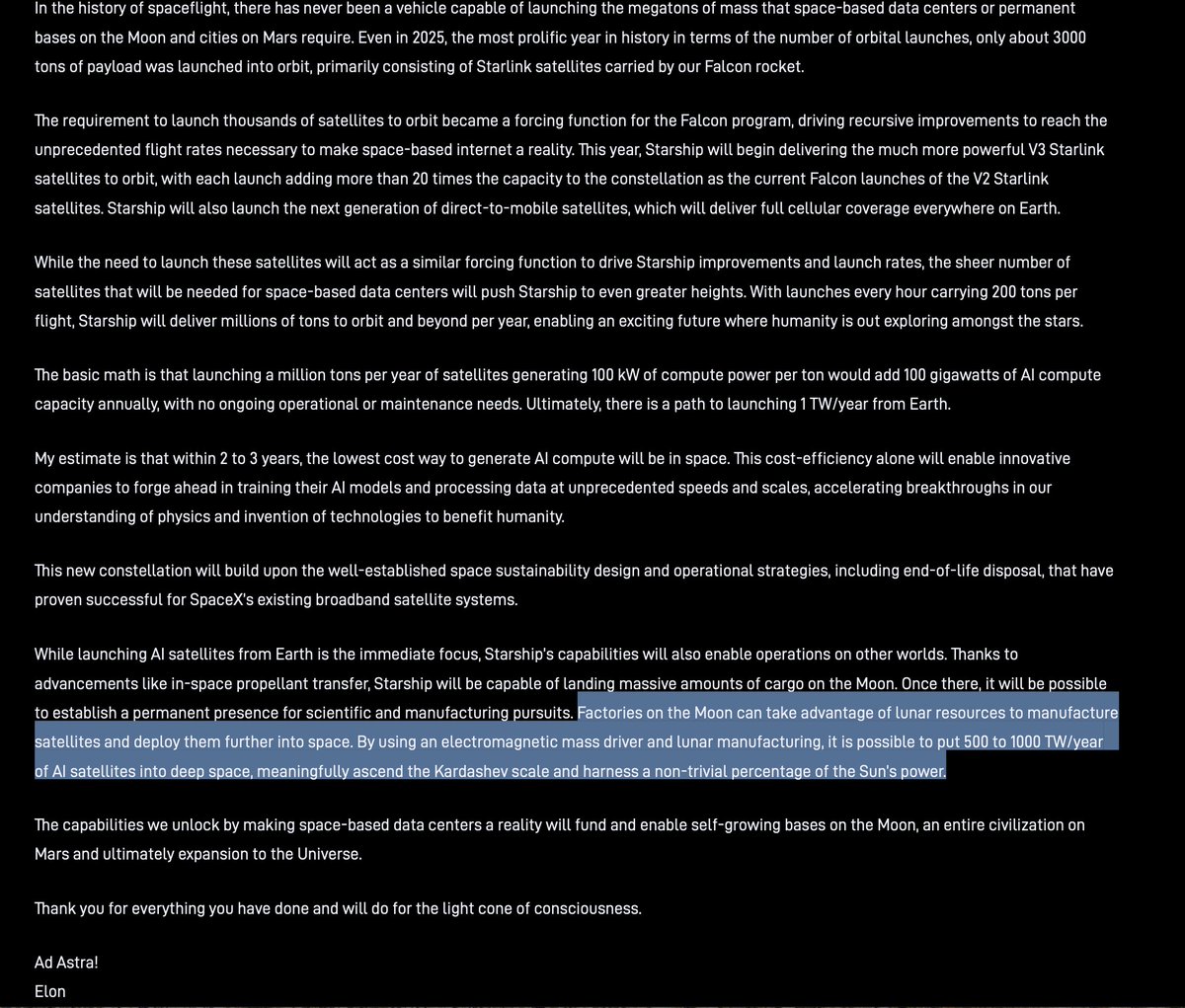
This is probably one of the wildest sentences I've ever read.
In Elon's new letter: "Factories on the Moon can take advantage of lunar resources to manufacture satellites and deploy them further into space. By using an electromagnetic mass driver and lunar manufacturing, it is possible to put 500 to 1000 TW/year of AI satellites into deep space, meaningfully ascend the Kardashev scale and harness a non-trivial percentage of the Sun’s power."
@Teslaconomics Ryanair is a budget airline that undercuts competitors by offering minimal seat space at low fares and boosting margins through add-ons like luggage and insurance. Airline margins are thin, I don't think buying Ryanair makes any sense.
I personally wouldn’t pay for Wi-Fi.
The world lost a great man today.
I remember seeing Dilbert comic strips as a kid growing up in Saudi Arabia. Little did I know that decades later, I'd get the chance to hang out with its creator and interview him several times.
Scott was always gracious and kind to me. Even approaching death, he remained a fighter and tried to be useful until the end. He didn't give up.
Millions of people around the world have been positively impacted by his work and I'm grateful to be one of them. What a brilliant mind.
Thank you @ScottAdamsSays! May you rest in perfect peace. 🙏🏾
@RKLBMan I expect the satellites business to drive a lot of the valuation in near term, and Neutron debut to result in stock price spike before the event. I believe RKLB could get to 100bn valuation in H1 2026, so about 150$ but likely will finish closer or lower than 100$.
Interesting analysis of data centers in space by @andrewmccalip. I'm not smart enough to follow all the physics, but I agree on the basic premise: Vertical integration is everything. If you don't own cheap launch and satellite production, good luck.
https://t.co/qgVlXPkRH8
@shshhs255803@MuldoonMartin@amitisinvesting They are re-directing capital towards space. For what use do you really need compute in space? What meaningful capacity you can build? It is cost prohibitive. Power and cooling are still much cheaper on earth, and new Ai infrastructure is yet to prove itself useful.
$RKLB: The Self-Taught Engineer Going Head-to-Head With Elon Musk and Jeff Bezos -- WSJ
By Micah Maidenberg
(Wall Street Journal) -- WALLOPS ISLAND, Va. -- The newly constructed Rocket Lab launchpad on Virginia's Atlantic coast needs to be able to withstand 1.5 million pounds of thrust.
Peter Beck, the company's founder and chief executive, had another requirement: It had to look beautiful.
"The launchpad behind us is almost an architectural monument," he said in August to a crowd of government officials and investors. "Launch sites are usually these boxy, horrible-looking things, but I was not going to have that."
Beck's fixation on detail and form has guided his course as an entrepreneur. A self-taught engineer from a remote part of New Zealand, he has been the driving force behind Rocket Lab's growth as a launch-and-satellite company. His company's next bet will soon roll onto the new pad -- a 141-foot-tall rocket called Neutron -- and help Rocket Lab go toe-to-toe with Elon Musk's SpaceX, Jeff Bezos' Blue Origin and other industry powers.
Neutron is Rocket Lab's most powerful rocket to date, designed to offer the kind of reusability that has made SpaceX's Falcon 9 the world's busiest. With Neutron, Rocket Lab wants to compete to handle a wider range of launches and more ambitious missions.
"If you're trying to build a big company, then you do bigger things," Beck, 48 years old, said in an interview.
Rocket Lab is pushing to fly Neutron for the first time before the end of 2025. Landing the rocket's booster could be tough. SpaceX has pulled it off hundreds of times, but the operation will be new for Beck's company.
"He's got to solve the reusability equation," said Marv Vander Weg, a former rocket executive at SpaceX and United Launch Alliance. "That's a huge challenge. Nobody has been able to do it like SpaceX."
'Do this myself'
Beck grew up in the southern New Zealand city of Invercargill, where a fascination with space came early in a place where the aurora borealis often lights the night sky.
So did a DIY mentality. Beck's father built a telescope that ended up in a regional observatory, and a workshop at home gave Beck access to tools. Shop-floor tinkering led him to skip college to work as a tool-and-die apprentice. Engineering jobs followed, including one for a yacht maker.
The space bug never went away for someone who designed a small engine in his spare time. Beck tried to enter the space industry about 20 years ago by traveling to the U.S., where he was able to visit with NASA officials. But he found that getting a job as a foreigner without a degree wasn't in the cards.
"I go back and go, 'Well, I'm just going to do this myself,'" he said.
Rocket Lab was founded in 2006. Its first vehicle was a roughly 20-foot-tall, needlelike suborbital rocket called tea-1. Later, Beck drummed up funds for the company's next project, the 59-foot-tall Electron.
Sven Strohband, a partner at Khosla Ventures, recalled speaking with Beck about a novel engine-pump system Rocket Lab was developing around the time he was considering an investment in the company.
He recommended Beck visit NASA officials in Huntsville, Ala., so they could suss out the technology. "I think Peter was on a flight in the next few hours," Strohband said. His friends at NASA said the pump system was a clever idea, and Strohband was impressed by Beck's drive. Khosla went forward with the investment.
Electron was ready for its first mission by 2017. That flight failed but Rocket Lab recovered and has used the vehicle to carve out a business in the launch market. It also created a business that makes satellites, sells equipment ranging from sensors to solar arrays and offers flight software.
Through both divisions, the company has bolstered connections with officials from the U.S. government and other clients.
Facing off with SpaceX
Rocket Lab has captured the imagination of investors of late. Shares closed Thursday near an all-time high, after soaring over the past year.
The run-up has heightened expectations for the company, and Neutron's debut will test investors' confidence in it. Setbacks for publicly traded space companies have been tough: Firefly Aerospace's stock plunged 21% Tuesday, the day after one of the company's rocket boosters exploded during a test.
Rocket Lab is increasingly competing with entrepreneurs and companies backed by the deepest pockets on the planet, including SpaceX and Blue Origin. United Launch Alliance, another big rocket launcher, is owned by Boeing and Lockheed Martin.
Beck's company can't outspend many rivals, but has tried to find other ways to get ahead. One opportunity came after the 2023 bankruptcy of rival Virgin Orbit. Rocket Lab was able to snag the Richard Branson-founded company's headquarters and factory in Long Beach, Calif., for $16 million.
Rocket Lab's revenue last year hit $436 million, almost doubling from 2023. Its net losses widened too, to $190 million, and the company hasn't generated a profit since going public four years ago. To help fund its work, Rocket Lab has sold shares.
While the company has beaten out many other would-be rocket companies in the small-launch market where Electron competes, SpaceX is a tougher rival.
Musk's company typically conducts at least a couple of missions a year, where companies and others split costs and space on a single Falcon 9 rocket to deploy their satellites. The shared rides are generally cheaper than what Rocket Lab offers.
But Rocket Lab executives said their vehicle has its own advantages. One compared the shared SpaceX missions to waiting for a city bus, while Electron is Uber -- more expensive but more flexible.
Its new Neutron rocket aims to offer flights priced at $50 million to $55 million each, below the current Falcon 9 list price of about $70 million. Rocket Lab is anticipating a response from SpaceX, which hasn't faced much competition while ramping up Falcon 9 flights. SpaceX didn't respond to a request for comment.
Beck said he wants to keep Rocket Lab focused on the tough challenges ahead, with Neutron's first flight coming up.
"The rocket gods do not care how much money you've got," he said. "You still have to execute."