🚀 AI Architect
⚙️ Distributed Systems & Microservices
🤖 Writing a book on AI Agent Architecture
✍️ Creator: PracticeOverflow
Let's build scalable tech.
Your p50 dashboard is lying about your agents.
A 20-step agent hits tail latency ~18% of the time. Not bad code. Just math: ~1% odds per call, compounded over 20 steps.
The median never sees it. Users do.
#SoftwareArchitecture#DistributedSystems#SRE#Reliability
Apple shipped the new Siri this week. The brain inside it belongs to Google — a 1.2T-param Gemini model it rents for ~$1B/yr.
The most integrated company on earth chose to rent intelligence, not build it.
#AI#LLM#Apple#Google#GenAI
AI won't take your job. It's quietly changing what your work is worth.
I spent months on how people actually survive automation waves. Wrote it up as a free 6-part series — no paywall. Thread of all six 👇
#AI#FutureOfWork#CareerGrowth#Upskilling
Part 5 — The Builder's Playbook. 30/90/365-day moves for engineers, freelancers & IT pros:
https://t.co/zYdNEf1vnC
Part 6 — The Knowledge Worker's Playbook:
https://t.co/R1RnJwJltp
Which of your tasks are gaining value as AI improves — and which are quietly losing it?
AI won't take your job. It's quietly changing what your work is worth.
I spent months on how people actually survive automation waves. Wrote it up as a free 6-part series — no paywall. Thread of all six 👇
#AI#FutureOfWork#CareerGrowth#Upskilling
Part 3 — The Structural Shift. What the labor data really says:
https://t.co/xDHt3j12WQ
Part 4 — Global & Industry Patterns. The survival map across 14 sectors:
https://t.co/uocQTao8yI
"Will AI take my job?" is the wrong question.
Ask: which of my tasks got cheaper, which got more valuable?
AI reprices tasks inside a job, not the whole job. Move toward work AI can't sign off on 👇
https://t.co/al2Dk5UCdf
#AI#FutureOfWork#AICareers#TechCareers
AI job loss is not one story.
Europe: hiring cuts.
China: robot supply chain.
India: mid-tier IT beats scale.
Philippines: BPO pivots to capability.
Same AI. Different labor markets.
The moat is capability per person.
#AI#FutureOfWork#Automation#IndiaIT#TechCareers
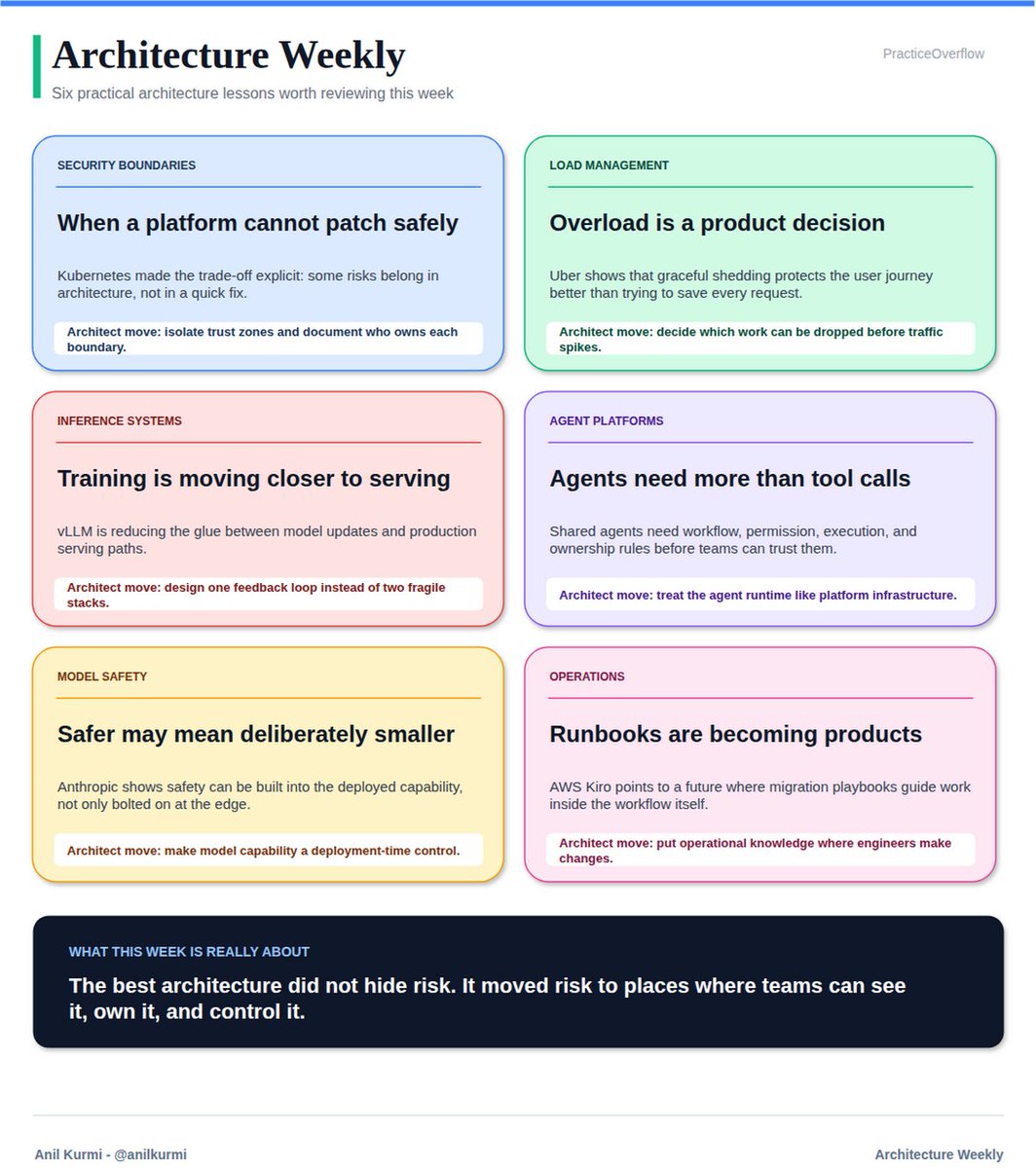
The best systems don't hide risk.
They move it where teams can control it.
This week: containment over fake fixes, graceful overload over heroics, agent runtimes over tool sprawl, living runbooks over PDFs.
#SoftwareArchitecture#DistributedSystems#SRE#AIInfra
AI Weekly W23: Microsoft shipped 7 in-house MAI models. Uber capped AI coding at $1,500/mo. Ladybird closed PRs. Hackers asked Meta AI for Instagram accounts and got them.
Capability is racing. Trust, budget, and auth aren't.
#AIWeekly#AI#Microsoft
@coolcoder56 Curious — was the system design round LLD or HLD heavy? And did they push on failure modes (worker death, partial writes) or stay on the happy path?
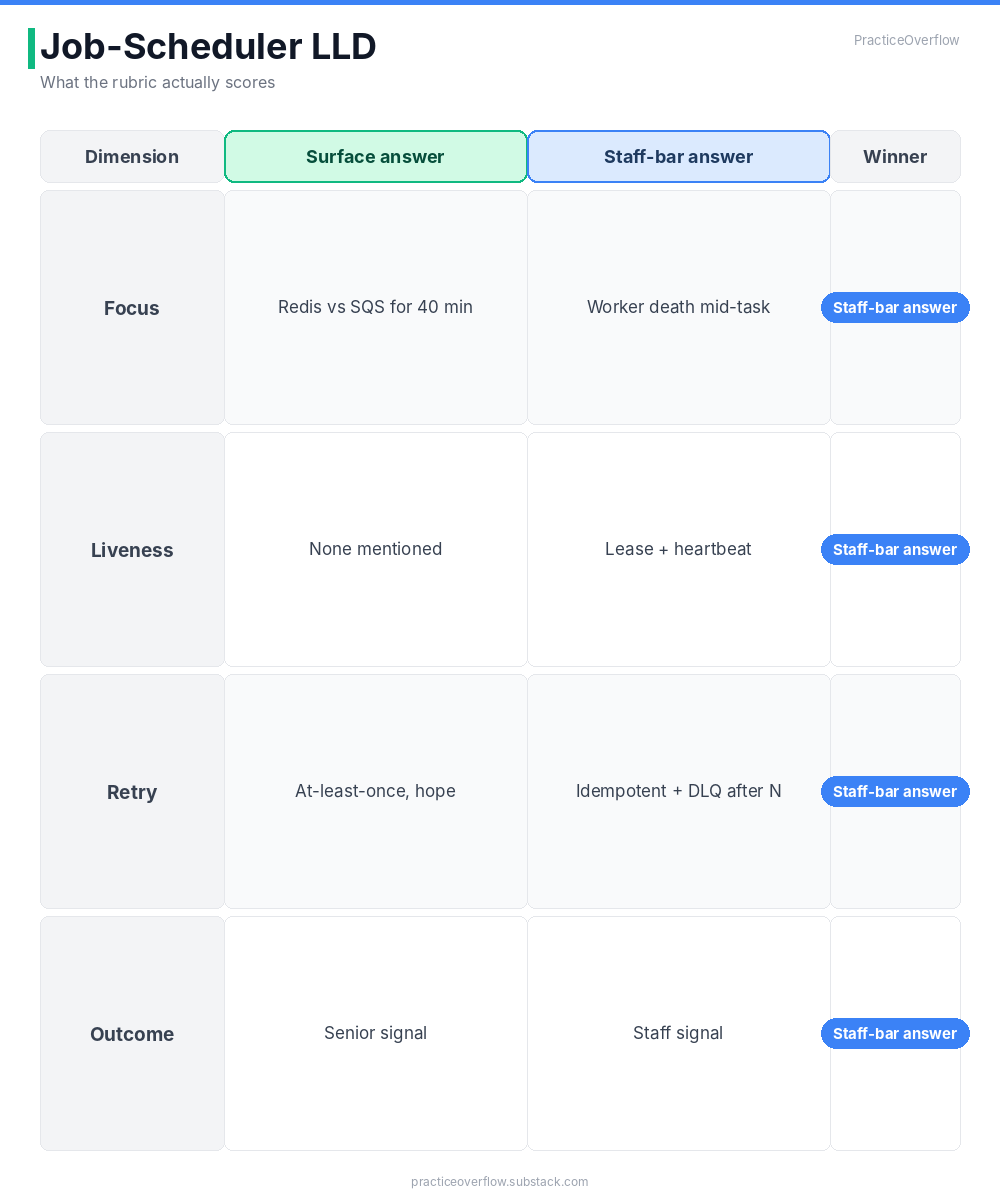
Job-scheduler LLD: 40 min burned on Redis vs SQS. Real rubric: what happens when a worker dies mid-task? Lease + heartbeat + idempotent retry + DLQ = yes. Miss it, stay senior. What failure mode did YOUR interviewer drill? #SystemDesign#InterviewPrep#BackendDev#Career
@RaulJuncoV Yes — and the catch is even teams with evals get burned by stale golden sets. Switched to property-based fuzzing on tool-call JSON last week, caught 3 schema drifts our 200-row set was happily green on.
Killed our 200-row golden set for property-based evals on tool-call JSON. Hypothesis fuzzed 5K variants, caught 3 schema drifts the GPT-4o→GPT-5 snapshot tests missed. $0.40/run. Anyone else ditching golden sets for fuzzing? #LLMOps#Evals#AI#SoftwareEngineering
@e_opore Most "fault-tolerant" systems fail the cross-region test. We thought sync multi-region replication was tolerance — turned out to be 280ms on every write. Async + per-region idempotency keys is what actually survives a region going dark.
Cross-region sync replication: 280ms per write. Switched to LOCAL_QUORUM + async cross-DC with per-region idempotency keys — same correctness, 18ms p99. Strong-everywhere is almost never what you actually need. #DistributedSystems#SystemDesign#BackendDev#Cassandra
@DbrxMosaicAI Curious how you scoped the fix — schema-typed tool outputs, post-hoc summarization, or both? Wrapping returns in Pydantic before the planner sees them got us a 27× shrink, but summarization felt more honest.