spent my 11-hour flight back from europe working on a very long report. started as a slack message but morphed into a several pages long doc. wifi was as shitty as it gets. after finally making it home i realized that the computer had forcefully restarted. opened slack: draft was gone :(
hail mary: claude pls save me, no clue how but pls try
it checked APFS snapshots, time machine, slack indexeddb, write-ahead logs, service worker / http caches, local storage, app logs, hibernation image... nothing. all gone
but then... it realized i have alfred installed. so it checked the clipboard snapshots alfred keeps in sqlite. sad news: alfred clipboard memory gets deleted after 24h. aggressive retention policy. however! when sqlite runs DELETE, nothing gets actually deleted. it only marks pages as reusable, but it doesn't override the physical bytes. so claude decided to do a raw-scan of the db, reverse eng alfred data format, figure out the portion containing the timestamp, stitched everything back together across overflow pages... and handed me the exact final version of my report, the last one i cmd+C'd
all this, in a single shot
... day 200 of "what if you had an elite hacker you can ask anything to"
I can share an interesting experience from last week. We have a person who is incharge of buying hardware, software and data sets. This might sound stupid but when you are buying 100s of servers, workstations and laptops a month, it's complicated. This dude used Claude to create an entire tracking and maintanence portal that inventoried everything. He even managed to integrate the portal with our monitoring software to display the status of every server vm. He then modified it to store invoices and so on. He's been at it for a couple of weeks and we've been able to identify wastage and needs.
Without Claude, this would have been a maze of spreadsheets and a lot of manual labor. But we wouldn't have hired a developer for this. To me, this kind of software is the killer use case for AI. Enough to simplify your life, but not enough to justify hiring someone or buying a product.
Is the code great? Is it scalable? Is it good software engineering? No, no and no. But that's besides the point.
I believe one of the great tests of a man is whether he can be hated. I don't just mean whether he can tolerate being hated or even accept it, but whether he can revel in it and take pleasure in the existence of people with a determination, if not the means, to destroy him.
I strongly believe there are entire companies right now under heavy AI psychosis and its impossible to have rational conversations about it with them. I can't name any specific people because they include personal friends I deeply respect, but I worry about how this plays out.
I lived through the great MTBF vs MTTR (mean-time-between-failure vs. mean-time-to-recovery) reckoning of infrastructure during the transition to cloud and cloud automation. All those arguments are rearing their ugly heads again but now its... the whole software development industry (maybe the whole world, really).
It's frightening, because the psychosis folks operate under an almost absolute "MTTR is all you need" mentality: "its fine to ship bugs because the agents will fix them so quickly and at a scale humans can't do!" We learned in infrastructure that MTTR is great but you can't yeet resilient systems entirely.
The main issue is I don't even know how to bring this up to people I know personally, because bringing this topic up leads to immediately dismissals like "no no, it has full test coverage" or "bug reports are going down" or something, which just don't paint the whole picture.
We already learned this lesson once in infrastructure: you can automate yourself into a very resilient catastrophe machine. Systems can appear healthy by local metrics while globally becoming incomprehensible. Bug reports can go down while latent risk explodes. Test coverage can rise while semantic understanding falls. Changes happens so fast that nobody notices the underlying architecture decaying.
I worry.
i love how people are saying "if we write a sufficiently detailed specification, the agent can write all our code"
do you know what writing a sufficiently detailed specification that deterministically maps to what a computer's actions is? it's coding
The first shot of AI generated code almost always feels like a duct tape, aka bad workaround. The solution is to figure out if and how a system needs to be adjusted to accommodate a change first.
I've waited for this quite a while: Anil Seth argues about why AI isn't and won't be conscious and the consequences if we treat it as such: https://t.co/m0Ilqu93K2
Sure you can earn a billion dollars. I've been teaching people how to do it for 20 years. The way you do it is to start a company that grows fast. You don't have to do anything bad to make a company grow fast. You just have to make something people want.
https://t.co/zXWErQqlwV
This GPT Image 2 prompt is going insanely viral right now.
“Redraw the attached image in the most clumsy, scribbly, and utterly pathetic way possible. Use a white background, and make it look like it was drawn in MS Paint with a mouse. It should be vaguely similar but also not really, kind of matching but also off in a confusing, awkward way, with that low-quality pixel-by-pixel feel that really emphasizes how ridiculously bad it is. Actually, you know what, whatever, just draw it however you want.”
Scientists have created one of the most detailed 3D reconstructions of a human cell (eukaryotic cell) ever produced.
This groundbreaking model, often termed a "Cellular Landscape Cross-Section Through a Eukaryotic Cell," combines data from X-ray tomography, nuclear magnetic resonance (NMR), and cryo-electron microscopy to map molecular structures in extreme detail.
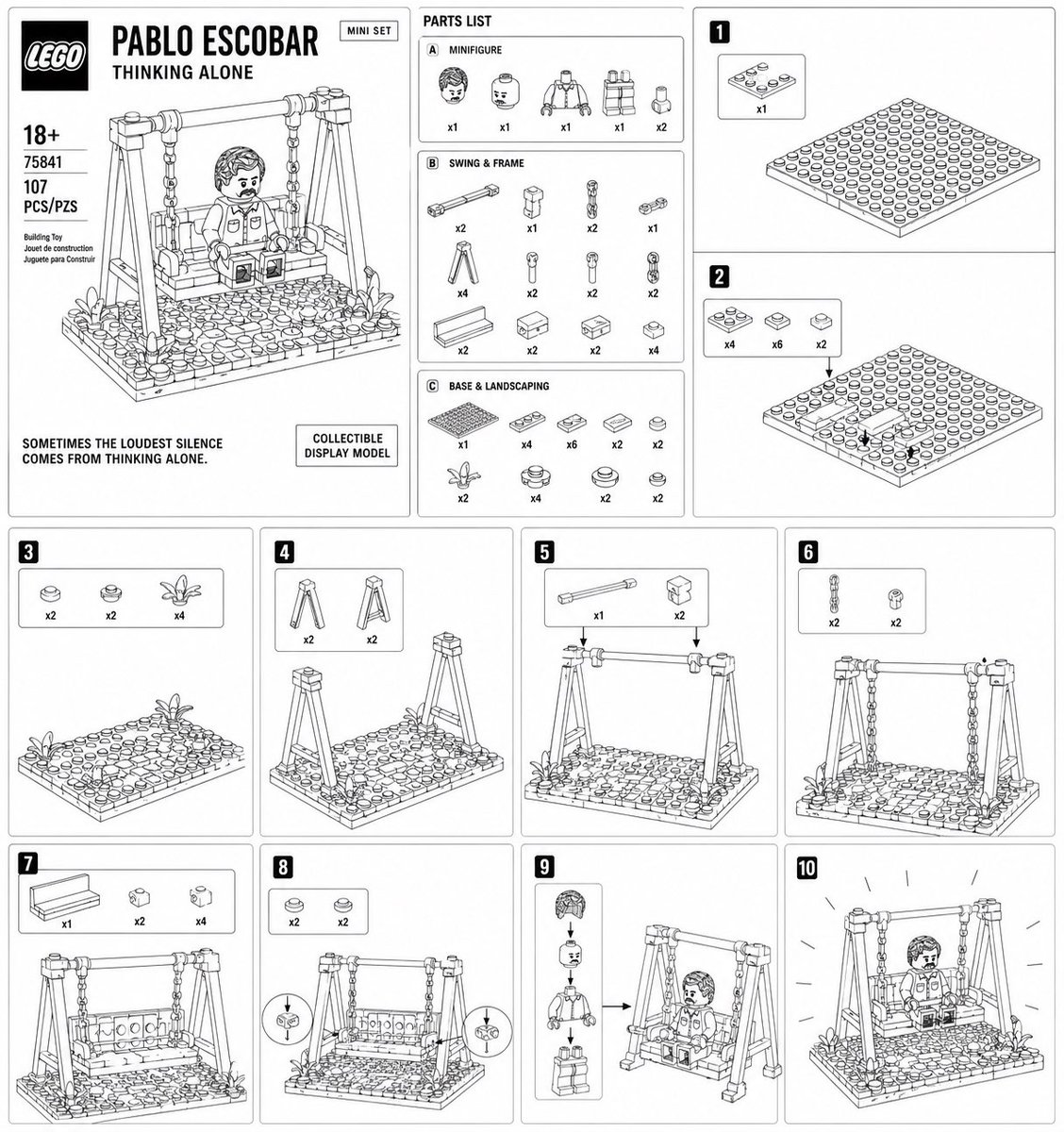
Yeah okay, Lego bros, brodettes and brotheys are cooked with this one.
GPT 2 Image can create full Lego sets! With actual Bricklink IDs so you can order the parts and build it.
Whole new business opportunity here for the taking.